
Your Members Are Building Wealth Right Now — Just Not With You
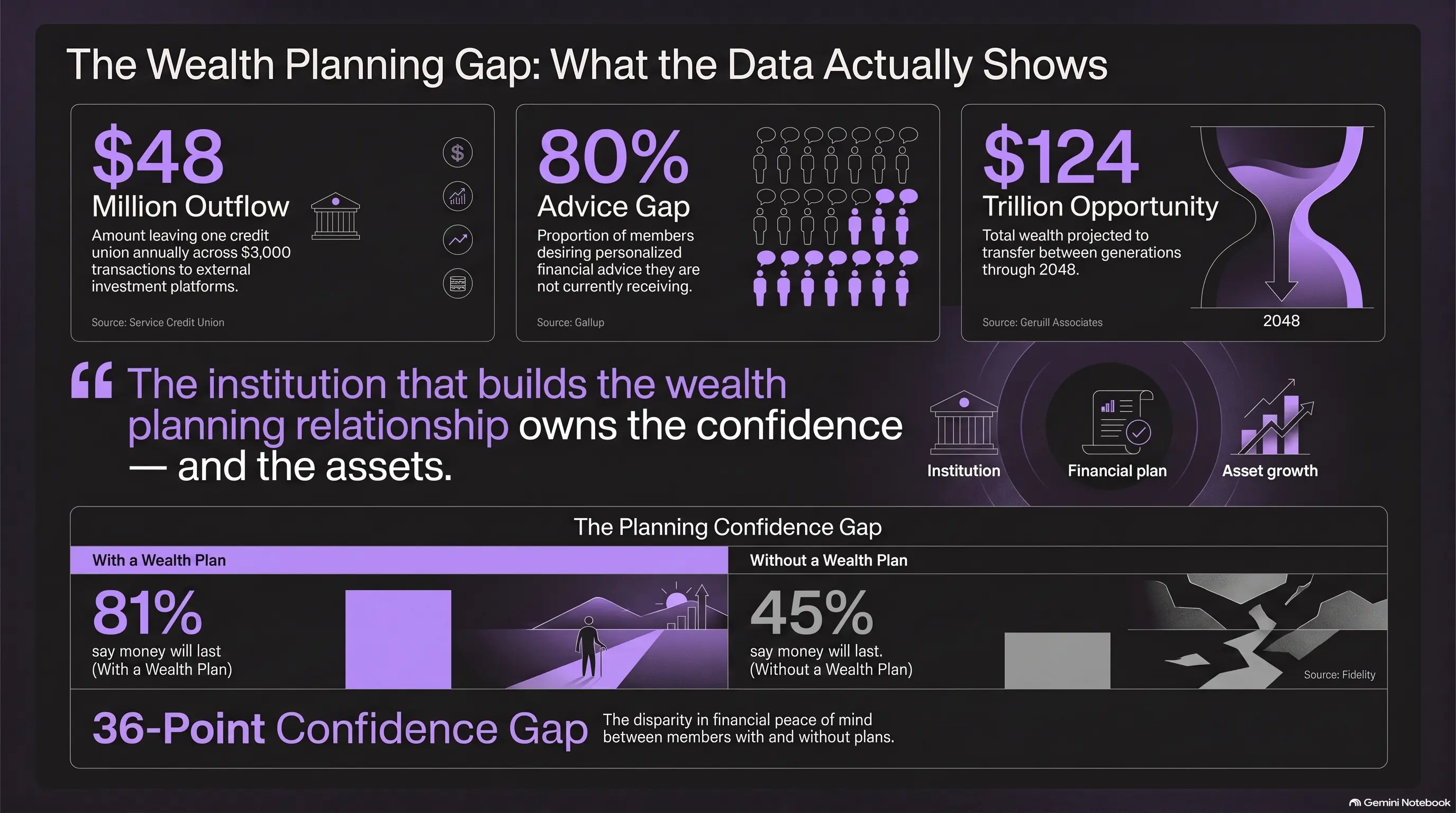
One credit union analyzed its transaction data and found $48 million leaving the institution in a single year — across 53,000 transactions moving to external investment platforms. The members were not leaving the credit union. They were simply going elsewhere to build wealth because the credit union had not offered to help them do it there. This is not one credit union's problem. It is the defining strategic gap of the credit union movement in 2026, as $124 trillion in generational wealth prepares to move between generations over the next two decades. The credit unions that will capture their share of that transfer are not the ones waiting for members to ask. They are the ones who showed up as wealth and legacy planning partners 20 years before the transfer happened.
In 2022 and 2023, Service Credit Union did something most credit unions have never done. They looked at their own transaction data and asked a question that should make every credit union CEO uncomfortable.
Where is our members' money going?
The answer was specific, measurable, and striking. $48 million left the credit union in a single year. Not because members were unhappy. Not because a competitor had better rates. The money left across 53,000 individual transactions — members moving their own money to external investment platforms to do something the credit union had not offered to help them with.
They were building wealth. Just not there.
"The opportunity wasn't hypothetical. It was measurable," said Matt Beaulieu, AVP of Member Services. That statement deserves to sit with every credit union leader who reads it. Because the data that Service Credit Union surfaced is not unique to Service Credit Union. It is happening at scale, across the movement, in institutions that have not yet looked at the evidence — or have looked and not yet responded.
The credit union movement holds $2.43 trillion in total assets and serves 145.9 million members across the United States. It has grown by 97% over the last decade. It carries a trust and mission advantage that no bank, no robo-advisor, and no fintech app can replicate. Members stay with their credit union for decades — through their first checking account, their first auto loan, their first mortgage, the financial crises and the milestones.
And then, quietly, systematically, they build wealth somewhere else.
Not because the credit union failed them. Because the credit union never offered to help them with the thing that matters most across an entire adult lifetime: building wealth, protecting it, and eventually passing it on with purpose.
That is the wealth and legacy planning gap. And the $124 trillion Great Wealth Transfer — the largest generational financial shift in modern history — is about to make the cost of that gap permanent for the credit unions that have not yet closed it.
The $124 Trillion Question
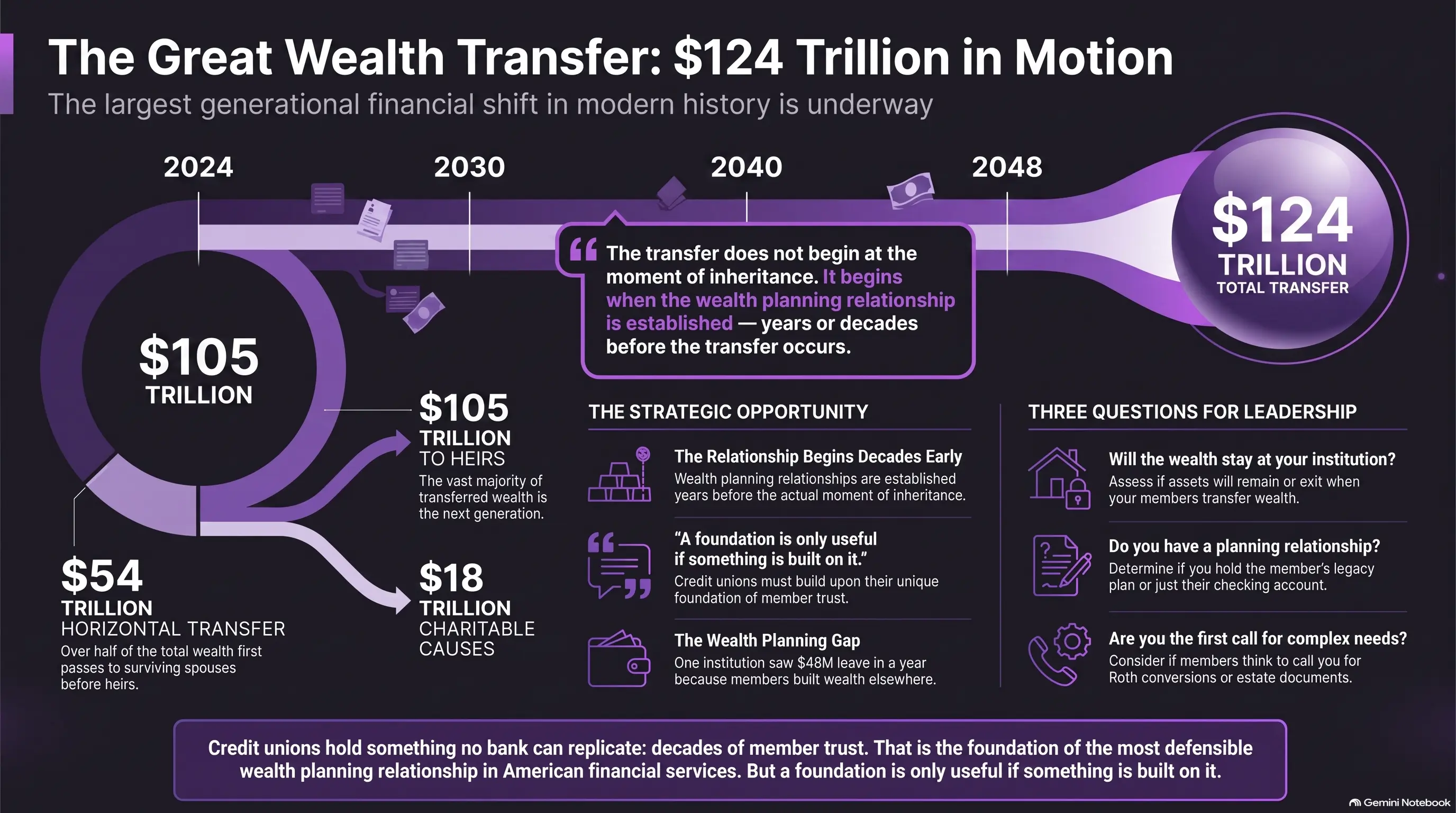
Over the next 25 years, an estimated $124 trillion in wealth will move between generations in the United States. That figure has been revised upward from earlier projections — driven by equity appreciation, real estate growth, and continued wealth concentration — and it represents a transfer unlike anything in modern economic history.
Baby Boomers and the Silent Generation will bequeath a combined $84.4 trillion, with $72.6 trillion going directly to heirs. Of the broader $124 trillion total, more than half will first pass horizontally to surviving spouses before reaching the next generation — a two-stage transfer pattern that creates multiple intervention points for institutions positioned to serve it.
$18 trillion — 15% of the total — is projected to go to charitable causes. That is more than the entire annual U.S. federal budget.
For credit unions, the question is not whether this transfer is happening. It is whether the assets will stay.
The answer depends almost entirely on one thing: whether the member who has held a checking account, a savings account, a mortgage, and a car loan at the credit union for 35 years also holds their wealth planning relationship there. If they do, the assets transfer within an existing relationship — through beneficiary designations, trust accounts, estate planning guidance, and the next generation of accounts opened at the institution the family already trusts. If they do not, the assets move with the external wealth manager who built the relationship the credit union never offered.
"One misconception about the Great Wealth Transfer is that it begins when an inheritance is received," a July 2026 analysis in CUInsight noted. "In reality, it begins years earlier." The wealth planning relationship that exists at 55 determines whether assets stay at 75. The relationship that does not exist at 55 is almost impossible to establish at 75 — when the member is already embedded with a family office, a private bank, or a wealth management firm that has been their primary financial relationship for the previous two decades.
The credit union that waits for retirement to become a wealth partner is not late to the conversation. It has missed it entirely.
What Members Are Actually Asking For — And Not Getting
The 2025 Gallup survey cited in the Service Credit Union white paper found that 80% of credit union members desire personalized financial advice. Eighty percent. In a movement built on member service, cooperative mission, and the explicit promise to serve members better than banks do.
The gap between what 80% of members want and what they are receiving from most credit unions is not a technology gap or a staffing gap. It is a strategic gap — the result of decades of positioning the credit union as a product provider rather than a lifelong wealth and legacy planning partner.
Members want guidance at every stage of life:
The 27-year-old trying to figure out whether to pay down student debt or open a Roth IRA with the money sitting in the checking account the credit union holds.
The 38-year-old with a mortgage at the credit union, young children, and no life insurance — carrying a financial vulnerability that a 15-minute conversation could address.
The 47-year-old in the sandwich generation — managing aging parents and college-bound children simultaneously — who needs a complete picture of their financial life more urgently than they need a better savings rate.
The 58-year-old approaching retirement who has already been approached by three wealth management firms but has not been approached by the institution where they have banked for 30 years.
The 72-year-old who never updated the beneficiary designations on the retirement account opened in 1994 — and whose family will discover that error after it is too late to correct it.
Each of these members is carrying a wealth and legacy planning need that the credit union is uniquely positioned to address — because the trust is already there, the relationship is already there, and the data about their financial life is already in the core system. What is missing is the positioning, the capability, and the deliberate intention to serve the whole financial life rather than the transaction.
According to the Northwestern Mutual 2026 Planning and Progress Study, more than half — 52% — of Americans say they suffer from a common blind spot: they place too much emphasis on building wealth without dedicating enough to protecting it and managing against risks. Among Millennials that number is 62%. Among Gen Z it is 57%.
These are credit union members. They are describing a gap that the credit union is positioned to fill — if it chooses to.
The Wealth and Legacy Planning Gap Across Every Life Stage
The deepest misunderstanding about wealth and legacy planning in the credit union context is that it is a product for older, wealthier members approaching retirement. It is not. It is a lifelong relationship that begins at the first paycheck and never really ends.
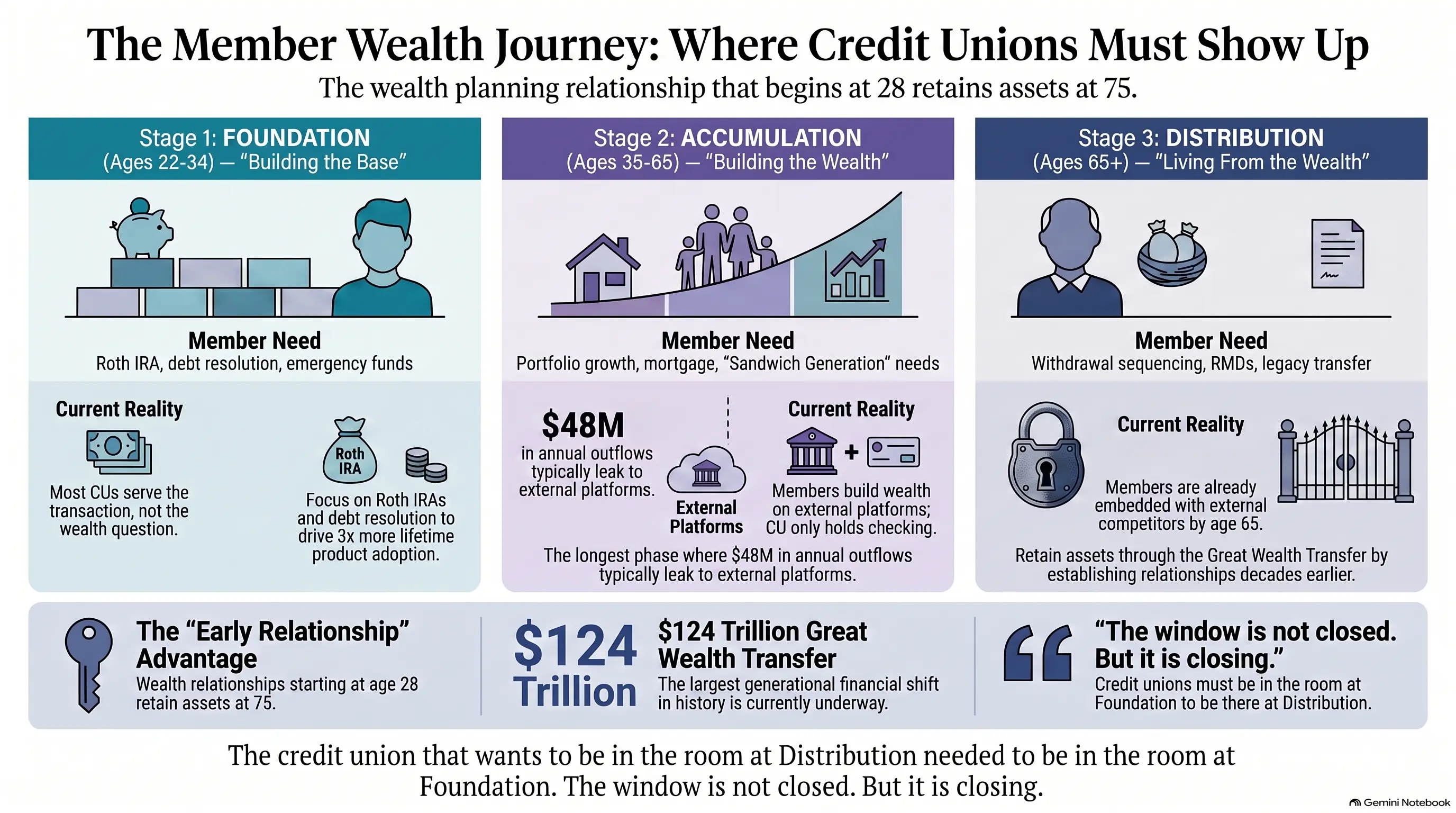
The Arthavita Framework — built around three pillars (Foundation, Accumulation, Distribution) and three lenses (Protection, Longevity, Legacy Intent) — maps precisely to the member journey that credit unions serve across an entire lifetime.
Foundation (Ages 22-34): This is where the wealth and legacy planning relationship should begin. The 24-year-old member with a checking account and a growing salary is making decisions right now — Roth versus traditional, debt versus investment, how much emergency fund is enough — that will compound for 40 years. The credit union that provides intelligent guidance at this stage builds a relationship that 10 banks and 5 fintech apps will never displace.
Under-35 members who adopt multiple products with a credit union deliver 2.5 to 3 times more lifetime product adoption than members acquired after age 50. That is not a relationship metric. That is a lifetime revenue and retention metric. The wealth and legacy planning relationship started at 28 is the most defensible competitive position available to any credit union.
Accumulation (Ages 35-65): This is the longest phase and the one where wealth is actually built — or where it silently fails to materialize. The mortgage member at 38 who is also carrying student loans, funding children's education, caring for aging parents, and trying to save for retirement is the sandwich generation member that no single financial product addresses.
The credit union that helps this member see their complete financial picture — the net worth trajectory, the insurance gaps, the retirement income projection, the estate documents that need updating — is the credit union that retains not just the checking account but the financial relationship for the next 30 years.
This is also the phase where the $48 million in outflows measured by Service Credit Union is primarily happening. Members in their 30s, 40s, and 50s are accumulating wealth. They are making investment decisions. They are choosing platforms and advisors. And most credit unions are absent from that conversation — not because they were uninvited, but because they never positioned themselves to be part of it.
Distribution (Ages 65+): This is the phase where credit unions typically try to enter the wealth relationship — and where they most often fail. The member who arrives at retirement already embedded with a family office or wealth management firm did not become that way at 65. The relationship was built at 50. The trust was established at 45. The credit union that knocks on the door at 63 is not building a new relationship. It is competing for one that already exists.
The credit union that wants to be in the room at Distribution needs to have been in the room at Foundation and Accumulation.
The Moment That Explains Everything
There is a moment that happens in the life of nearly every credit union member who eventually leaves for a wealth management firm. It does not happen at the moment they sign with the new advisor. It happens years earlier.
It is the moment when they had a real wealth planning question — about their 401(k) allocation, their estate documents, their long-term care insurance, their Social Security timing — and they thought about calling the credit union. And then they did not call, because they assumed the credit union only handled deposits and loans, not the complex financial questions they were actually carrying.
In that moment, the credit union lost the relationship. Not because it failed to serve the member. Because the member did not believe it could.
That perception gap — between what credit unions are capable of offering and what members believe they offer — is the most expensive strategic problem in the movement. It costs members the guidance they need at the moments that matter most. And it costs credit unions the relationships and assets that should have stayed.
The solution is not more marketing. It is not a brochure about wealth management services buried on page 12 of the member newsletter. It is a fundamental repositioning — from product provider to lifelong wealth and legacy planning partner — that shows up in every member interaction from the first account through the final estate.
Fidelity's 2026 Retirement Planning Study quantified what that repositioning produces: 81% of retirees who had a plan say their money will last a lifetime. Among retirees without a plan, only 45% say the same. That 36-point confidence gap is the outcome of the wealth planning relationship — and it belongs to whichever institution builds it.
The New York Life 2026 Wealth Watch Midyear Outlook put the number even more sharply: 86% of Americans who work with a financial professional and own protection products are confident their assets will last throughout retirement. Among those without a financial professional, only 43% are confident. A 43-point gap — measurable, attributable, and waiting for the institution that closes it.
Credit union members are not immune to this gap. They are the gap. They are the 80% who want personalized financial advice. They are the 50% who lack a recently updated written plan, per the LIMRA August 2026 Retirement Income Readiness Report. They are the people sending 53,000 transactions to external investment platforms because nobody at their trusted institution ever offered to help.
What Wealth and Legacy Planning Looks Like in the Credit Union Context
The credit union that commits to wealth and legacy planning as a member service is not committing to becoming a broker-dealer or an investment advisor. It is committing to showing up as a partner across the entire financial life of its members — providing the intelligence, the tools, and the guidance that members need at every stage of the journey.
In practical terms, this means:
A member who opens their first Roth IRA at the credit union at 26 gets access to a wealth planning tool that shows them what that account is worth at 65 under different contribution scenarios — and what it is not worth if they wait until 36.
A member who takes out a mortgage at 34 gets a conversation about whether their life insurance coverage is adequate for the household financial obligation they just assumed — and a path to addressing the gap if it is not.
A member at 47 who is simultaneously supporting aging parents and funding a 529 for their teenager gets a complete picture of their financial life — the retirement income gap, the estate documents that have not been updated since the children were born, the long-term care insurance window that is closing as they approach 55.
A member at 58 who has been accumulating in a 401(k) for 30 years gets a Roth conversion analysis, a Social Security timing model, and a four-bucket distribution strategy — before a wealth management firm shows up with the same conversation.
A member at 72 who has never updated their beneficiary designations gets a proactive alert — not a reactive discovery after it is too late.
None of these interactions require the credit union to become an investment advisor or a broker-dealer. They require the credit union to position itself as the institution that helps members understand their complete financial picture and take the right actions at the right moments across their entire lifetime.
That is what wealth and legacy planning looks like in the credit union context. Not a product. A relationship.
The Cooperative Mission Makes This Non-Optional
There is an argument that some credit union leaders make — silently, if not out loud — that wealth and legacy planning is for wealthy members, and credit unions serve the full spectrum of the community.
That argument misunderstands both wealth planning and the cooperative mission.
Wealth and legacy planning is not for the wealthy. It is for anyone who has a paycheck to deploy wisely, a family to protect, a retirement to fund, and something they want to leave behind — whether that is financial assets, an organized estate, or simply the knowledge that their family will not face the chaos of an unplanned financial exit.
That description covers nearly every credit union member of every income level.
The 35-year-old earning $55,000 who has never opened a Roth IRA needs wealth planning. The 48-year-old with $80,000 in a 401(k) and no estate documents needs wealth planning. The 61-year-old with a modest home and a Social Security decision approaching needs wealth planning. None of them are wealthy by conventional definition. All of them are carrying wealth and legacy planning needs that the credit union is uniquely positioned to address — because the cooperative mission was always about serving the complete financial life of members, not just the transaction layer of it.
The credit unions that recognize this — and build the capability to serve it — are the ones that will retain member relationships across generations. The ones that do not will continue to watch $48 million leave in a single year, 53,000 transactions at a time, to institutions that asked the question the credit union never got around to asking.
The Wealth Transfer Window Is Open — But Not Forever
The $124 trillion Great Wealth Transfer is underway. It does not pause while credit unions decide whether to participate. It moves — to the institutions that have built relationships, to the advisors who showed up early, to the platforms that gave members the tools to understand their own wealth picture before the moment of transfer arrived.
Credit unions hold something no bank, no robo-advisor, and no wealth management firm can replicate: decades of member trust, relationship history, and community connection. That is the foundation of the most defensible wealth planning relationship available in American financial services.
But a foundation is only useful if something is built on it.
The credit unions building wealth and legacy planning capability now — deploying intelligent tools that serve members across every life stage, positioning themselves as the institution that helps members from first investment to lasting legacy — are the ones that will be in the room when the transfer happens.
The ones waiting for members to ask will discover, as Service Credit Union discovered, that the members were never going to ask. They were going to act — quietly, 53,000 transactions at a time — and build their wealth somewhere else.
Arthavita provides a wealth and legacy planning platform built for lifelong member engagement — from Foundation through Accumulation through Distribution, across Protection, Longevity, and Legacy Intent. If your credit union is ready to close the wealth planning gap, we would like to talk. Reach out at kgp@arthavita.co.
This article is for informational and thought leadership purposes. Statistics cited are sourced from publicly available research including the Service Credit Union / TAPP Engine white paper (April 2026), Cerulli Associates, America's Credit Unions, LIMRA Retirement Income Readiness Report (August 2026), Fidelity 2026 Retirement Planning Study, New York Life 2026 Wealth Watch Midyear Outlook, Northwestern Mutual 2026 Planning and Progress Study, MDT Great Wealth Transfer white paper (June 2026), and Journey Advisory Group 2026 Great Wealth Transfer Statistics Report.
Ketan Patel
Founder, Arthavita
Ketan Patel is the founder of Arthavita and a multi-industry entrepreneur with 30+ years of experience in technology and business operations. He built Arthavita to bring institutional-quality financial intelligence to individual investors.
LinkedIn ↗This article is for educational purposes only and does not constitute financial, tax, or legal advice. Arthavita is a recommendation-only platform. Always consult a qualified professional before making financial decisions.