
Your Clients Are Making Wealth Decisions Every Day. They Are Not Calling You.
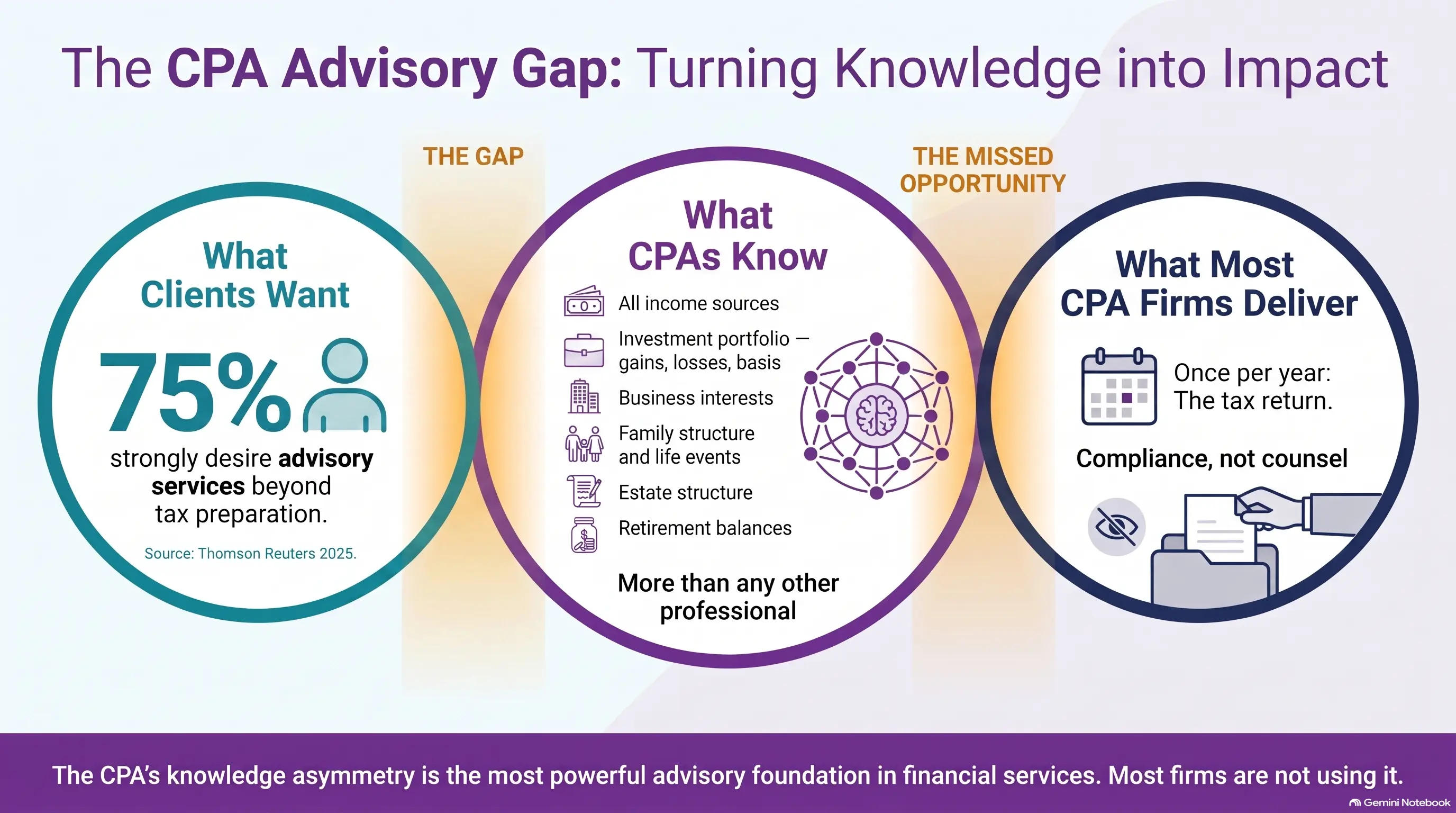
According to Thomson Reuters' 2025 State of Tax Professionals Report, 75% of tax professionals say their clients strongly desire additional advisory services beyond tax preparation. The clients are asking. Most CPA firms are not answering — not because they lack the expertise, but because they have not positioned themselves to deliver the service clients are requesting between April and April. The CPA who sees the tax return already knows more about the client's complete financial picture than any investment advisor, wealth manager, or financial planner the client will ever hire. That asymmetric knowledge advantage is the most underutilized opportunity in financial services today.
Your client sits down with you in March. You review the return together. You notice the Roth conversion that was too large — it pushed income above the IRMAA threshold, adding $974 in Medicare premium surcharges for the following year. You note the IRA beneficiary designation that still names a deceased parent. You see the capital gain from a stock sale in October that could have been offset with a loss harvest in November if anyone had been watching.
You file the return. The conversation ends.
And for the next 11 months, that client — who trusts you more than they trust almost anyone with their financial life — makes decisions about their money without you. They decide whether to convert traditional IRA to Roth. They decide when to claim Social Security. They decide whether the long-term care insurance quote sitting in their email is worth the premium. They decide what to do with the inherited IRA from a parent who passed away in June. They make each of these decisions alone, or with a financial advisor who does not know what you know, or with no professional guidance at all.
And then they come back to you in March, and you see the consequences.
This is the CPA's paradox. You are the most informed professional in your client's financial life — and you are systematically absent from most of the decisions that shape it.
The Gap Between What Clients Want and What They Are Getting
Thomson Reuters' 2025 State of Tax Professionals Report is specific about the scale of this gap: 75% of tax professionals report that their clients strongly desire additional tax and business advisory services beyond tax preparation. Three-quarters of practitioners are watching clients request a service they are not systematically providing.
The AICPA has been documenting the same pattern for years. The profession calls it the "trusted advisor" evolution — the shift from compliance-based, seasonal service to proactive, year-round advisory engagement that addresses the complete financial picture. The direction is clear. The profession broadly acknowledges it. And most CPA firms are still organized primarily around the tax return.
The consequence is not just lost revenue. It is a specific, measurable client harm. Clients experiencing their financial lives as one connected picture — where investment decisions affect taxes, taxes affect retirement income, estate structure affects both — are receiving siloed guidance from professionals who do not talk to each other, or no guidance at all.
The investment advisor manages the portfolio without knowing the tax implications. The CPA prepares the return without knowing the portfolio strategy. The estate attorney drafts the documents without knowing the retirement income picture. And the client stands at the intersection of all three professionals, responsible for coordinating information that none of them share.
That coordination failure costs clients money every year. The Roth conversion that was the right size from an income perspective but the wrong size for IRMAA. The 401(k) that was left at a previous employer for three years while the client forgot to roll it over. The life insurance policy that lapsed. The Social Security claim at 63 that cost $200,000 in lifetime income compared to claiming at 70.
The CPA who sees the tax return sees the aftermath of these decisions. The CPA who has positioned themselves as a year-round wealth and legacy planning partner sees the decision before it is made — and changes the outcome.
What You Already Know That Nobody Else Does
Here is the asymmetry that makes the CPA's opportunity in wealth and legacy planning categorically different from every other professional's:
You already know everything.
You see the tax return. You know the income — all of it, from every source. You know the investment portfolio — the gains, the losses, the basis, the turnover. You know the business interests. You know the real estate. You know the charitable contributions. You know the estate structure — or the absence of one. You know the retirement account balances. You know the family situation. You know the life events — the inheritance, the business sale, the divorce, the death in the family — because every one of them shows up on the return.
The investment advisor sees the portfolio. The wealth manager sees the assets. The estate attorney sees the documents. You see the complete financial picture, assembled from every corner of the client's life, every year.
That knowledge asymmetry is the foundation of the most powerful wealth and legacy planning relationship available in financial services — if the CPA chooses to use it.
Select Advisors Institute made this explicit in 2026: "Accounting firms are sitting on the most underutilized opportunity in financial services today. You already have deep relationships with high-income, high-trust clients. You already understand their cash flow, asset base, business entities, and family dynamics. The question is not whether you have the knowledge. It is whether you have positioned yourself to act on it."
The positioning is the gap. The knowledge is already there.
The Decisions Being Made Without You — Every Month of Every Year
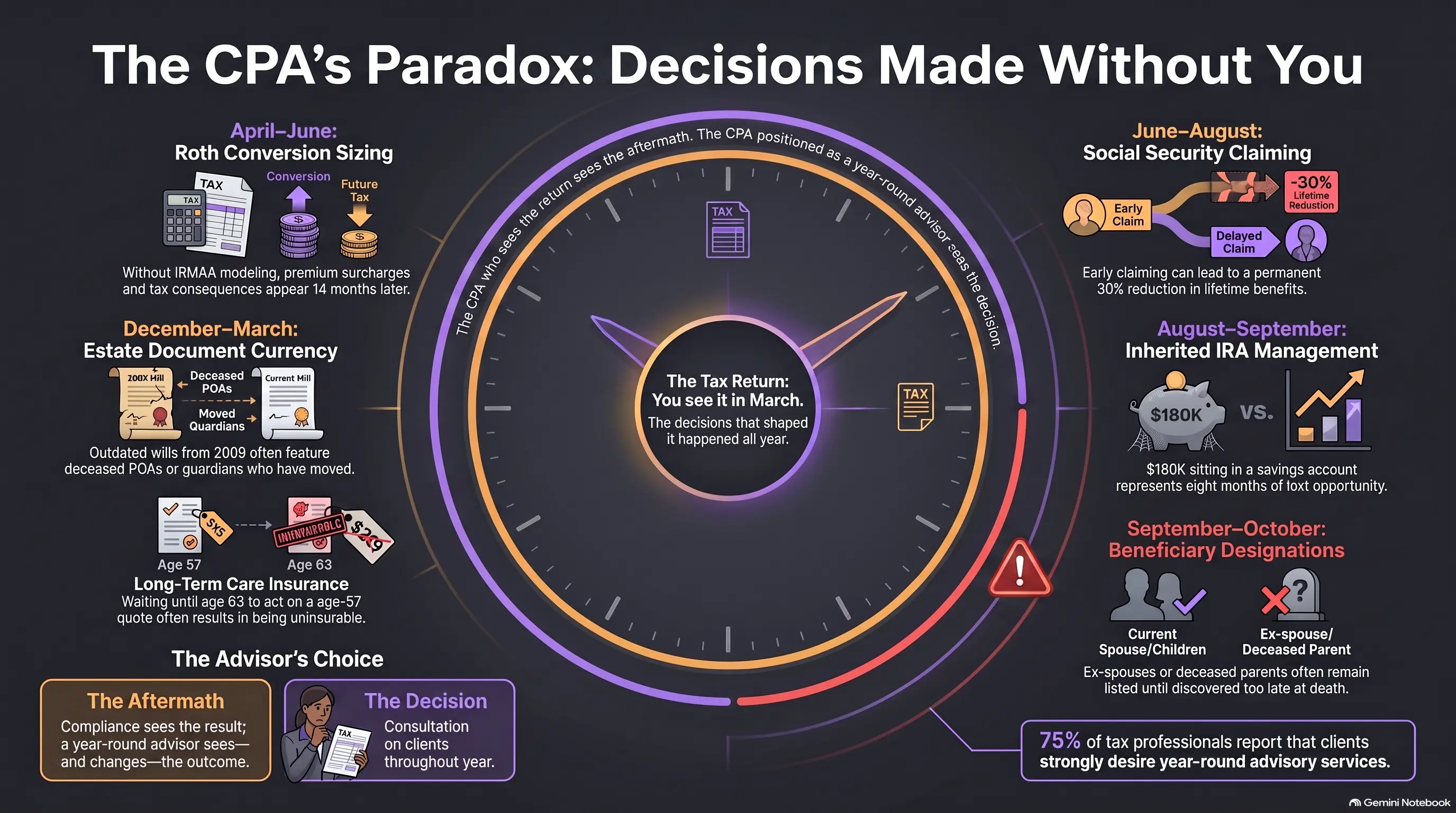
Between the March filing and the following March, a typical client makes dozens of financial decisions that carry significant tax and wealth implications. Here is a partial inventory of what is happening without you:
Roth conversion decisions: The client read an article about Roth conversions and executed one in October — without modeling the IRMAA impact, without checking whether the conversion amount would push them into the next bracket, without coordinating with Social Security income or RMD projections. The consequences show up on the return in March. The opportunity to optimize closed in October.
Beneficiary designation updates: The client's mother passed away in August. She was listed as the contingent beneficiary on the IRA opened in 1998. Nobody told the client to update the designation. The primary beneficiary — the client's ex-spouse, from a divorce in 2011 — is still listed. This surfaces on a future return or, worse, at the moment of the client's death.
Social Security timing: The client turned 62 in September and claimed Social Security immediately because they were not working and needed income. The decision, made without modeling, permanently reduced their monthly benefit by approximately 30% compared to their full retirement age benefit — and eliminated the 76% maximum benefit available by waiting until 70. The lifetime income cost is significant. Nobody modeled it before September.
Estate document currency: The client's will was drafted in 2009 when their children were minors. The guardian designation names a sibling who has since moved across the country. The power of attorney designates an elderly parent who passed away in 2022. None of this was updated because nobody was watching.
Long-term care insurance: The client received quotes for long-term care insurance at 57 and put them in a folder to review later. At 63, when they finally decided to apply, a newly diagnosed condition made them uninsurable. The window that existed at 57 closed quietly while they intended to decide.
Inheritance management: The client inherited $180,000 from a parent in November. They put it in a savings account because they did not know what to do with it. By March, eight months of potential investment return — and a Roth conversion opportunity — have passed.
Every one of these is a wealth and legacy planning failure. Every one of them shows up on your desk in March as a fact rather than as a choice. And every one of them was preventable with year-round engagement.
The Wealth and Legacy Planning Opportunity for CPA Firms
The CPA who positions themselves as a year-round wealth and legacy planning partner is not abandoning tax expertise. They are applying it to the complete financial picture rather than to the annual return.
The AICPA has been explicit about this evolution: "CPAs are redefining their roles from traditional tax compliance experts to holistic financial advisers because clients' needs are expanding beyond just tax." The Personal Financial Planning section of the AICPA exists specifically to support CPAs who are making this transition — providing credentials, resources, and a practice framework for integrating wealth planning into the CPA relationship.
The specific services that CPAs are uniquely positioned to provide — because the tax knowledge is already there — are the services most directly connected to wealth and legacy outcomes:
Roth conversion planning: Sizing annual conversions to maximize tax efficiency over the full pre-retirement window, coordinated with IRMAA thresholds, Social Security timing, and RMD projections. This is fundamentally a tax problem that requires investment context. The CPA who sees both is positioned to solve it better than the investment advisor who sees only the portfolio or the tax return preparer who sees only the return.
Social Security optimization: The Social Security timing decision interacts with taxable income in ways that most financial advisors model inadequately. The provisional income calculation — which determines how much of Social Security is taxable — requires understanding every income source in the client's picture. The CPA who knows the complete income picture is the natural professional to lead this analysis.
Tax-efficient withdrawal sequencing: In retirement, which accounts to draw from in which order determines the lifetime tax burden on the portfolio. Traditional first, Roth last, taxable in between — the conventional rule — is often not optimal when IRMAA thresholds, Social Security taxation, and RMD management are modeled together. This is a tax optimization problem disguised as a distribution problem.
Estate document review: The CPA who sees the beneficiary designations on the return, knows the family structure, and understands the estate tax picture is the natural professional to flag when documents are outdated, when beneficiary designations create problems, and when the estate structure has not kept pace with the financial reality.
Legacy intent planning: The client who has a specific charitable intent, a family goal, or a wealth transfer objective needs that intent modeled against their actual financial picture — not as a separate estate planning exercise, but as part of the integrated wealth plan. The CPA who understands the tax implications of different legacy vehicles — DAFs, QCDs, trusts, annual gifting — can translate intent into strategy.
The Trusted Advisor Advantage — And Why It Is At Risk
The CPA is historically one of the most trusted professional relationships in American financial life. Surveys consistently show that Americans trust their CPA more than their financial advisor, their attorney, or their banker. That trust is the product of decades of serving the complete financial picture honestly, with no product to sell and no commission to earn.
That trust is also at risk — not from scandal or failure, but from the quiet drift of clients toward advisors who are engaging with the complete picture year-round while the CPA engages once per year.
The Thomson Reuters survey finding — 75% of clients wanting more — is also a warning. Clients who want more advisory engagement and are not getting it from their CPA will eventually find it somewhere else. The family office that reaches out. The wealth management firm that offers a complimentary planning session. The robo-advisor platform that offers a comprehensive financial plan for $30 per month.
The client does not leave the CPA. They just stop bringing their most important questions there. The CPA retains the compliance relationship and loses the advisory influence. And over time, the tax return becomes a record of decisions made without CPA input rather than a reflection of a coordinated plan.
The CPA firms that are building lasting competitive advantage in 2026 are the ones that recognized this drift early and repositioned before it became permanent. Modern American Advisor documented this in July 2026: "The common thread across [the leading integrating firms] is that the market is moving beyond simple introductions. The opportunity is not just for advisors to win referrals from accountants, or for CPAs to find somewhere to send clients who need investment advice. The larger opportunity is to create a more complete advisory experience around the client."
Clients do not experience their financial lives in professional silos. They experience one life, one tax position, one retirement plan, one estate, one set of consequences. The professional who helps them see that picture as one integrated system — not as a collection of separate expert opinions — is the professional who becomes irreplaceable.
What Year-Round Wealth and Legacy Planning Looks Like in Practice
The transition from annual compliance provider to year-round wealth and legacy planning partner does not require becoming a registered investment advisor or hiring a financial planning team. It requires a deliberate repositioning of the CPA relationship around the complete financial picture — and the tools to support that repositioning.
In practical terms, it looks like this:
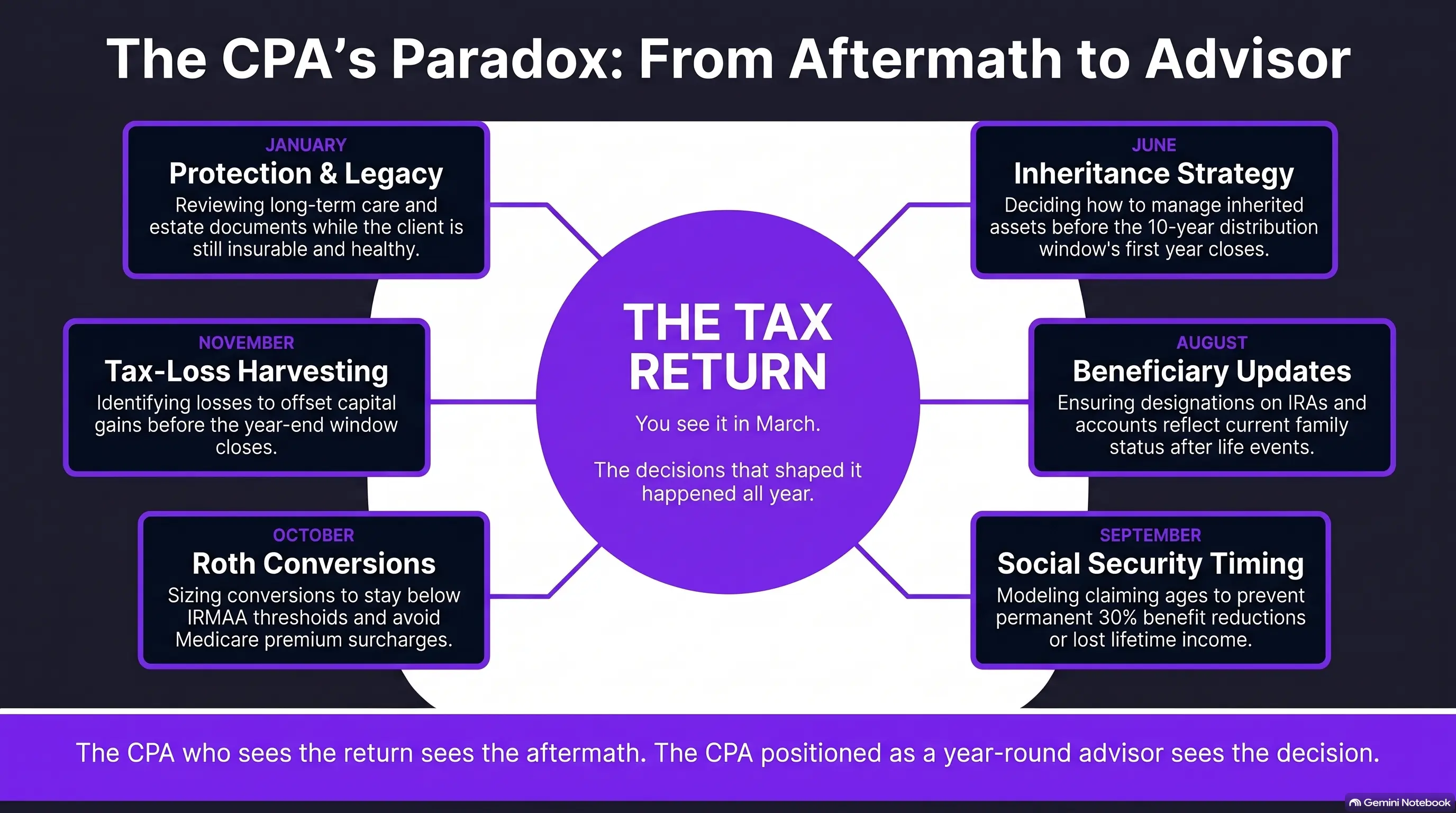
The client who comes to you in March for their return also gets a conversation in June about the Roth conversion window — how much could be converted this year, at what tax rate, staying below which IRMAA threshold.
The client who turned 61 in January gets a Social Security analysis before they make a claiming decision — with the lifetime income comparison modeled against their specific earnings record and their complete income picture.
The client who inherited an IRA in August gets a call in September — before the 10-year distribution window's first year closes — about the most tax-efficient approach to distributions across their specific income trajectory.
The client who has a 55-year-old spouse gets a conversation about the long-term care insurance window — while it is still open, before health conditions develop, before the premium becomes prohibitive.
The client whose will was drafted when their children were young gets a document review flag — not a legal service, but an awareness that the documents need attention and a referral to the estate attorney to provide it.
None of these conversations require the CPA to practice as a financial advisor. They require the CPA to apply the knowledge they already have — knowledge of the complete financial picture — to the decisions the client is making right now, rather than to the return that reflects decisions made in the past.
Arthavita's wealth and legacy planning platform was built specifically to support this kind of year-round engagement. Deployed to client households, it gives clients access to a life-stage-adaptive financial intelligence tool — Monte Carlo simulation against actual numbers, Tax Efficiency Score with specific Roth conversion and IRMAA optimization, estate document tracking, beneficiary designation review, and a complete wealth and legacy planning picture — while keeping the CPA in the advisory role.
The platform surfaces the decisions that need attention. The CPA provides the judgment. The client receives the year-round guidance they have been requesting.
The Question That Changes the Practice
There is one question that every CPA firm should ask about every client relationship: if this client made a major wealth or legacy decision this year — a large Roth conversion, a Social Security claim, an inherited IRA, a life insurance lapse — would we know about it before the return arrived?
For most firms, the honest answer is no.
That gap — between what you know and what you know in time to act on it — is the wealth and legacy planning opportunity. Not a new service to sell. Not a credential to earn. A fundamental repositioning of when in the client's financial year the CPA shows up.
The AICPA's guidance on this transition is direct: "Clients want clarity, strategy, and guidance to assist with life's big financial decisions. CPAs can rise to this challenge and shift their offerings to include personal financial planning services and drive overall client value."
The clients are asking. The expertise is there. The trust is already built. The knowledge asymmetry — knowing more about the client's complete financial picture than anyone else — is the most powerful advisory foundation in financial services.
What remains is the decision to use it.
Arthavita provides a wealth and legacy planning platform built for lifelong client engagement — from Foundation through Accumulation through Distribution, across Protection, Longevity, and Legacy Intent. If your CPA firm is interested in learning how Arthavita supports year-round client engagement, reach out at kgp@arthavita.co.
This article is for informational and thought leadership purposes. Statistics cited are sourced from the Thomson Reuters 2025 State of Tax Professionals Report, AICPA Personal Financial Planning Section resources, Select Advisors Institute 2026, Modern American Advisor (July 2026), Capital Group 2026 Advisor Benchmark Survey, and CPA.com / AICPA PCPS CAS Benchmark Survey.
Ketan Patel
Founder, Arthavita
Ketan Patel is the founder of Arthavita and a multi-industry entrepreneur with 30+ years of experience in technology and business operations. He built Arthavita to bring institutional-quality financial intelligence to individual investors.
LinkedIn ↗This article is for educational purposes only and does not constitute financial, tax, or legal advice. Arthavita is a recommendation-only platform. Always consult a qualified professional before making financial decisions.