
Why Your 40s Are the Most Important Decade of Your Financial Life
The median 45-54 year old in America has saved $115,000 for retirement. The Fidelity checkpoint benchmark says they should have $300,000-$450,000. But the actual inflation-adjusted retirement target for a 45-year-old retiring in 2046 is closer to $1.5 million — after Social Security offset. The gap is not $185,000. It is $1.4 million. This decade is the last one where closing that gap through disciplined action is still realistically possible. Income is at its peak. Compounding still has time to work. The decision is whether you use this window or watch it close.
There is a version of your financial life where the 40s are the decade everything finally clicked.
Income reached its peak. The mortgage started feeling manageable. The kids got older and childcare costs dropped. And you looked at your retirement account and thought: now I can really start building.
There is another version where the 40s became the decade that slipped away. The home needed repairs. The kids needed college savings. The aging parents needed help. The promotion came but so did the lifestyle upgrade. And the retirement account — which was going to get serious attention next year — never quite got it.
Both versions start from the same place. The difference is not income. It is not luck. It is whether you recognized, somewhere in your early 40s, that this decade is not just another stretch of building toward something — it is the decade where the outcome gets decided.
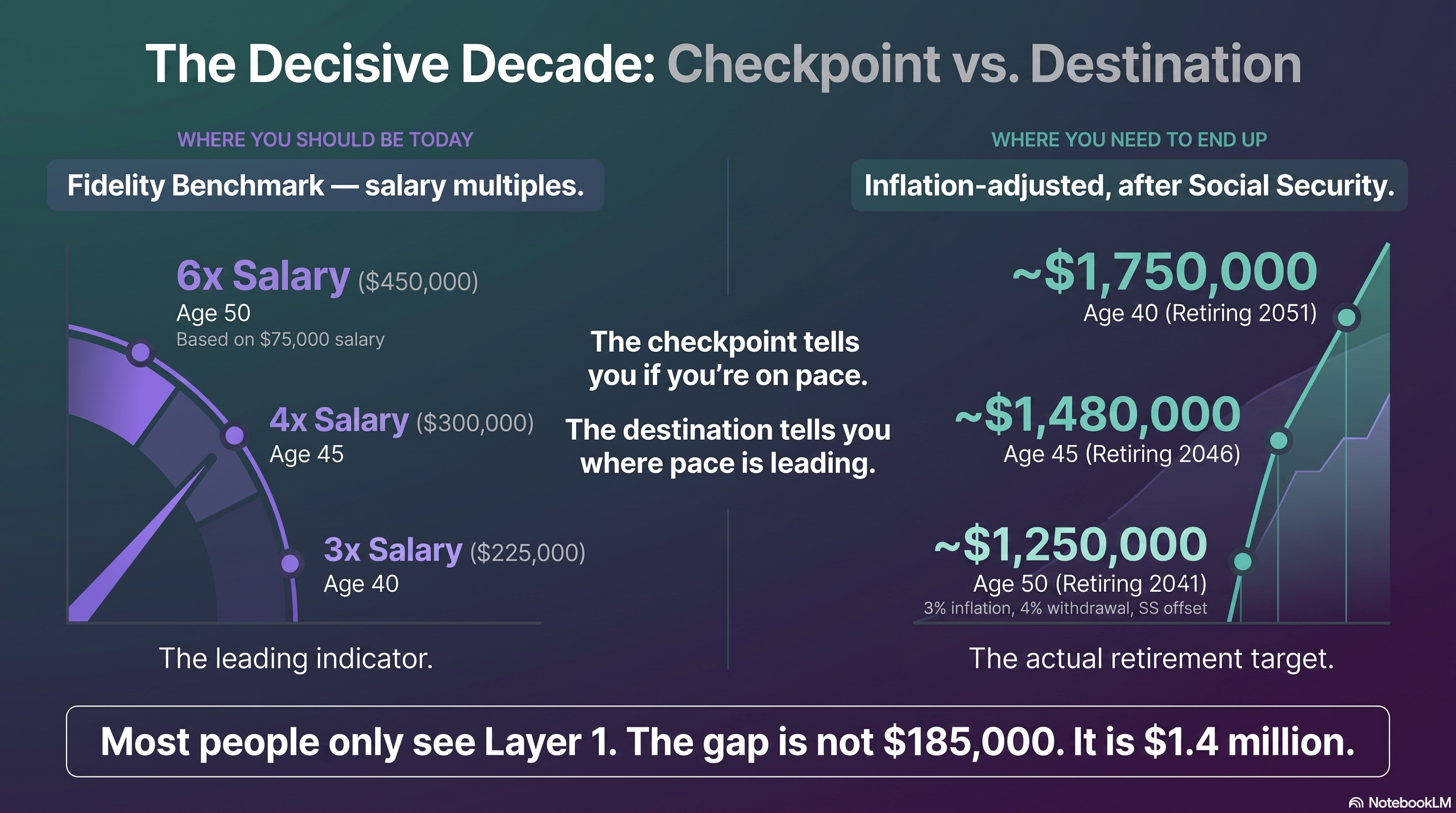
The numbers tell the story plainly. The median 45-54 year old in America has saved $115,000 in retirement accounts. That sounds like a reasonable start — until you see what the actual retirement target looks like in the year they plan to retire. Most people in their 40s are not 10% behind. They are a fraction of where they need to end up.
That gap is not a life sentence. But closing it requires treating the next ten years differently than the last ten.
Why the 40s Work Differently Than Every Other Decade
Every financial decade has its own logic.
In your 20s, time is the asset. Small amounts invested early compound dramatically over 40 years. The amounts barely matter — the habit and the starting date do.
In your 50s, the priority shifts to preparation. Roth conversion windows, Social Security timing, healthcare cost modeling — the accumulation phase is winding down and the distribution phase needs to be designed.
In your 30s, the challenge is complexity. Competing priorities arrive simultaneously — mortgage, children, career advancement, student loans — with limited margin to address all of them well.
Your 40s sit at an intersection that will never align this favorably again.
Income is at or near its peak. Salaries typically peak somewhere between the mid-40s and early 50s for most professions. You are earning more than you ever have. The question is whether that income is building wealth or funding a lifestyle that has quietly expanded to absorb it.
Compounding still has meaningful time to work. A 45-year-old who starts maximizing contributions today has 20 years of compounding before a typical retirement age. That is enough. Someone who maxes out a 401(k) and Roth IRA starting at 45 can shelter roughly $32,500 per year in tax-advantaged accounts. At 7% average annual return over 20 years, that produces approximately $1.4 million — not including whatever was already saved. The window is narrower than it was at 25. It is not closed.
Financial obligations that constrained prior decades are beginning to ease. Childcare costs drop as children get older. The mortgage is further along. Student loans may be behind you. For the first time in years, you may have real discretionary margin. The question is whether it goes toward retirement or toward the lifestyle upgrade that rising income makes feel affordable.
Miss this window and the recovery options narrow significantly. Use it deliberately and the financial outcome changes permanently.
The Real Numbers: Two Layers Everyone in Their 40s Needs to See
Most conversations about retirement savings for people in their 40s show one number — where you should be today — and stop there. That is useful but incomplete. The full picture requires two layers.
Layer 1 is the checkpoint. Where should you be right now, relative to where you are headed? This is what benchmarks like Fidelity's widely cited salary multiples measure. They are waypoints — leading indicators that tell you whether you are on pace.
Layer 2 is the destination. What does the actual retirement target look like in inflation-adjusted dollars, accounting for what Social Security will actually provide, at the specific year you plan to retire?
Most people only see Layer 1. They compare their current savings against a benchmark and feel either relief or anxiety based on that single comparison — without ever knowing what the destination actually is. That is like knowing you are 40 miles into a 200-mile drive without knowing how fast you need to go.
Both layers matter. Here is what they look like with honest numbers.
Layer 1: The Checkpoint — Where You Should Be Today
The Federal Reserve's Survey of Consumer Finances shows the median retirement savings for 45-54 year olds is $115,000. The average is $313,220 — but averages are skewed upward by a small number of very high-balance households. The median tells the real story.
Fidelity's benchmark framework suggests having approximately three times your annual salary saved by 40, four times by 45, and six times by 50.
For someone earning $75,000:
- Checkpoint at 40: $225,000
- Checkpoint at 45: $300,000
- Checkpoint at 50: $450,000
The median 45-year-old has $115,000 against a $300,000 checkpoint. That gap creates urgency — and it is a real gap worth taking seriously. But the checkpoint is not the destination. It is the leading indicator that you are on pace toward the destination. And the destination is a very different number.
Layer 2: The Destination — What Retirement Actually Costs in the Year You Retire
This is where most retirement conversations stop being honest. The $450,000 benchmark at 50 is not how much you need to retire. It is a checkpoint designed to tell you whether you are on track. The actual retirement target — accounting for inflation, Social Security, and the cost of living 15 to 25 years from now — is significantly larger.
Here is what the math actually looks like, using three standard assumptions: 3% average annual inflation, Social Security replacing approximately 40% of pre-retirement income (growing at 2.5% COLA per year), and a 4% portfolio withdrawal rate in retirement.
| Age Today | Salary | Retire Year | Inflation-Adj Spending | SS Offset | Portfolio Needed |
|---|---|---|---|---|---|
| 40 | $75,000 | 2051 | ~$126,000/yr | ~$56,000 | ~$1,750,000 |
| 45 | $75,000 | 2046 | ~$108,000/yr | ~$49,000 | ~$1,480,000 |
| 45 | $100,000 | 2046 | ~$144,000/yr | ~$66,000 | ~$1,975,000 |
| 50 | $75,000 | 2041 | ~$93,000/yr | ~$43,000 | ~$1,250,000 |
| 50 | $100,000 | 2041 | ~$125,000/yr | ~$58,000 | ~$1,670,000 |
Illustrative only. Assumes 80% income replacement, 3% inflation, 2.5% SS COLA, 4% withdrawal rate. Your numbers will differ based on actual spending, Social Security earnings history, state taxes, and healthcare costs.
Read these numbers carefully. A 45-year-old earning $75,000 who retires at 65 in 2046 needs a portfolio of approximately $1.48 million — not $300,000. The $300,000 checkpoint at 45 is the waypoint that tells you whether you are on pace to reach $1.48 million. The two numbers serve completely different purposes and should never be confused for each other.
Connecting the Two Layers: Why Both Matter
The checkpoint tells you whether your current savings trajectory is going in the right direction at the right pace. The destination tells you what you are actually building toward — and whether the plan you are executing today, extended 20 years, actually gets you there.
The gap between the typical 45-year-old's actual savings ($115,000) and the checkpoint ($300,000) is $185,000. The gap between their actual savings and the destination ($1.48 million) is $1.365 million. Both gaps are real. The first creates urgency. The second creates context for why the urgency matters.
Neither number can give you your specific answer. Your actual retirement target depends on your real spending, your Social Security earnings history, your state's tax treatment of retirement income, your healthcare situation, your spouse's income and benefits, whether you plan to downsize, and dozens of other variables that a salary multiple cannot capture.
That is exactly why the 25,000-scenario Monte Carlo simulation in Arthavita exists. It runs your actual numbers — your specific balances, your specific income, your planned retirement year, your Social Security estimate — against 25,000 possible market scenarios. It does not give you a single target number. It gives you a probability distribution and a clear picture of what actions move that probability in the right direction.
The checkpoint tells you whether you are on pace today. The destination tells you where pace is leading. The Monte Carlo tells you whether the combination of where you are and what you are doing actually works.
The Five Financial Priorities That Define Your 40s
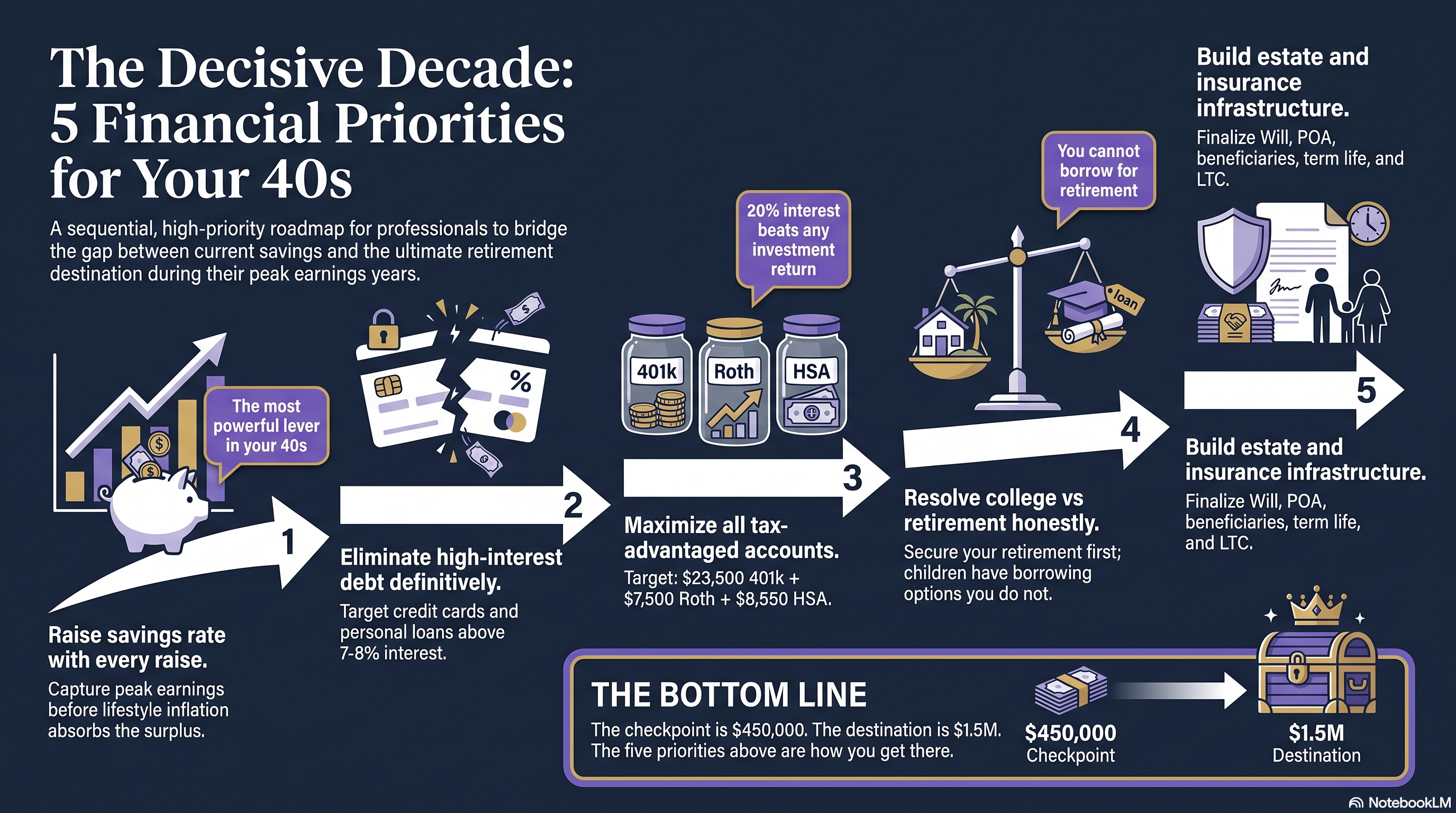
Priority 1: Increase Your Savings Rate Before Lifestyle Inflation Absorbs Every Raise
The single most destructive financial pattern in the 40s is earning more and saving the same percentage. Income rises from $75,000 to $90,000 to $110,000 over a decade, and the retirement contribution stays at 6% — capturing the match, technically doing the right thing, but missing the compounding opportunity that peak earning years represent.
The discipline that changes outcomes is simpler than it sounds. Every time income increases, increase the contribution rate before the new income appears in your checking account. Not to the point of deprivation — to the point where the savings rate grows alongside the income rather than trailing it.
The math matters here. Someone earning $100,000 who increases their 401(k) contribution from 10% to 15% adds $5,000 per year to retirement savings. Over 20 years at 7% average annual return, that additional $5,000 per year becomes approximately $218,000. That is the cost of not adjusting the contribution rate when income grew.
The savings rate in your 40s is the most powerful lever available — more powerful than investment selection, more powerful than market timing, more powerful than any optimization that gets more attention.
Priority 2: Settle the Debt Question Definitively
The 40s are when debt should be decisively resolved — not managed indefinitely.
High-interest debt — credit cards, personal loans above 7-8% — must be eliminated before meaningful investment beyond the employer match. A 20% credit card interest rate is a guaranteed negative return that no investment portfolio can overcome. Every dollar sitting in a taxable investment account while high-interest debt persists is earning 7-10% while losing 20%. The math is not close.
Student loans require the specific interest rate calculation. Federal loans below 6% can reasonably coexist with investment contributions. Loans above 7-8% have a stronger case for aggressive paydown before additional investment.
The mortgage is a different question. At rates most 40-somethings are carrying, the tax treatment, leveraged appreciation, and relatively modest interest cost generally favor maintaining the mortgage rather than aggressively paying it down. The exception is someone within five to seven years of retirement who wants to eliminate the payment from their retirement income picture.
The target entering your 50s: consumer debt at zero, student loans resolved, mortgage on schedule, and financial resources fully available for the retirement savings push the next decade requires.
Priority 3: Maximize Tax-Advantaged Accounts — All of Them
In 2026, the 401(k) employee deferral limit is $23,500. Standard catch-up for ages 50 and older adds $8,000, bringing the total to $31,500. The Roth IRA limit is $7,500, with a phase-out beginning at $150,000 for single filers. A health savings account — available with a qualifying high-deductible health plan — adds another $8,550 for families with its unique triple tax advantage.
Combined, fully maximizing these accounts means sheltering $39,000 or more annually in tax-advantaged growth. That is not achievable for everyone. But it is the target to move toward as aggressively as income and fixed obligations allow.
The sequence matters. 401(k) to the employer match first — always, because the match is a guaranteed 50-100% return. Then the HSA, if available, because no other account offers a tax deduction on contributions, tax-free growth, and tax-free withdrawals simultaneously. Then the Roth IRA. Then back to the 401(k) up to the full limit. Then taxable brokerage.
The Roth IRA deserves special attention in your 40s. For many people, the 40s are a transition — taxes are higher than in their 20s, but the Roth window is still open for most incomes. Every dollar in a Roth IRA is a dollar that will never generate a taxable Required Minimum Distribution, never push Social Security into higher taxation, and never contribute to IRMAA surcharges on Medicare premiums. Those benefits compound over decades.
Priority 4: Resolve the College vs. Retirement Trade-Off Honestly
This is the defining financial tension of the 40s for parents, and it has a clear answer most people resist emotionally.
Prioritize retirement over college savings. Not because your children's education does not matter — it matters enormously. But because your children can borrow for education and you cannot borrow for retirement. Your children have access to scholarships, work-study, student loans, and 40 years of earning ahead of them. You have one shot at the retirement savings window that your 40s represent.
This does not mean ignoring 529 plans. A 529 account grows tax-free for education expenses and is worth funding — particularly if grandparents are contributing. But contributions to a 529 should come after retirement accounts are maximized, not instead of them.
The conversation that changes the emotional framing: funding your retirement fully is the most generous financial decision you can make for your children. The alternative — arriving at 70 with insufficient savings — means your children spend their most productive decades managing your financial situation rather than building their own.
Priority 5: Build the Supporting Architecture Retirement Requires
The 40s are when the infrastructure of long-term financial security needs to be in place — not planned for next year, but actually built.
Insurance coverage reviewed. Life insurance needs in your 40s are typically at their highest — the mortgage, the children, the income your household depends on. Term life is still affordable and provides meaningful protection. Long-term care insurance becomes worth evaluating in your mid-to-late 40s, before health conditions that develop in your 50s make coverage unavailable or prohibitively expensive.
Estate documents current. Will, trust, durable power of attorney, healthcare directive, and beneficiary designations — all should be in place and current. A will drafted when your children were young that names guardians who have since moved needs to be revisited. Beneficiary designations that still name an ex-spouse or deceased parent need to be updated. These are not complicated tasks. They are the ones families most regret not completing.
Emergency fund fully funded. Three to six months of living expenses in a high-yield savings account provides the buffer that makes every other financial decision more stable. Without it, the next unexpected expense becomes a financial crisis that disrupts the momentum you spent years building.
Net worth tracked deliberately. The 40s are when net worth begins to accelerate meaningfully for disciplined savers. Knowing exactly where you stand — across every account, every asset, every liability — is the foundation of every financial decision you make.
The Two Scenarios That Play Out From Here
The decisions made in the 40s produce two dramatically different retirement outcomes. Not because of market timing or investment genius — because of savings rate, debt management, and the discipline to use the years when income is highest.
The person who treats the 40s as decisive:
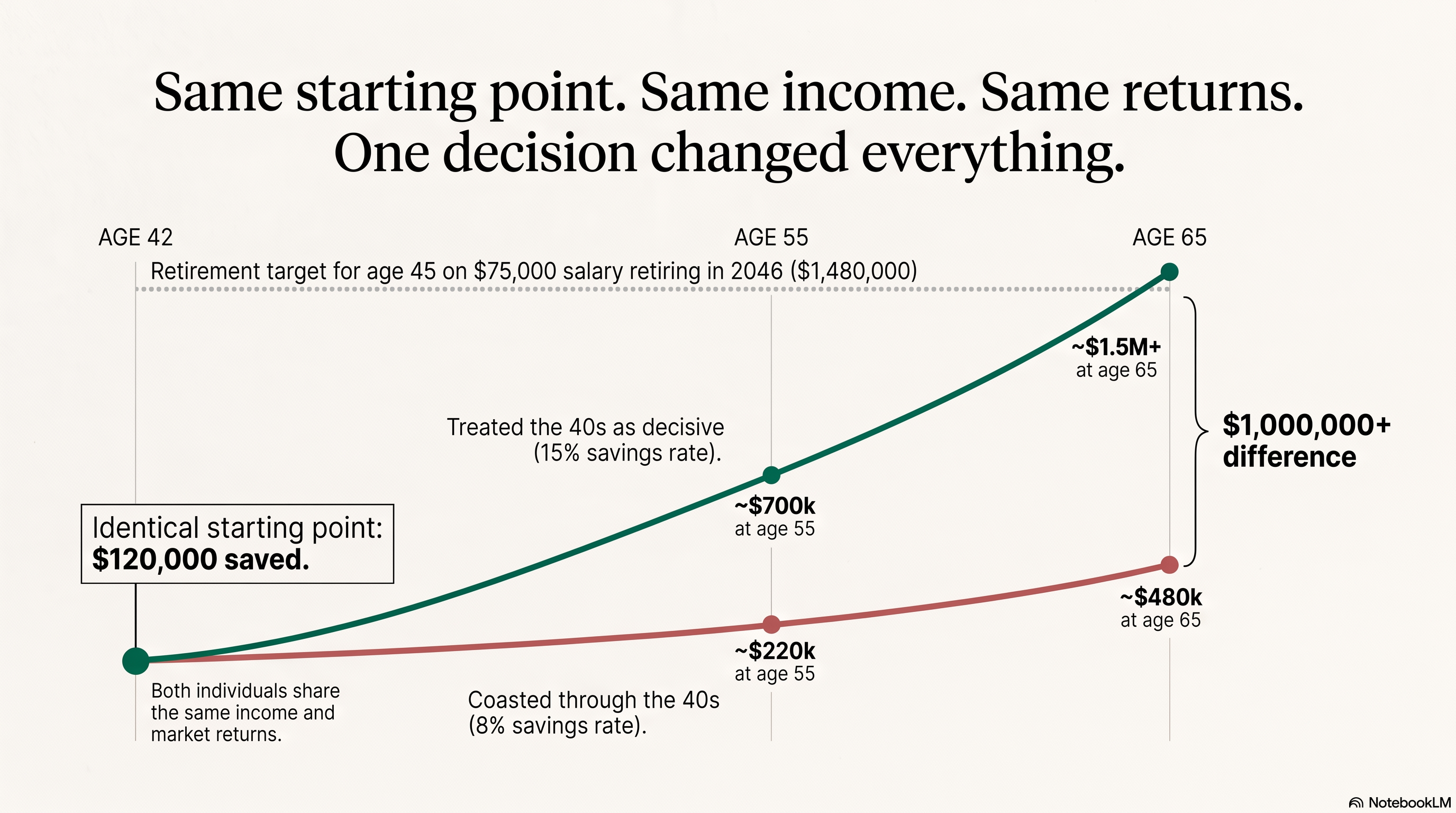
At 42, with $120,000 saved, they increase their 401(k) contribution from 8% to 15%, eliminate remaining consumer debt, open a Roth IRA for both spouses, and increase the savings rate every time income grows. They do not fully fund their children's college — they fund it partially and let their children take on manageable loans.
By 55, with 13 years of disciplined saving at peak income, their portfolio has grown to approximately $600,000-$800,000. The mortgage is nearly paid. The children have launched. More importantly, they are now on a trajectory toward the $1.5 million destination — not just the checkpoint.
The person who treats the 40s as another decade of intention without action:
Same starting point. Same income growth. But college savings competed with retirement savings. The lifestyle upgrade absorbed the raise. The contribution rate stayed at 8%. The Roth IRA remained on the to-do list.
By 55, the portfolio has grown — but only to $180,000-$250,000. The mortgage still has 12 years left. The retirement timeline either extends significantly or the retirement lifestyle compresses dramatically. And the destination — $1.5 million — now requires either a dramatic change of course or a fundamental revision of what retirement actually means.
Same decade. Same opportunities. Two outcomes determined entirely by whether this window was treated as decisive.
The Five Most Common Mistakes People Make in Their 40s
Mistake 1: Keeping the contribution rate flat as income rises. The most expensive mistake — not dramatic, just the slow accumulation of unrealized potential. Automate the rate increase. Every raise, every promotion, a portion goes to the contribution rate before it hits the checking account.
Mistake 2: Over-funding college at the expense of retirement. The emotional pull is real. But sacrificing retirement contributions in your highest-earning decade to fully fund college is a permanent trade with permanent consequences. Your children have options you do not.
Mistake 3: Treating the emergency fund as optional. Many 40-somethings have meaningful investment accounts but inadequate cash reserves. They reason they could liquidate an investment if necessary. That reasoning produces exactly the wrong financial behavior in an actual emergency — selling investments at potentially unfavorable times, incurring taxes on gains, and disrupting the compounding progress that took years to build.
Mistake 4: Ignoring the estate and insurance architecture. Life events accumulate in the 40s. The beneficiary designation that still lists an ex-spouse. The life insurance amount appropriate at 32 and insufficient at 44. The power of attorney that named a sibling who now lives across the country. These gaps cost families significant money and create legal complexity at the moments when both are least welcome.
Mistake 5: Confusing the checkpoint with the destination. Seeing the $450,000 benchmark at 50 and thinking "I need $450,000 to retire" is one of the most common and expensive misunderstandings in retirement planning. The benchmark is a waypoint. The destination for most 50-year-olds today is $1.25 million to $1.67 million or more — depending on income, spending, and Social Security history. Know the difference.
What Arthavita Shows People in Their 40s
For users in the Wealth Accumulation life stage, the Arthavita dashboard renders a completely different set of priorities than it shows for Pre-Retirement or Young Adult users.
The three AI-prioritized action items for a 40-something typically focus on optimizing the savings rate relative to current income, resolving the retirement versus college funding trade-off with actual numbers, and reviewing insurance coverage gaps. The Tax Efficiency Score surfaces opportunities specific to this life stage — asset location optimization, Roth IRA strategy based on current income, and tax-loss harvesting in the taxable portfolio.
The Wealth Foundation Score — a composite 0-100 metric tracking net worth, cash flow, debt ratios, insurance coverage, savings rate, and estate documentation — shows exactly where the gaps are. For most 40-somethings seeing it for the first time, the score reveals a financial life that is stronger in some dimensions and significantly weaker in others.
And the 25,000-scenario Monte Carlo simulation runs against your actual numbers — your specific balances, your specific income, your planned retirement age, your Social Security estimate — and answers the question the benchmarks cannot: given everything about your specific situation, what is the probability your money lasts, and what actions move that probability in the right direction?
That is the difference between knowing your checkpoint and knowing your destination.
The Decade You Cannot Afford to Coast Through
There is a recurring pattern in financial planning conversations with people in their 50s. The regret is almost never about investment choices. It is almost never about market timing. It is about the years in their 40s when they earned well, meant to get serious, and let the decade slip by on intention rather than action.
The 40s are the decade where financial outcomes crystallize. Not immediately — the consequences show up 15-20 years later when the destination becomes visible and the distance between where you are and where you need to be can no longer be ignored.
The checkpoint gap is real. The destination gap is larger. And both are still closeable for most people in their early-to-mid 40s — not easily, not without deliberate structural changes, but closeable.
The compounding window is still open. The income is there. The question is whether this decade becomes the one where everything clicked — or the one that set the trajectory for a retirement that required compromising on everything you planned to build.
Frequently Asked Questions
I am 45 with $100,000 saved. Is it too late?
No — but the urgency is real and the target is larger than most people realize. Based on the table above, a 45-year-old on a $75,000 salary needs approximately $1.48 million by 65. With $100,000 already saved growing at 7% for 20 years, that becomes approximately $387,000. You need to build the remaining $1.09 million through contributions over 20 years — which requires contributing approximately $27,000 per year. That means maximizing a 401(k) and Roth IRA combined. It is achievable at a $90,000+ income with disciplined savings. The window is still open.
Should I prioritize paying off the mortgage or investing?
For most 40-somethings, investing in tax-advantaged accounts takes priority over accelerated mortgage paydown — because the tax benefits, employer match, and expected long-term investment returns typically exceed the mortgage interest rate. The exception is someone approaching retirement who wants to eliminate the payment from their retirement income needs, or someone with a variable rate mortgage in a rising rate environment.
How much life insurance do I need in my 40s?
A common starting point is 10-12 times annual income in term life insurance. If you earn $100,000, a $1 million to $1.2 million policy provides meaningful income replacement for your dependents. The relevant variables are years until your youngest child is financially independent, outstanding mortgage balance, and whether your spouse could sustain the household on their income alone.
How do I balance supporting aging parents with my own retirement savings?
This is the defining financial tension of the sandwich generation. The principle that guides the decision: you can receive care you cannot pay for, but your parents cannot receive the same accommodation in most cases. If your retirement savings are insufficient, you become the financial burden your children will need to manage — the outcome most parents most want to avoid. Prioritize your retirement contributions. Contribute to your parents' care in ways that do not compromise your own security. Have the honest conversation with siblings about shared responsibility before one person absorbs the full burden alone.
The retirement target table shows I need $1.5 million or more. How do I even know if I'm on track?
The table is illustrative — it uses standard assumptions that may not match your situation. Your actual target depends on your spending plans, your Social Security earnings record, your state's tax treatment, healthcare needs, and whether you have other income sources. The Arthavita Monte Carlo simulation runs all of these variables against your specific numbers and tells you not just the target, but the probability you reach it and what adjustments move that probability. A static table gives you the question. The simulation gives you your answer.
What is the single most important action I can take this year?
Increase your retirement contribution rate. Not to the maximum — to a rate that is meaningfully higher than today. If you contribute 6%, move to 9%. If you contribute 9%, move to 12%. Do it before the next paycheck so the increase happens automatically. Then commit to increasing again with every raise. The destination is a large number. The path there is built one contribution rate increase at a time.
Have a question this article didn't answer?
Every financial situation is different. If something here raised a question specific to your numbers — your savings balance, your retirement target, your specific trade-offs — we'd like to hear it. Send us a note at support@arthavita.co and we'll do our best to address it directly or in a future post.
Arthavita is an educational and planning platform. This article is for informational purposes only and does not constitute personalized financial, tax, or legal advice. All figures in the retirement target table are illustrative and based on standard assumptions that may not reflect your individual circumstances. All financial decisions remain with you. For personalized guidance, consult a qualified financial or tax professional.
Ketan Patel
Founder, Arthavita
Ketan Patel is the founder of Arthavita and a multi-industry entrepreneur with 30+ years of experience in technology and business operations. He built Arthavita to bring institutional-quality financial intelligence to individual investors.
LinkedIn ↗This article is for educational purposes only and does not constitute financial, tax, or legal advice. Arthavita is a recommendation-only platform. Always consult a qualified professional before making financial decisions.