
Why the Best RIAs Are Adding AI to Every Client Household — Not Just the Wealthy Ones
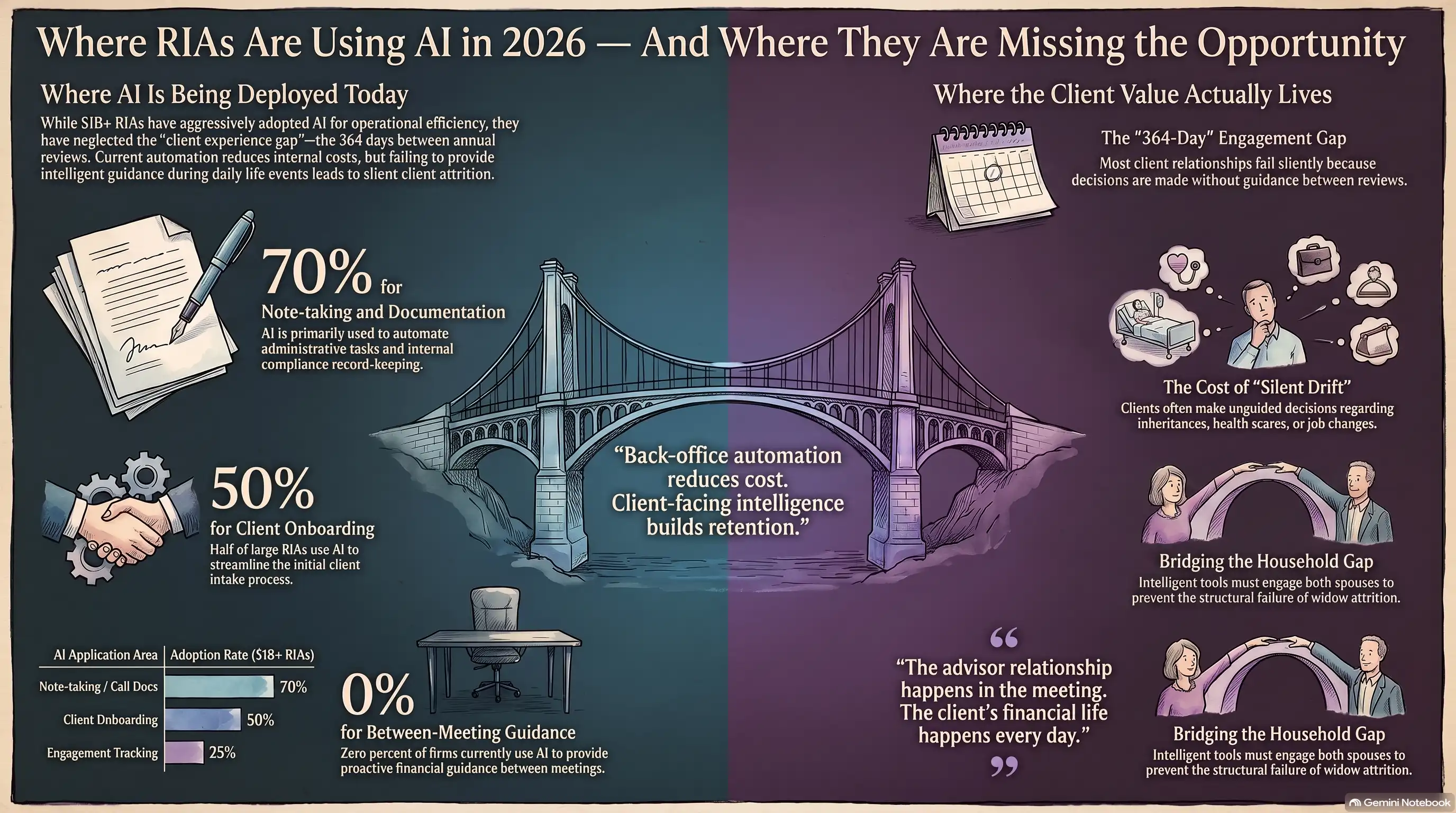
About 70% of $1 billion-plus RIAs now use AI for note-taking and call documentation. 50% use it for client onboarding. But almost none are using AI to solve the problem that matters most to client retention: the gap between the annual review meeting and the 364 days when clients make financial decisions alone, without guidance, under stress. The firms that will compound their competitive advantage over the next five years are the ones solving that engagement gap — not just automating their back office.
There is a question that follows every client meeting.
Not the question the advisor asked during the meeting. The question the client asks themselves six weeks later, when something has changed in their life and they cannot remember what the advisor told them to do, or whether it still applies, or whether they should call and ask, or whether the question is too small to bother anyone about.
That question — and the financial behavior it produces in the absence of guidance — is where most client relationships fail silently. Not in the annual review. Between them.
The RIA industry has spent the last decade automating the wrong parts of the advisory relationship. Note-taking, compliance documentation, portfolio rebalancing, reporting — these are operational efficiencies that reduce cost and free advisor time. They are valuable. They are not the same as improving what the client actually experiences in the 364 days between annual reviews.
According to Cerulli's 2026 research, about 70% of $1 billion-plus RIAs use AI for note-taking or call documentation, 50% for client onboarding, and 25% to track client engagement. The automation is real. But the client experience gap — the period between meetings when clients make decisions that should have advisor input but do not — remains largely unaddressed.
The firms building a durable competitive advantage in 2026 are not the ones with the best back-office automation. They are the ones solving the engagement gap with the same intelligence, consistency, and personalization that a world-class advisor would provide — at a scale no advisor headcount can match.
The Problem No Technology Has Solved
An RIA with 150 client households has 150 individual financial situations, 150 different risk profiles, 150 different life stages, and 150 sets of goals that change constantly based on events the advisor learns about at the next meeting — if the client remembers to mention them.
The 53-year-old client who inherited money from a parent in February and put it in a checking account because she did not know what to do with it — and mentioned it at the October review. Eight months of cash drag and a missed Roth conversion opportunity.
The 61-year-old client who had a health scare in April, started researching long-term care insurance online, found confusing information, and made no decision — and did not think to call because he was not sure whether it was "advisor territory." He mentioned it in November.
The 47-year-old client who changed employers in June, left a 401(k) at the old employer, and joined the new 401(k) with the default contribution rate and the default fund selection because the enrollment deadline was coming and he did not want to bother the advisor until the next meeting.
These are not unusual situations. They are the ordinary reality of a client's financial life. And they represent the gap between what advisors intend to provide — ongoing, responsive, intelligent financial guidance — and what most clients actually experience, which is periodic reviews separated by months of operating without guidance.
No amount of back-office automation closes this gap. It requires something different: a persistent, intelligent presence in the client's financial life that can surface the right question at the right moment, provide context-aware guidance between meetings, and alert the advisor when something in the client's picture warrants a conversation.
The Widow Attrition Problem — and Why It Is Structural
The financial advisory industry has a specific, well-documented retention failure: when a married client dies, the surviving spouse — most often a wife — leaves the firm within 12 to 18 months in the majority of cases.
The reasons are real and human. The surviving spouse often was not the primary relationship with the advisor. The financial picture that the advisor knew was primarily the deceased spouse's picture. The surviving spouse does not feel known, does not feel served, and finds a new advisor who treats them as the primary client rather than the secondary one.
This attrition pattern costs the average RIA millions in AUM over a career. And it is entirely preventable — not by adding staff, but by including the spouse in the financial planning relationship from day one in a way that makes them feel equally seen and served.
An intelligent planning tool deployed to both spouses — showing the complete household financial picture, surfacing the priorities relevant to each person, and providing guidance that acknowledges both as full participants in the financial plan — changes the relationship structure before the crisis arrives.
When the primary earner passes away and the surviving spouse has been engaged with the same financial intelligence that the primary was engaged with, the advisor is not starting from scratch. The relationship exists. The knowledge exists. The trust exists.
This is not a technology argument. It is a relationship argument that technology enables. The advisor who deploys household financial intelligence to both partners is the advisor whose clients stay.
What "Client-Facing AI" Actually Means in 2026
The phrase "AI for advisors" has been used to describe so many different things — AI note-takers, AI compliance tools, AI portfolio managers — that it has lost precision. What matters is the specific question: what does the client experience, and is that experience better because of the technology?
Arthavita's approach is specific. It is not a back-office tool. It is a client-facing financial intelligence platform that the advisor deploys to client households — particularly the households where the complete financial picture is complex enough that a periodic review is genuinely insufficient.
What the client household gets:
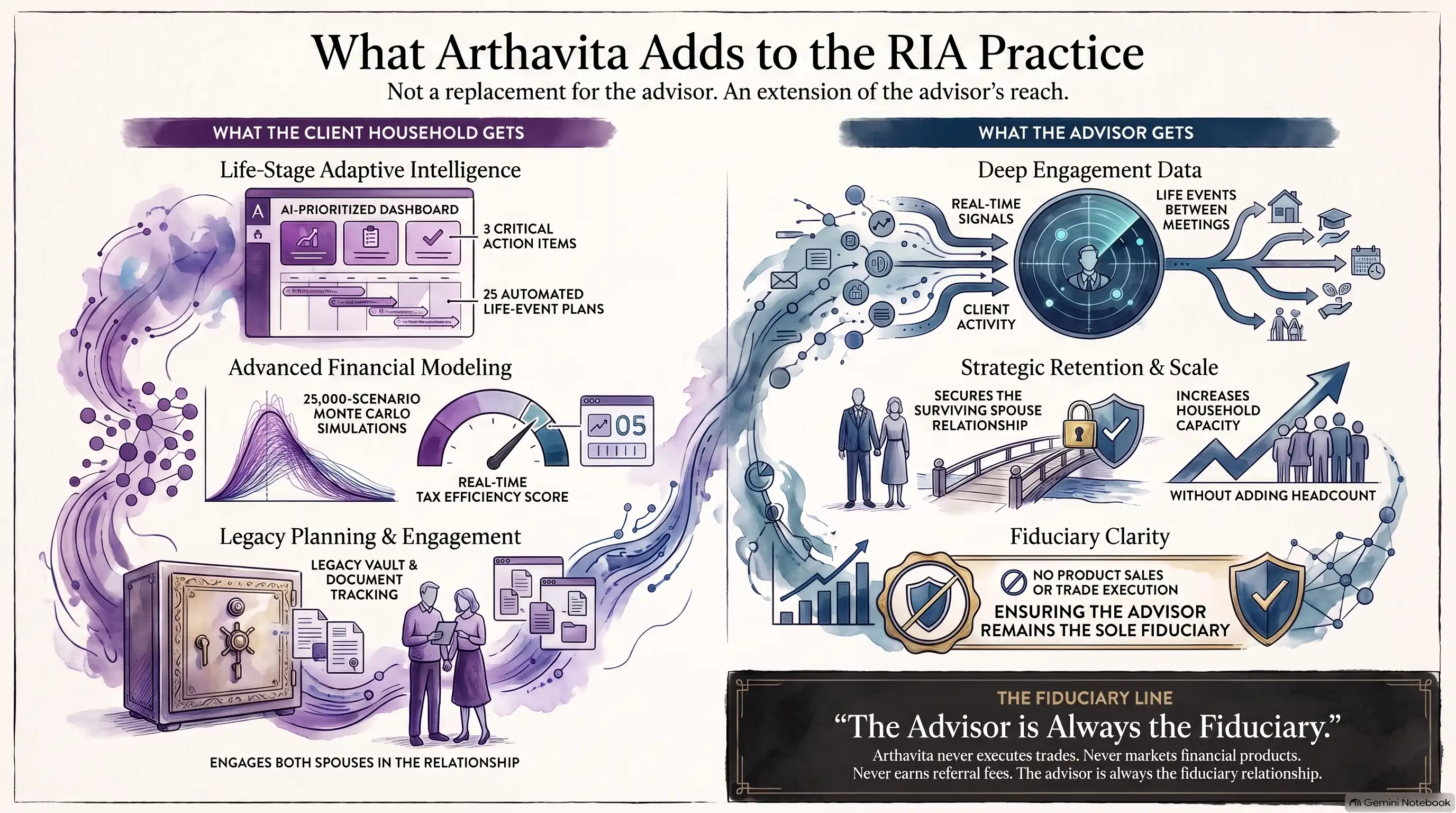
A life-stage-adaptive dashboard that surfaces the three most important financial priorities at this specific moment in their financial life — not a generic checklist, but AI-prioritized action items based on their actual balances, their actual goals, their actual life events, and their actual proximity to retirement.
A 25,000-scenario Monte Carlo simulation run against their actual numbers — every account, every income source, their planned retirement date. Not a static projection, but a probability distribution that shows the range of possible outcomes and what actions move the probability in the right direction.
A Tax Efficiency Score with specific, actionable optimization recommendations — asset location, Roth conversion opportunity, tax-loss harvesting alerts, IRMAA threshold management — surfaced in real time rather than at the annual tax planning meeting.
Legacy planning infrastructure — estate document tracking, beneficiary designation review, Legacy Vault for the organized financial picture, Journey Partners for executor access. The complete legacy picture documented and accessible, not filed away in a binder no one knows how to find.
Life event action plans — 25 specific, prioritized action plans triggered by life events that the client can navigate themselves between advisor meetings, or that surface for the advisor as client-initiated moments that warrant outreach.
What the advisor gets:
Client engagement between meetings — real data on which clients are actively engaging with their financial plan, which are drifting, and which have experienced a life event that warrants advisor contact.
Prepared clients at every meeting — clients who have reviewed their dashboard, updated their information, and arrived with specific questions rather than starting the meeting from a blank page.
The household relationship — both spouses engaged with the same financial picture, both feeling served, both building a relationship with the advisor through the platform that reflects the advisor's guidance.
Fiduciary clarity — Arthavita is recommendation-only. It never executes trades, never connects to brokerage accounts for execution, never markets financial products, and never earns referral fees. The advisor remains the trusted fiduciary relationship. The platform extends the advisor's reach between meetings without creating any conflict of interest.
The Scalability Argument — Serving More Households Without More Headcount
The RIA industry's fundamental challenge is not finding clients. It is serving them profitably at scale.
An advisor who can meaningfully serve 80-100 households at a high-touch level faces a ceiling. Adding households beyond that ceiling either dilutes the service quality or requires adding staff — which adds cost and complexity and does not always produce proportional revenue.
The firms that are compounding their advantage in 2026 are the ones that have extended meaningful service capacity — the ability to provide ongoing, intelligent, personalized financial guidance — without proportionally increasing headcount.
A client household with access to Arthavita's Wealth Journey Dashboard, Monte Carlo simulation, Tax Efficiency Score, and Legacy Vault is a household that has meaningful, personalized financial intelligence available 365 days a year. The advisor's expertise and judgment are embedded in the platform and available whenever the client needs it — not just during the 90 minutes per year of meeting time.
The advisor who deploys this across 120 households is providing a higher-quality ongoing experience than the advisor who is manually trying to reach 120 households through email newsletters and quarterly check-in calls. And they are doing it without hiring two additional staff members.
This is the scalability argument for AI in the advisory practice — not replacing the advisor, but extending the advisor's effective reach.
The Arthavita B2B Model — What It Looks Like in Practice
Arthavita's B2B deployment model for RIAs is straightforward. The firm becomes a tenant on the Arthavita platform — with the firm's branding optionally applied — and deploys the platform to client households at a per-household monthly fee.
The advisor relationship stays intact. The advisor is still the trusted fiduciary. The platform provides the between-meeting financial intelligence that makes the advisor relationship more valuable, more sticky, and more present in the client's daily financial life.
The deployment starts with the households where it adds the most value: Pre-Retirement clients (50-65) who are in the decade when the major positioning decisions need to be made and who will engage most actively with a platform that helps them model Social Security timing, Roth conversions, and long-term care options. Family Focus clients who are managing competing financial priorities and who benefit from the household multi-member view.
The platform's B2B tenant layer — complete as of July 2026 — provides the firm-level administrative infrastructure: organization-level user management, advisor-client relationship linking, RLS policies that ensure data isolation between households, and the JWT-level organizational context that routes every platform interaction correctly.
Arthavita never competes with the advisor. There are no financial products to sell, no brokerage connectivity for execution, no referral fees. The advisor is the relationship. The platform is the capability that makes the relationship more valuable.
Three Questions Every RIA Should Be Asking
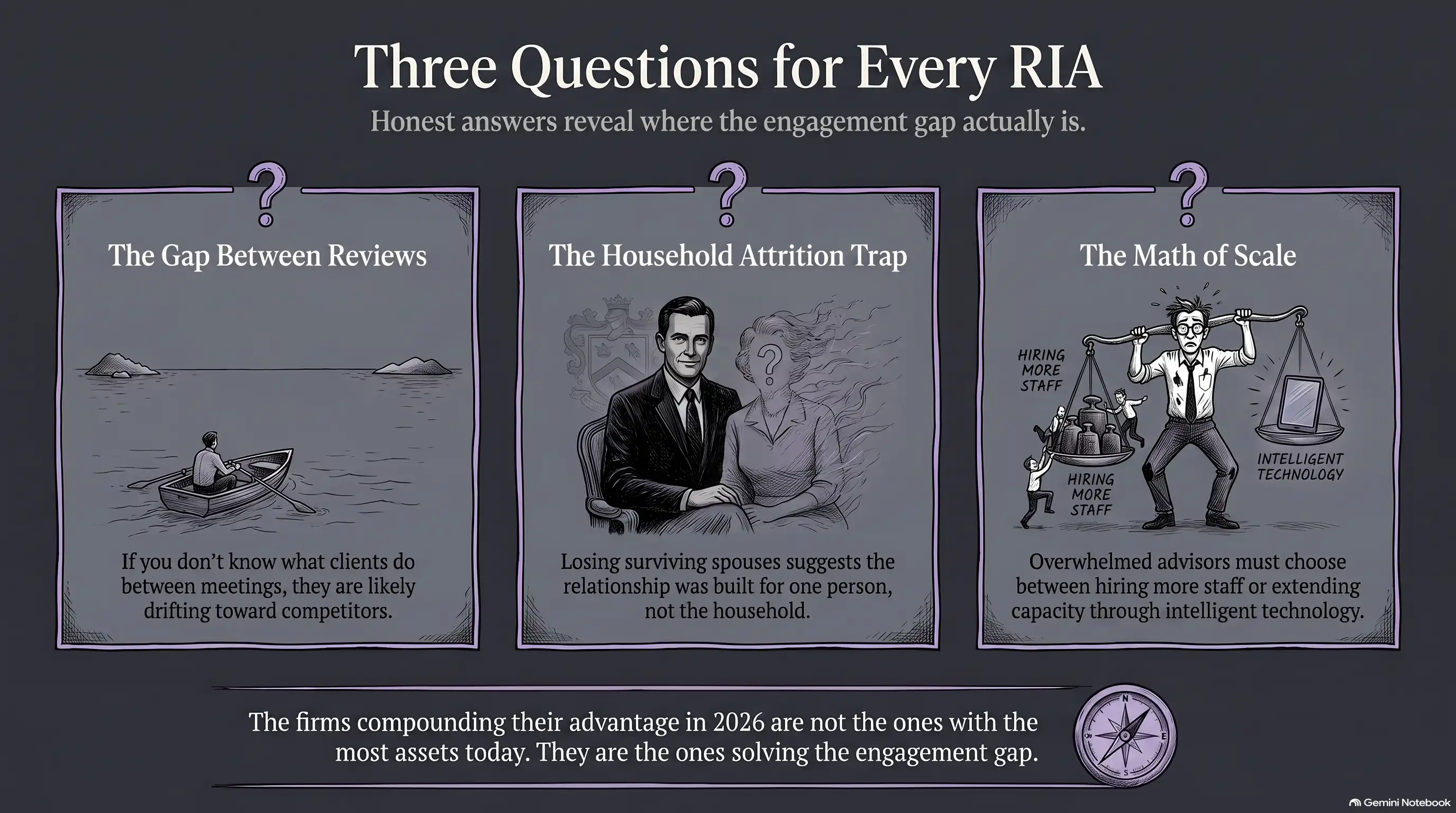
Question 1: What do your clients do between annual reviews?
If the honest answer is "we don't know," that is the gap. The clients who are making financial decisions without guidance, who are experiencing life events without advisor contact, and who are slowly drifting toward the competitor who calls more frequently — those clients are in that gap.
Question 2: What happens when the primary earner in your client households dies?
If the answer involves any version of "the surviving spouse usually leaves eventually," the relationship was built for one person and not for the household. That is a structural vulnerability that costs real AUM and real relationships.
Question 3: How many clients can one advisor meaningfully serve at high touch?
If the number is 80 and you have 150 households, the math on service quality does not work. The question is whether you solve it by hiring or by extending capacity through technology that can deliver personalized, intelligent financial guidance to every household, every day, without the advisor being in the room.
The Fiduciary Line — Where Arthavita Ends and the Advisor Begins
This point deserves explicit clarity because RIAs operate in a fiduciary context where the line between guidance and advice matters legally and professionally.
Arthavita is a recommendation-only educational and planning platform. It provides financial intelligence — projections, scenario modeling, tax optimization frameworks, legacy planning infrastructure — but it does not provide personalized investment advice, does not execute trades, does not connect to brokerage accounts for execution, and does not act as an RIA.
The platform's recommendations are educational — they surface considerations and frameworks, not specific investment recommendations. The advisor's judgment, fiduciary responsibility, and personalized advice remain entirely with the advisor.
This is not a limitation. It is a feature. The advisor who deploys Arthavita to client households is extending their clients' access to powerful financial planning intelligence without creating any question about who the trusted fiduciary is. It is always the advisor. Arthavita is the tool that makes the advisor's clients more financially engaged, more financially literate, and more financially prepared — which makes every advisor meeting more productive and every advisor relationship more valuable.
What the Next Five Years Look Like
The RIA firms that will compound their advantage over the next five years are not necessarily the ones with the most assets under management today. They are the ones that solve the engagement gap — the 364 days between meetings — in a way that makes their clients feel continuously served, continuously guided, and continuously connected to a financial plan that reflects their actual life.
According to InvestmentNews, success in 2026 is defined by clarity, consistency, and a seamlessly connected client experience. The firms building that experience — not just for the $5 million households but for every household on the book — are the ones that will retain clients through life transitions, capture the household relationship rather than the primary-earner relationship, and serve more households without proportionally increasing cost.
The technology to do this exists in 2026 in a way it did not in 2021. The question for every RIA is not whether to use it. It is whether to move first or move after the competitor across town already has.
Frequently Asked Questions
Does Arthavita replace financial planning software like RightCapital or eMoney?
No — and it is not designed to. RightCapital, eMoney, and similar tools are advisor-facing planning platforms that advisors use to build plans for clients. Arthavita is a client-facing platform that the client uses themselves, between advisor meetings, to stay engaged with their financial picture. The two categories serve different purposes. Many advisors use both: a planning tool for building the plan in meetings, and a client-facing platform for keeping clients engaged between meetings.
What about compliance and regulatory considerations?
Arthavita is a recommendation-only educational platform — not an investment advisor and not a broker-dealer. The content it provides is financial intelligence and planning guidance, not personalized investment advice. Advisors deploying Arthavita to clients should review its educational content in the context of their own compliance program and disclose the tool in their ADV as appropriate. Arthavita's fiduciary positioning — no AUM fees, no product sales, no execution capability — eliminates the most common compliance concerns around advisor tool deployment.
How does the B2B deployment work technically?
Arthavita's multi-tenant architecture supports RIA deployment through an organization-level tenant structure. Client households are linked to the advisor relationship through the platform's organizational context. The advisor has firm-level administrative access to manage household deployments, monitor engagement, and receive alerts on life events and planning milestones. Client data is isolated at the organization level through row-level security policies that ensure no cross-household data exposure.
What is the pricing model?
Arthavita's B2B model for RIAs is a per-household monthly fee — a PEPM (per enrolled member per month) structure that scales with the number of households deployed. Pricing reflects the household's life stage and planning complexity. Specific pricing is available through direct conversation with the Arthavita team at kgp@arthavita.co.
Can Arthavita be white-labeled with the firm's branding?
White-label capability is on the Arthavita roadmap for 2026-2027. Current B2B deployments use the Arthavita brand with the advisor firm identified within the platform as the client's advisor relationship. Firms interested in white-label deployment can contact us to discuss timeline and requirements.
Interested in deploying Arthavita for your client households?
We are working with a small number of RIA firms as inaugural B2B partners. If your firm serves households in the Pre-Retirement and Wealth Accumulation life stages and you are looking for a way to extend meaningful financial intelligence to your clients between meetings, we would like to talk. Reach out directly at kgp@arthavita.co.
Arthavita is an educational and planning platform. This article is for informational purposes only. Arthavita does not provide personalized investment advice and is not a registered investment advisor or broker-dealer. RIAs considering Arthavita as a client-facing tool should review the platform in the context of their own fiduciary obligations and compliance program.
Ketan Patel
Founder, Arthavita
Ketan Patel is the founder of Arthavita and a multi-industry entrepreneur with 30+ years of experience in technology and business operations. He built Arthavita to bring institutional-quality financial intelligence to individual investors.
LinkedIn ↗This article is for educational purposes only and does not constitute financial, tax, or legal advice. Arthavita is a recommendation-only platform. Always consult a qualified professional before making financial decisions.