
When a Marriage Ends: The Financial Reset Nobody Prepares You For
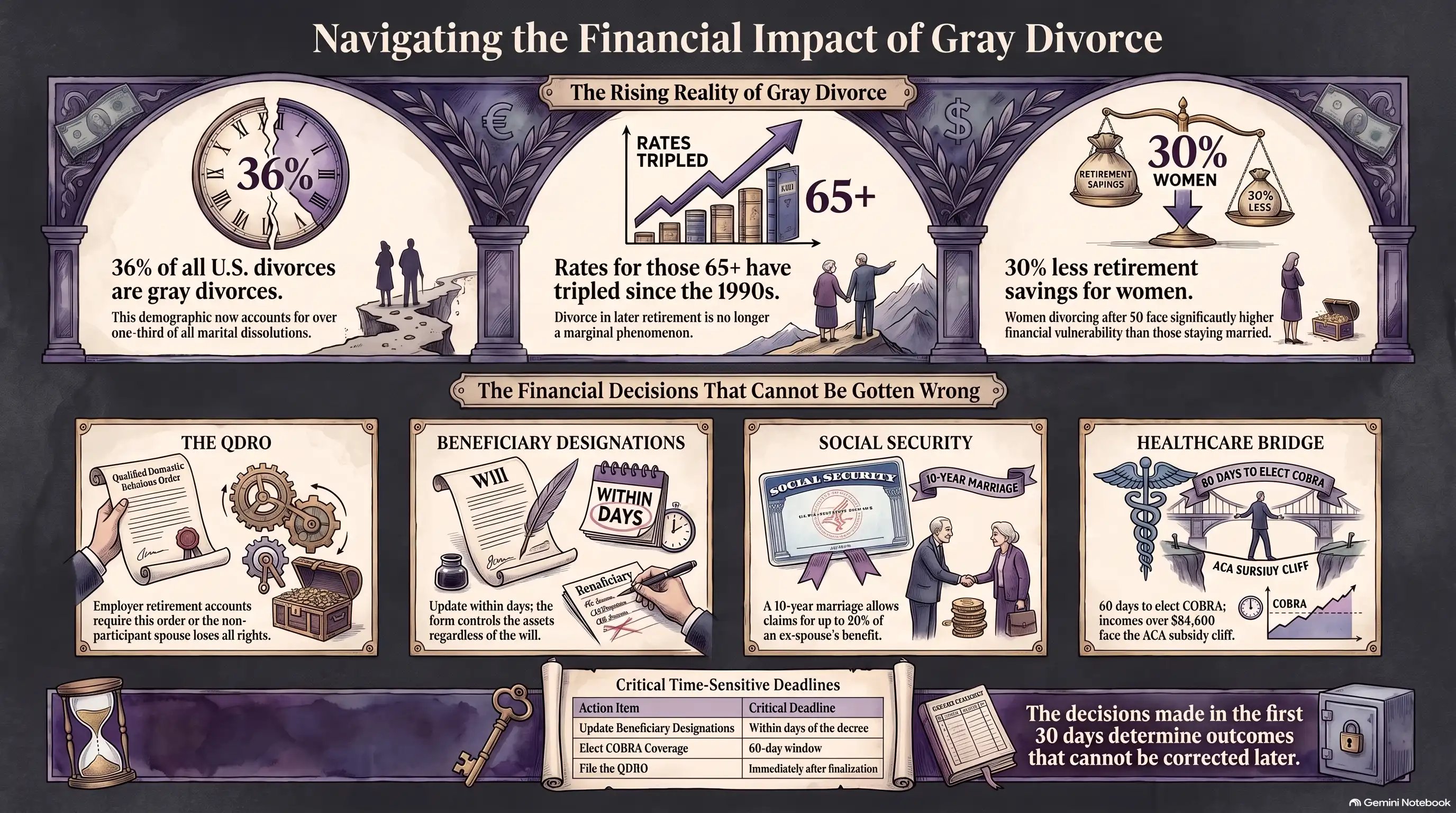
Gray divorce — divorce among adults 50 and older — now accounts for 36% of all U.S. divorces, and rates for those 65 and older have tripled since the 1990s. The financial complexity of divorce at 50, 55, or 60 is categorically different from divorce at 30. One portfolio becomes two at exactly the moment retirement planning requires both. A QDRO executed incorrectly loses retirement benefits permanently. A beneficiary designation not updated within days of a divorce decree can send assets to an ex-spouse years later. Social Security spousal benefits that divorced spouses are entitled to go unclaimed by millions who do not know they exist. This is the financial reset guide nobody gives you when a marriage ends.
Nobody plans for this conversation.
Not the financial plan built over 25 years of marriage. Not the retirement projections that assumed two incomes, two Social Security benefits, and one household. Not the beneficiary designations that made sense in a different life. Not the estate documents that named a spouse who is no longer a spouse.
When a marriage ends, the financial architecture of a life built for two has to be rebuilt for one — often under legal, emotional, and time pressure that makes clear thinking nearly impossible.
Gray divorce — divorce among adults 50 and older — now accounts for 36% of all U.S. divorces, according to Bowling Green State University data reported in 2026. Rates for those 65 and older have tripled since the 1990s. This is not a phenomenon at the margins. It is one of the defining financial planning challenges of midlife and early retirement — and almost nothing in mainstream financial content addresses what it actually requires.
This article is not a guide to the legal process of divorce. It is a guide to the financial decisions that determine whether someone rebuilds successfully or carries the financial damage of a poorly navigated divorce into the retirement years that follow.
Why Divorce at 50 Is Categorically Different From Divorce at 30
A 30-year-old who divorces has decades to rebuild. Income is still growing. The portfolio is modest. The financial disruption is real but the time horizon absorbs it.
A 55-year-old who divorces faces a different reality entirely. The retirement savings window — the decade of peak earnings during which compounding does its most critical work — is partly behind them. One portfolio becomes two at exactly the moment retirement planning requires concentration, not division. Two households replace one, at a cost that often requires reducing retirement contributions just when they should be maximized.
The financial stakes are higher. The time to recover is shorter. And the decisions made in the first 90 days of the process — before emotions have settled and before most people have consulted a financial professional — often determine outcomes that cannot be corrected later.
Three categories of financial decisions are made during divorce that have permanent consequences: retirement account division, Social Security planning, and the comprehensive financial reset that every aspect of the financial architecture requires.
The QDRO — The Document That Cannot Be Gotten Wrong
Retirement accounts held in employer-sponsored plans — 401(k), 403(b), pension, profit-sharing — cannot be divided simply by agreement between spouses or by instruction in a divorce decree. They require a separate legal document called a Qualified Domestic Relations Order.
A QDRO is a court order that instructs the plan administrator to pay a specified portion of one spouse's retirement benefits to the other spouse as an alternate payee. Without a properly drafted and approved QDRO, the plan administrator cannot legally pay any portion of the account to the non-participant spouse.
The consequences of getting the QDRO wrong — or of not getting one at all — are severe and largely permanent:
Without a QDRO, the non-participant spouse loses their right to any portion of the retirement account, regardless of what the divorce settlement agreement says. The plan controls the distribution. A divorce decree that says "50% of the 401(k) goes to the former spouse" means nothing to the plan administrator without a separately filed and approved QDRO.
A QDRO executed incorrectly — with the wrong plan name, the wrong benefit formula, the wrong payment trigger, or language that conflicts with plan rules — can be rejected by the plan administrator, sometimes after years of delay. Correcting a rejected QDRO requires reopening legal proceedings, which is expensive and sometimes impossible if the other party is uncooperative.
A QDRO that is never filed leaves the assets in the participant's account indefinitely — where they can be depleted through withdrawals, loans, or QDROs from a subsequent divorce.
One important exception: IRAs are not employer-sponsored plans and are not subject to ERISA. They do not require a QDRO. IRA division is handled through a transfer incident to divorce — a process outlined in the divorce decree or property settlement agreement that allows direct transfer without taxes or penalties. The mechanics are different, but the requirement for precision is the same.
For pension plans, the QDRO must address specific plan provisions — the form of the benefit, the survivor annuity, the payment trigger — that vary significantly from plan to plan. A generic QDRO template is often wrong for a specific pension. The attorney drafting the QDRO needs access to the plan's Summary Plan Description and often needs to communicate directly with the plan administrator before drafting.
The QDRO is the most technically demanding financial document in a divorce, and it is often the most neglected. It is rarely completed at the time of the divorce decree. Months or years pass. The participant spouse changes jobs, dies, or begins taking distributions. The window to file the QDRO narrows or closes entirely.
File the QDRO immediately after the divorce is finalized. Do not wait.
Social Security After Divorce — The Benefits Millions Do Not Know They Have
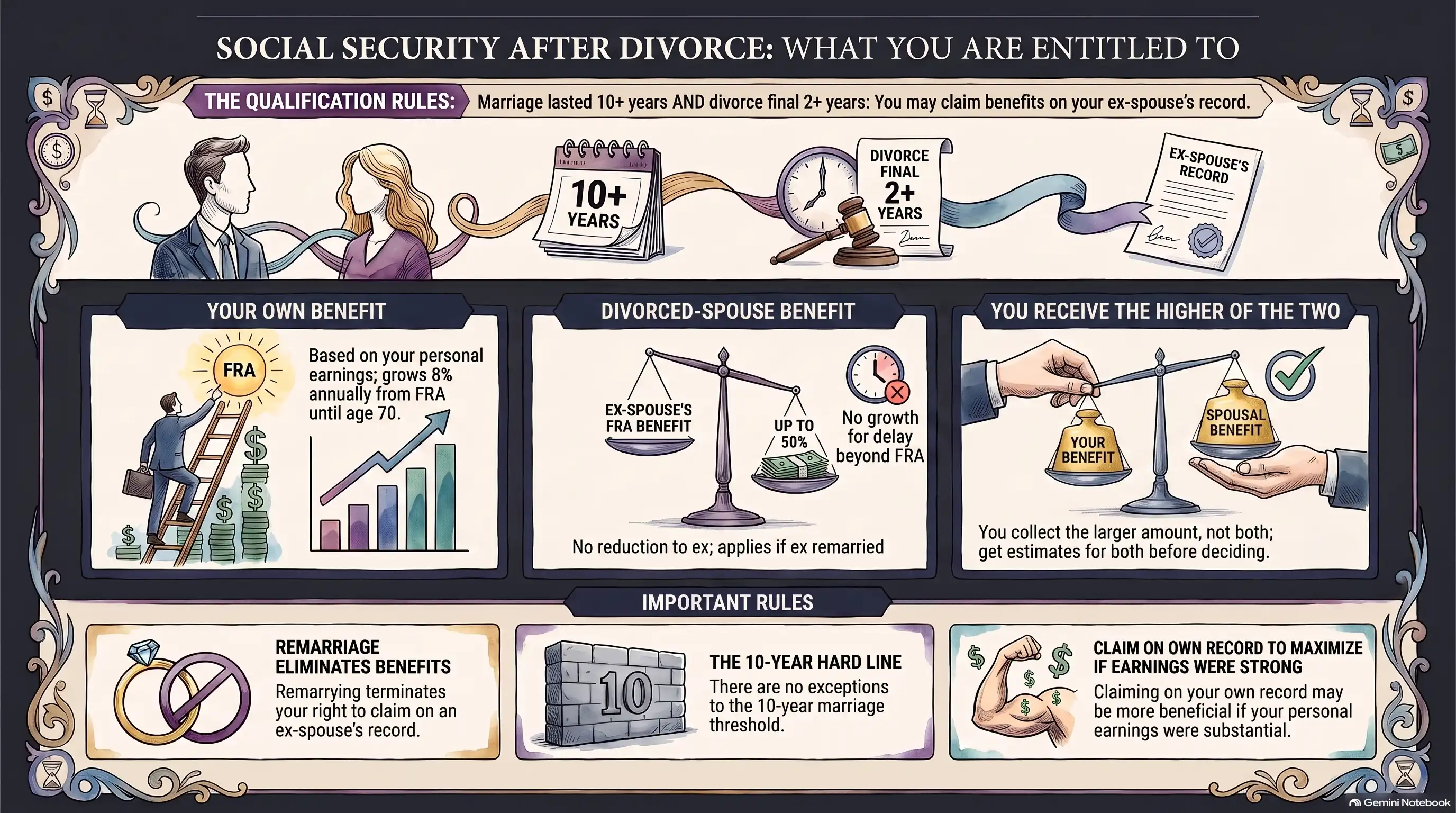
If a marriage lasted at least 10 years and the divorce has been final for at least two years, a divorced spouse is entitled to Social Security benefits based on the ex-spouse's earnings record — even if the ex-spouse has remarried, and without reducing the ex-spouse's own benefit.
The divorced-spouse benefit is up to 50% of the ex-spouse's full retirement age benefit. The divorced spouse receives the higher of their own earned benefit or the divorced-spouse benefit — not both stacked on top of each other.
The rules that matter:
The 10-year marriage requirement is a hard threshold. A marriage that ended one month before the 10-year mark does not qualify. This rule has direct implications for settlement timing decisions.
Remarriage eliminates the divorced-spouse benefit. A divorced spouse who remarries loses the right to claim on the ex-spouse's record for as long as the remarriage continues. If the remarriage subsequently ends in divorce or death, the right may be restored.
The two-year waiting period after divorce applies only to claiming before the ex-spouse has filed. Once the ex-spouse has filed for their own benefits, the two-year wait is waived.
The divorced-spouse benefit is based on the ex-spouse's full retirement age benefit, not on the actual amount they are receiving. If the ex-spouse claimed early and receives a reduced benefit, the divorced spouse's 50% calculation is still based on the unreduced full retirement age benefit.
Delaying the divorced-spouse claim past full retirement age does not increase the benefit — unlike the 8% annual increase available for delaying a person's own earned benefit. If the divorced-spouse benefit will be larger than the personal benefit, claiming it at full retirement age rather than delaying is the right decision. If the personal benefit will be larger (which is increasingly common for women with significant earnings records), delaying to 70 to maximize the personal benefit may be the better strategy.
The Social Security claiming decision for a divorced spouse is meaningfully more complex than for a married couple — because it involves comparing two benefit streams, understanding how claiming age affects each, and modeling the interaction with other retirement income sources. It deserves specific analysis, not generic guidance.
The First 30 Days — The Most Critical Financial Window
The 30 days immediately following a divorce decree are the most important financial period of the entire process. Decisions not made in this window become significantly harder or impossible to make correctly later.
Beneficiary designations — update immediately. Every retirement account, every life insurance policy, every annuity, every bank account with a payable-on-death designation must be updated within days of the divorce decree. These designations override the will. Courts will not automatically remove an ex-spouse from a beneficiary designation because of a divorce. A beneficiary form naming an ex-spouse remains legally binding until it is changed — and it can be changed only by the account holder, not by a court order or a divorce settlement.
This is not a hypothetical risk. It is one of the most common and most expensive post-divorce financial mistakes. The 401(k) accumulated over 20 years of marriage that still names the ex-spouse as beneficiary two years after the divorce decree goes to the ex-spouse. The life insurance policy that was never updated. The IRA that lists a name from a previous chapter of life.
Update every designation. Now. Before anything else.
Health insurance — resolve within 30 days. A spouse removed from the other's employer health insurance plan at divorce has 60 days to elect COBRA coverage. COBRA is expensive — the full premium plus a 2% administrative fee — but it maintains continuous coverage while a longer-term solution is arranged. Failing to elect COBRA within 60 days leaves a gap in coverage that pre-existing condition underwriting on individual plans can exploit, and in 2026, the ACA subsidy cliff means a single person crossing $84,600 in income loses all premium assistance for the year. Health insurance planning is a financial planning problem that must be resolved immediately.
Retitle accounts and property. Joint accounts, joint brokerage accounts, and any property held in both names need to be retitled to reflect the new ownership structure. A joint account that remains joint after divorce gives both parties access to withdraw funds — and provides no protection against the other party doing so.
Emergency fund assessment. The financial shock of divorce includes not just the legal costs and the asset division, but the transition to a single-income household, often with legal fees that have depleted savings. Assessing the emergency fund — and rebuilding it to three to six months of the new, single-person expense structure — is an immediate priority before any investment decisions are made.
The Tax Picture That Changes Everything
Divorce changes the filing status from married filing jointly to single or head of household — a change that affects tax brackets, standard deduction amounts, capital gains rates, IRA deductibility limits, and Roth IRA eligibility thresholds.
The shift is not always adverse. A lower-earning spouse who filed jointly at a higher marginal rate may find their own effective rate is lower filing as single. But the higher-earning spouse moving from married to single filing typically sees meaningful bracket changes.
The specific changes that require immediate attention:
Capital gains on asset division. The division of investment accounts in divorce is generally not a taxable event — transfers between spouses incident to divorce are excluded from recognition. But the cost basis of transferred assets carries over. A portfolio transferred at a current value of $200,000 with a cost basis of $80,000 has $120,000 of embedded gain — which will be taxable when the assets are eventually sold. Understanding the cost basis of every asset received in the settlement, not just the current market value, is essential for accurate financial planning.
The family home. The capital gains exclusion for home sale — $250,000 for a single filer, $500,000 for married filing jointly — changes at divorce. A recently divorced person selling the family home they received in the settlement may qualify for the $250,000 single-filer exclusion, but the calculation depends on ownership and use tests that are more complex post-divorce. Professional tax guidance is essential before selling.
Alimony. For divorces finalized after December 31, 2018, alimony is neither deductible to the payer nor taxable to the recipient — a major change from prior law. For divorces finalized before 2019, the old treatment still applies. Understanding which rules govern a specific situation matters for both income planning and tax projection.
IRA deductibility. Filing as single with a workplace retirement plan makes traditional IRA contributions non-deductible above $91,000 in 2026. A household that was below the married filing jointly phase-out threshold may find the same income pushes them above the single filer limit.
The Retirement Reset — Rebuilding for One
The retirement plan that was built for two — two incomes, two Social Security benefits, one shared household expense structure — needs to be rebuilt from scratch for one.
This is not a refinement of the existing plan. It is a fundamentally different problem that requires a new model.
The household expense structure changes dramatically. Two people sharing a home typically spend 60-70% of what two single people living separately would spend. The fixed costs — housing, utilities, insurance — do not divide in half when the household divides. The person who keeps the family home may find that maintaining it on one income is structurally unworkable, regardless of what the settlement provides in other assets.
The retirement income projection changes. Where the plan assumed two Social Security benefits, there is now one — possibly supplemented by a divorced-spouse benefit, but not doubled. Where the plan assumed two retirement accounts growing to a combined target, the account is now half its prior size with the same retirement date.
The withdrawal strategy changes. A single person in retirement has no partner's income to draw on if portfolio performance is poor. The sequence of returns risk is absorbed by one portfolio and one income stream rather than two. The emergency reserve must be larger relative to annual spending. The guardrails on withdrawal flexibility may need to be tighter.
What Women Face Specifically — The Gray Divorce Financial Vulnerability
The financial vulnerability of gray divorce falls disproportionately on women — and the gap is significant enough to deserve direct acknowledgment.
Women who divorced after 50 have, on average, 30% less saved for retirement than women who remained married, according to research from the Government Accountability Office. The primary drivers are the career interruptions that reduced Social Security earnings records, the lower average lifetime earnings that reduced retirement account accumulation, and the higher likelihood of having been the dependent spouse in a long marriage.
The Social Security divorced-spouse benefit was designed in part to address this vulnerability. A woman who spent decades as the lower-earning or non-earning spouse in a long marriage is entitled to 50% of her ex-spouse's full retirement age benefit — a benefit that acknowledges the economic partnership of the marriage even after it ends.
Healthcare is the other specific vulnerability. A woman who was covered under her husband's employer health insurance faces the COBRA transition and then the individual market, often at ages — 55 to 64 — when health conditions make individual coverage expensive and the time until Medicare eligibility is still a decade away. The healthcare bridge is a specific planning problem that must be modeled explicitly, not assumed.
Rebuilding the Wealth Foundation Score
After divorce, every dimension of Arthavita's Wealth Foundation Score needs to be rebuilt from the single-person baseline.
Net worth is now individual, not joint. The emergency fund target is based on one person's expense structure. The insurance coverage — life insurance, disability insurance, health insurance — has gaps that must be identified and filled. The estate documents all need to be updated: the will, the trust, the power of attorney, the healthcare directive, and every beneficiary designation.
The Wealth Journey Dashboard for a newly divorced user in the Family Focus or Wealth Accumulation life stage surfaces the specific action items that divorce creates — the beneficiary updates, the estate document review, the insurance gap analysis, the retirement projection rebuild. The 25,000-scenario Monte Carlo runs against the new single-person numbers, not the married household model that no longer applies.
Life Events in Arthavita includes a specific action plan for divorce — 25 prioritized steps that address the immediate financial decisions in the correct sequence, starting with the beneficiary designations and working through the complete financial reset that the new situation requires.
The Emotional and Financial Parallel
There is a reason the financial decisions of divorce get made badly. The legal process is adversarial, expensive, and emotionally exhausting. The financial decisions that require careful modeling and long-term thinking are being made by people who are simultaneously managing grief, anger, logistical complexity, and an uncertain future.
The financial industry does not serve divorced people well. Most financial advisors are optimized for married couples with household assets. Most retirement planning tools assume a spouse. Most tax planning assumes joint filing. The newly single person at 55 is navigating a financial system that was largely not built for them.
The decisions made in this period matter enormously. The QDRO that is never filed. The beneficiary designation that is never updated. The home that is kept because letting it go feels like another loss, when the financial reality is that it cannot be maintained on one income. The Social Security benefit that goes unclaimed because nobody explained that a 10-year marriage creates a right that survives the marriage itself.
Getting these decisions right does not require optimism or a positive outlook. It requires accurate information, a clear-eyed assessment of the new financial reality, and decisions made in the right sequence by someone who understands both the technical requirements and the emotional weight of the moment.
Frequently Asked Questions
What is the 10-year rule for Social Security divorced-spouse benefits?
If a marriage lasted at least 10 years and the divorce has been final for at least two years, a divorced spouse can claim Social Security benefits based on the ex-spouse's earnings record — up to 50% of the ex-spouse's full retirement age benefit. This applies even if the ex-spouse has remarried, and it does not reduce the ex-spouse's own benefit. Remarriage by the divorced spouse eliminates this right for as long as the remarriage continues.
What happens if the QDRO is never filed?
Without a QDRO filed and approved by the plan administrator, the non-participant spouse has no legal right to any portion of the employer retirement account, regardless of what the divorce settlement agreement says. The plan administrator cannot pay benefits to anyone other than the participant without a valid QDRO. If the participant spouse dies, changes jobs, or begins taking distributions before a QDRO is filed, obtaining the required benefits may become extremely difficult or impossible.
Can I take money from a QDRO without paying the early withdrawal penalty?
Yes — distributions paid directly to an alternate payee under a QDRO from a qualified plan are exempt from the 10% early withdrawal penalty, regardless of age. This exception applies only to qualified plans, not to IRAs. If the alternate payee rolls the QDRO distribution into their own IRA, subsequent withdrawals before age 59½ are subject to the penalty again.
Should I keep the family home?
The home carries strong emotional weight — and that weight often drives a decision that does not hold up financially. The relevant questions are whether the mortgage, taxes, insurance, and maintenance can be sustained on a single income; whether keeping the home requires giving up retirement assets in the settlement that would otherwise fund retirement; and whether the home will need to be sold within the next few years anyway, in which case the liquidity may be needed immediately. Model the financial reality before making the decision. Many people keep the home and later regret it. Some find it financially workable and are glad they did. The decision needs numbers, not sentiment.
How do I know if I qualify for divorced-spouse Social Security benefits?
Contact the Social Security Administration directly or create an account at ssa.gov to view your own earnings record and projected benefit. If your marriage lasted 10 or more years and your divorce has been final for at least two years, request an estimate of the divorced-spouse benefit based on your ex-spouse's record. Compare that amount to your own projected benefit at various claiming ages. The higher of the two is what you receive — you cannot receive both.
What should I do first after the divorce is finalized?
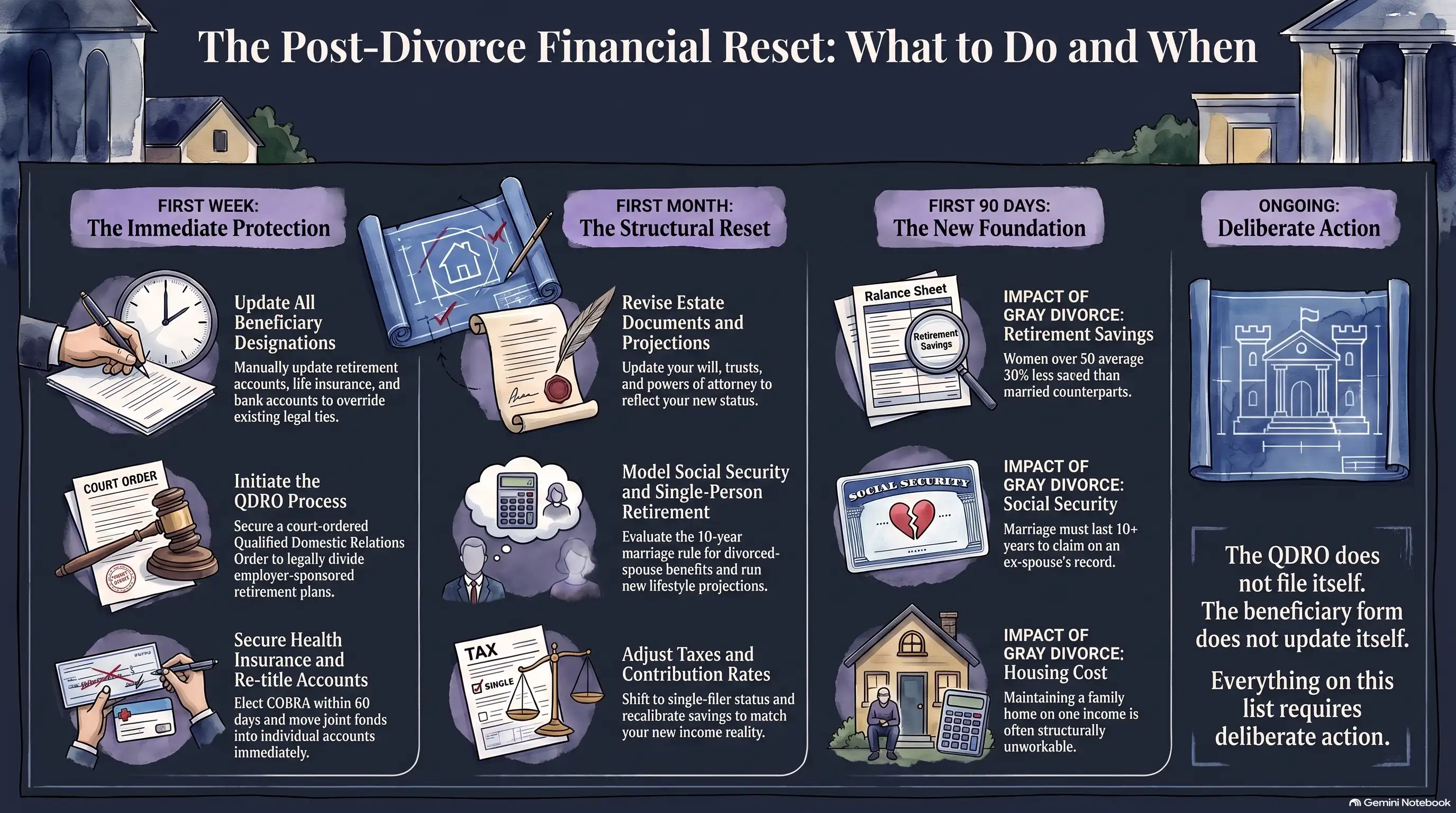
Update beneficiary designations on every account — retirement accounts, life insurance, annuities, bank accounts with payable-on-death designations — within the first week. File or begin the QDRO process immediately. Elect COBRA or arrange alternative health insurance within 60 days. Then, in the following weeks, retitle joint accounts and property, rebuild the emergency fund, update estate documents, and run a new retirement projection based on the single-person financial picture.
Have a question this article didn't answer?
Every divorce situation is different — the specific assets, the length of the marriage, the ages of both parties, and the state laws that apply all create planning questions that generic guidance cannot fully address. If something here raised a question specific to your situation, send us a note at support@arthavita.co and we will do our best to address it directly or in a future post.
Arthavita is an educational and planning platform. This article is for informational purposes only and does not constitute personalized financial, legal, or tax advice. Divorce involves legal proceedings that vary significantly by state and individual circumstance. For personalized guidance, consult a qualified divorce attorney, a Certified Divorce Financial Analyst, and a tax professional.
Ketan Patel
Founder, Arthavita
Ketan Patel is the founder of Arthavita and a multi-industry entrepreneur with 30+ years of experience in technology and business operations. He built Arthavita to bring institutional-quality financial intelligence to individual investors.
LinkedIn ↗This article is for educational purposes only and does not constitute financial, tax, or legal advice. Arthavita is a recommendation-only platform. Always consult a qualified professional before making financial decisions.