
What Happens When One Spouse Passes Away: A Financial Roadmap for What Comes Next
When a spouse passes away, nothing about Social Security transfers automatically — the survivor has to apply, and receives the higher of two benefits, never both combined. The following tax year, most surviving spouses shift from "married filing jointly" to "single," and the standard deduction gap alone is $17,350 in 2026 — before tax brackets compress further and Medicare premiums potentially rise. Retirement accounts come with a rollover-versus-inherited-IRA decision that is largely irreversible. And the account's beneficiary form, not the will, decides who inherits it. None of this needs to be solved in week one. But knowing the shape of it in advance is what turns a crisis into a plan.
There is a moment that arrives for most married couples eventually — statistically, more often for the wife than the husband — when one spouse is left to manage a financial life that was, until that point, a shared project.
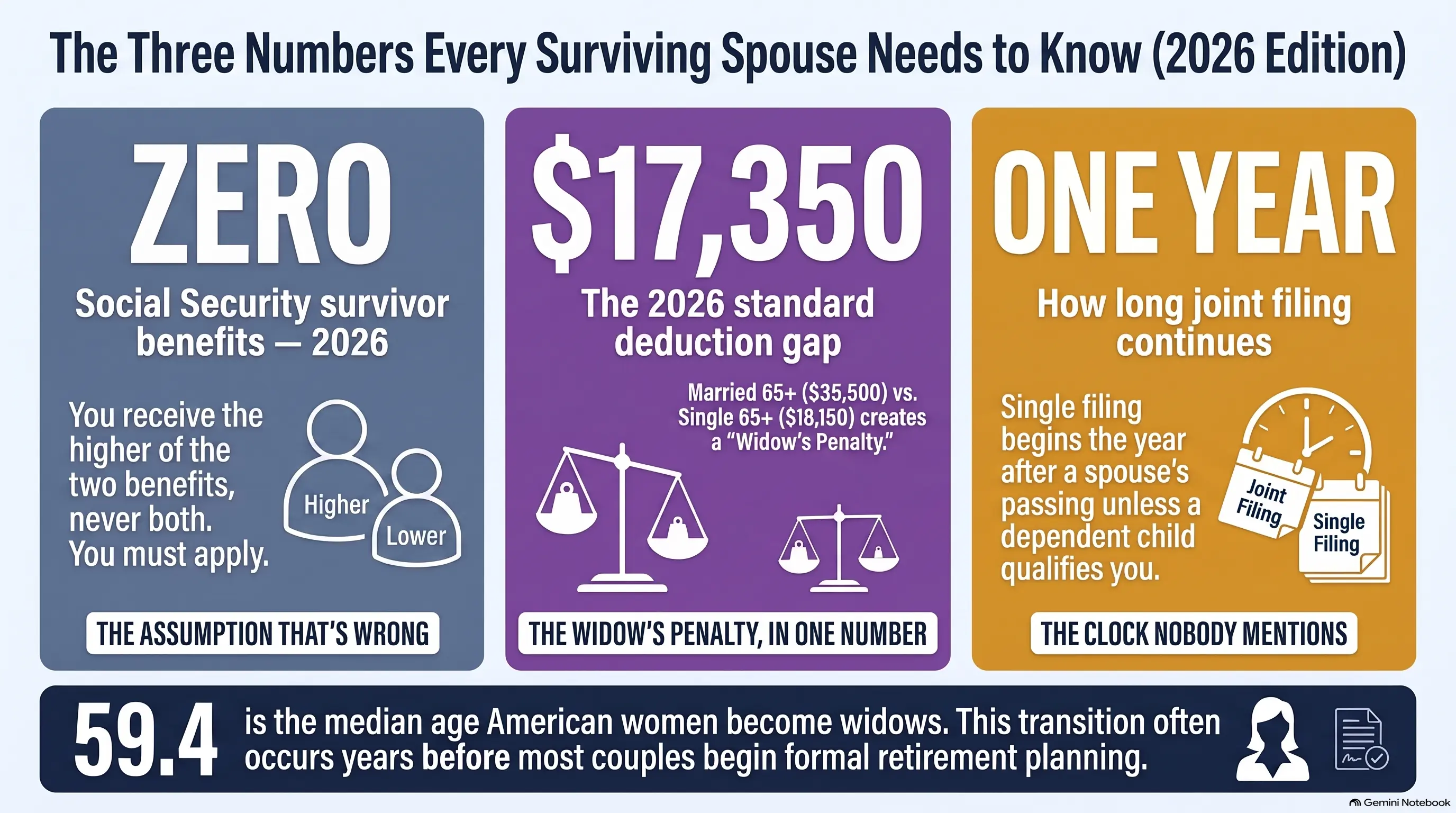
For many households, this moment comes earlier than people expect. The median age at which American women become widows is 59.4 — squarely in the pre-retirement years, not the elderly retirement most people picture.¹ Half of widows over 65 will go on to outlive their husbands by 15 years or more.² This is not a distant, unlikely event to plan around. It is a phase of life the majority of women, and a meaningful share of men, will eventually live through.
What almost nobody explains clearly, in the weeks when it matters most, is what actually happens to the money. Not the emotional weight of it — the mechanics. Social Security doesn't do what most people assume. The tax code changes in a way that can raise the tax bill in the very year household income falls. Retirement accounts come with a choice that's easy to get wrong and hard to undo. This article walks through all of it, in the specific, actionable terms that turn a frightening set of unknowns into a plan that can actually be followed.
The Three Numbers Every Surviving Spouse Needs to Know in 2026
Before any of the detail, three numbers anchor everything that follows:
Zero — the amount of a deceased spouse's Social Security benefit that automatically transfers or adds to the survivor's own benefit. It is zero. Survivor benefits are a completely separate benefit type that must be applied for, and a surviving spouse receives the higher of the two benefits — never both combined.³
$17,350 — the gap between the 2026 standard deduction for a married couple filing jointly, both 65 or older ($35,500), and a single filer 65 or older ($18,150).⁴ That gap is the first, most concrete number behind what planners call the "widow's penalty" — and it applies even when household income has already fallen.
One year — how long a surviving spouse can continue filing "married filing jointly" after a spouse passes away. It's the tax year of death only. After that, unless there's a dependent child in the home — which allows up to two additional years of "Qualifying Surviving Spouse" status — the filing status shifts to single the very next year.⁵
These three numbers are the foundation of everything a surviving spouse needs to plan around, and they are almost never explained together, in one place, before the moment they matter.
The Zero That Surprises Everyone: How Social Security Survivor Benefits Actually Work
This is the piece most couples get wrong before it's ever relevant, because the natural assumption — "I'll just get whichever benefit is bigger, automatically" — is only half right.
A surviving spouse is entitled to the higher of their own retirement benefit or a survivor benefit, not both added together. And the survivor benefit itself isn't fixed; it depends on two separate decisions, one of which was made years earlier by the spouse who passed away.
How much you receive depends on when you claim it. A surviving spouse can claim survivor benefits as early as age 60 — two years earlier than any other Social Security benefit — or as early as 50 if disabled, or at any age while caring for the deceased's child under 16.⁶ Claiming early comes at a real, permanent cost: benefits claimed at 60 are reduced to about 71.5% of what they'd be at survivor Full Retirement Age, rising steadily the longer you wait, up to 100% at survivor FRA or later.⁷
How much you receive also depends on when your spouse claimed. This is the detail that turns Social Security into a genuine joint household decision, not an individual one, years before it's needed. The survivor benefit is based on what the deceased spouse was actually receiving — not their theoretical maximum. Claim early at 62, and the survivor inherits that permanent reduction. Delay to 70 and earn delayed retirement credits, and the survivor benefit reflects that higher, maximized amount instead.⁸
Put plainly: the age at which the higher-earning spouse claims Social Security isn't only a decision about their own retirement income. It sets the floor for what the survivor lives on, potentially for a decade or two afterward. This is exactly the kind of household-level, multi-decade tradeoff Arthavita's Social Security Optimization tool and Survivor Scenario Planning feature are built to model jointly, while both spouses can still weigh in on the decision together.
One more detail worth knowing: unlike retirement or spousal benefits, "deemed filing" doesn't apply to survivor benefits. A surviving spouse can often start one type of benefit first — a reduced survivor benefit at 62, say — and switch to a larger benefit based on their own record later, once it maxes out at 70. Comparing every combination before filing is worth the time it takes.⁹
Remarriage. Remarrying at or after age 60 (or 50, if entitled to disabled widow's benefits) preserves eligibility for survivor benefits on the late spouse's record. Remarriage before that age generally ends eligibility, though it can be restored if the later marriage ends.¹⁰
The Widow's Penalty: Why the Tax Bill Can Rise When Income Falls
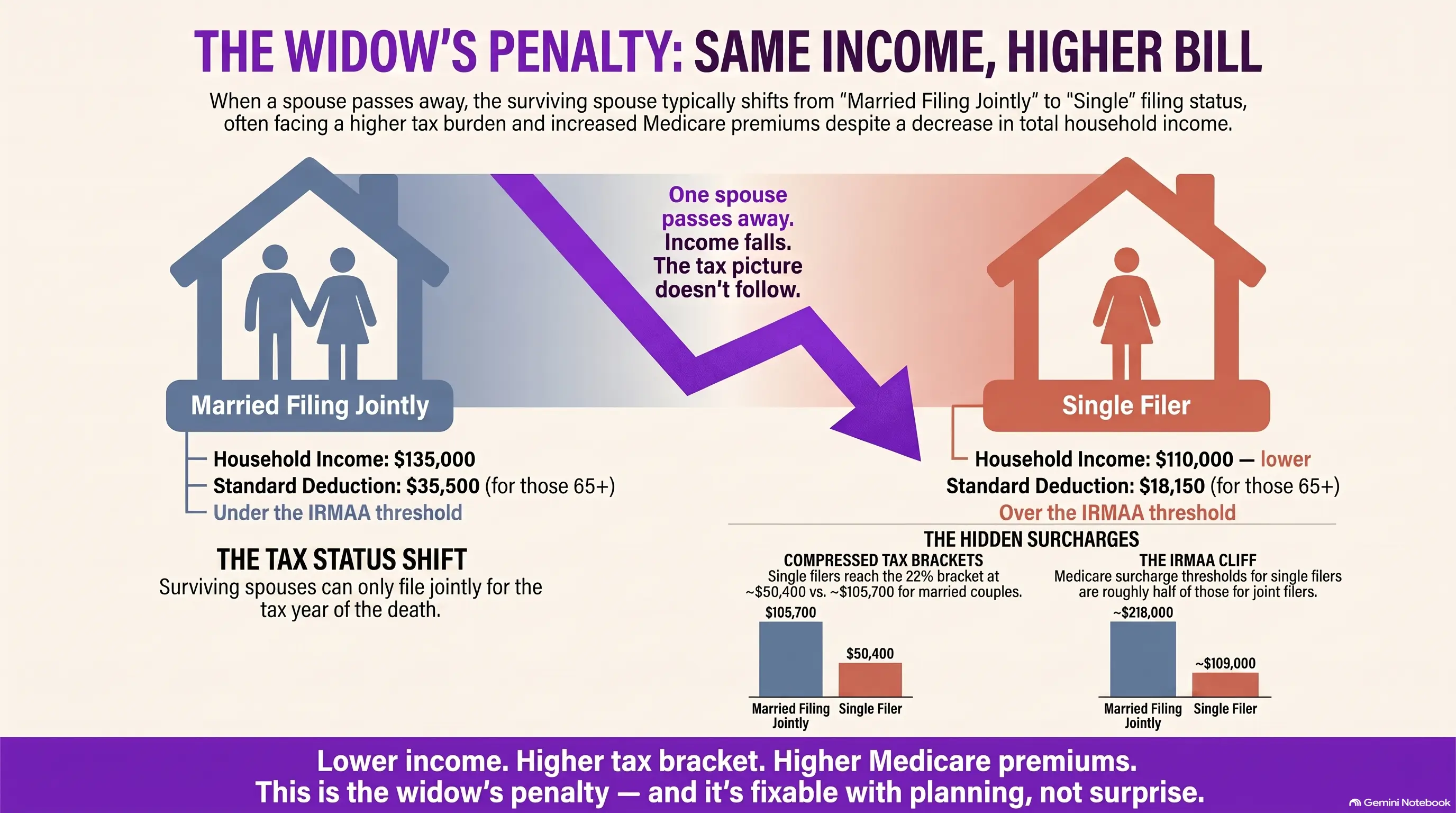
Household income typically falls after a spouse passes away — one Social Security check instead of two, sometimes a reduced pension. And yet the tax bill often goes up. Financial planners have a name for this: the widow's or widower's penalty.¹¹
The mechanism compounds in several directions at once:
The standard deduction roughly halves. That $17,350 gap between the married and single 65-plus standard deduction for 2026 is income that used to be shielded from tax and suddenly isn't.
Tax brackets compress. Single-filer brackets are narrower than joint brackets — not simply half, but structured so a given dollar of income is more likely to land in a higher bracket. One professional financial planning analysis illustrates the effect this way: in 2026, a single filer can reach the 22% bracket at roughly $50,400 of taxable income, while a married couple doesn't reach that same bracket until income tops roughly $105,700 — more than double.¹²
More Social Security becomes taxable, sooner. The income thresholds at which Social Security benefits become taxable are lower for single filers, so a larger share of the survivor's Social Security can become taxable even while the household collects only one benefit instead of two.
Medicare premiums can rise through IRMAA — even as income falls. Medicare's income-related monthly adjustment amount uses roughly half the threshold for single filers that it uses for joint filers — one planning firm cites 2026 figures around $109,000 single versus $218,000 married filing jointly.¹³ A household comfortably under the joint threshold at $135,000 of combined income can find the survivor — now filing single, even with lower total income — suddenly over the single-filer line.
There's a practical wrinkle worth flagging directly: IRMAA is calculated on a two-year lookback, so 2026 premiums are based on 2024 tax returns. A newly surviving spouse can pay elevated premiums based on the couple's old joint income even after household income has already dropped. The fix that's frequently missed: the death of a spouse is a recognized "life-changing event" under Social Security's rules, and filing Form SSA-44 lets the survivor request that IRMAA be recalculated using current, lower income instead of the outdated joint return.¹⁴
None of this needs to be solved in the first weeks. It's a reason to build the transition into the plan deliberately, often with a tax professional, in the months that follow — commonly through Roth conversions in the year of death or the year after, while wider brackets are still available, and by filing Form SSA-44 promptly if IRMAA is affected.
Your Spouse's Retirement Accounts: A Decision That Deserves Care
If a spouse named you the beneficiary of an IRA or 401(k) — standard for married couples — you have more flexibility than any other type of beneficiary, but the choice is largely a one-way door, so it's worth understanding before acting.
Spousal rollover. You move the account into an IRA in your own name and treat it as if you'd always owned it. Required withdrawals follow your own age and your own Required Beginning Date — currently 73 for those born 1951–1959 and 75 for those born 1960 or later.¹⁵ If your spouse hadn't started RMDs yet, a spousal rollover can defer all withdrawals until you reach your own required age.
Remaining a beneficiary (inherited IRA). You keep the account titled as inherited rather than rolling it into your own name. The advantage: if you're under 59½ and need access to the money, an inherited IRA lets you take distributions without the 10% early-withdrawal penalty that would normally apply. The tradeoff: required withdrawals are generally calculated using the IRS Single Life Table rather than the more favorable Uniform Lifetime Table available to account owners — which, at the same balance and age, typically produces a larger required withdrawal than a spousal rollover would.¹⁶
A newer option under SECURE 2.0, sometimes called the spousal election, can combine early access with Uniform Lifetime Table treatment for future RMDs — worth raising with a tax professional rather than defaulting into either extreme.¹⁷
One point worth remembering before any distribution is taken: a surviving spouse is exempt from the 10-year payout rule that now applies to most non-spouse IRA beneficiaries.¹⁸ There's no rush to decide in the first weeks. Arthavita's Retirement Planning module can model both paths side by side using your real account balances rather than a generic example.
What Happens to the House and the Brokerage Account
For jointly held taxable accounts — a brokerage account, or a home held in both names — the tax code offers a genuine, underappreciated benefit: the cost basis of appreciated assets can reset, in whole or in part, to fair market value as of the date of death, erasing some or all of the unrealized capital gain that had built up.¹⁹
How much of the basis steps up depends heavily on where you live. In the nine community property states — Arizona, California, Idaho, Louisiana, Nevada, New Mexico, Texas, Washington, and Wisconsin — both halves of jointly owned community property typically receive a full step-up, sometimes called the "double step-up."²⁰ In the remaining common-law states, only the deceased spouse's half of a jointly titled asset steps up; the surviving spouse's half retains its original, lower basis.²¹
This matters directly if you're planning to sell an appreciated brokerage account or a highly appreciated home in the years after a loss. It's also a reminder that not everything gets this treatment — traditional IRAs and 401(k)s never receive a step-up, since withdrawals from those accounts were never going to be taxed as capital gains in the first place.²²
Life Insurance, Pensions, and Employer Benefits
Life insurance proceeds paid to a named beneficiary are generally received income-tax-free and are usually available within weeks once the claim and death certificate are filed — one of the more straightforward parts of this process. Employer-provided group life insurance works similarly but may require confirming the coverage amount and beneficiary directly with HR, since these policies are sometimes updated less carefully than personal ones.
Pensions are more variable, and worth understanding well before the moment it matters. If a spouse selected a joint-and-survivor payout option at retirement, survivor income should continue, typically at a reduced percentage of the original payment — but the plan administrator still has to be notified to activate it. If a spouse instead chose a single-life payout to maximize the monthly amount while both spouses were alive — a common tradeoff, and often a reasonable one at the time — that pension income stops entirely at passing. That's a significant, permanent change to household cash flow, and it's far better understood in advance than discovered in the moment.
Beneficiary Designations vs. the Will
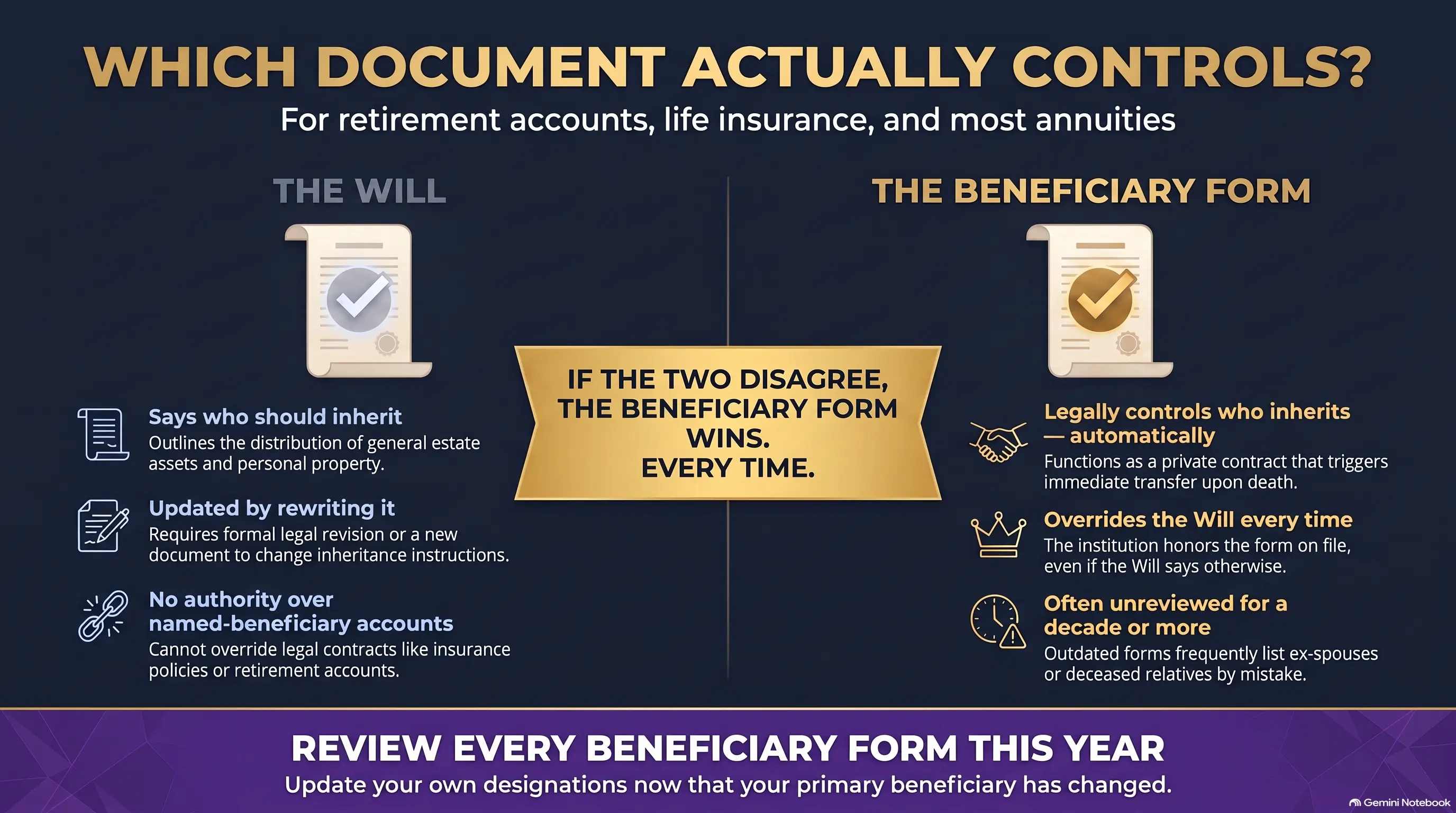
Financial and estate planning professionals consistently point to outdated beneficiary designations as the single most common and most costly mistake in estate settlement — not because one dataset proves it's the most frequent error, but because it comes up so often in practice that it's become a near-universal warning among practitioners. The reason is simple and easy to overlook: a beneficiary designation form legally controls who receives that specific account, regardless of what the will says.
Life insurance policies, IRAs, 401(k)s, and many annuities pass directly to whoever is named on the most recent beneficiary form on file with the institution — not to whoever is named in the will. A will that leaves "everything, split evenly" among children has no legal authority over an IRA that still lists an ex-spouse, or names only one child, from a form filled out fifteen years ago and never revisited.
In the months after a spouse's passing, this is worth checking twice: first, to confirm the deceased spouse's beneficiary forms were current and are being honored correctly, and second — just as important — to update your own beneficiary designations now that your spouse is no longer the natural primary beneficiary. This is exactly what Arthavita's Legacy Planning module is built to surface: a beneficiary records and review feature that flags accounts where the named beneficiary may be outdated, alongside the broader estate documents tracker for wills, trusts, and powers of attorney.
The First 30 Days: What Can't Wait, and What Genuinely Can
Certified death certificates. Order more than seems necessary — typically 10 to 15 certified copies.²³ Banks, brokerages, Social Security, life insurers, and the probate court each require their own original.
Report the death to Social Security. Many funeral homes report the death to the SSA automatically, but confirm this directly rather than assuming.²⁴ Any payment for the month of death must be returned — Social Security does not pay benefits for the month a beneficiary passes away. Separately, a one-time $255 lump-sum payment is available to a surviving spouse who was living with the deceased.²⁵
Contact the pension or employer plan. If your spouse chose a pension payout option with a survivor benefit at retirement, that election is generally locked in but still needs to be activated with the plan administrator.²⁶
Notify banks, brokerages, and insurers. For jointly titled accounts, this is usually a name change rather than a transfer.
What can wait. Estate planners are near-unanimous on one point: avoid major, irreversible financial decisions for the first six months.²⁷ Don't sell the house, don't liquidate the portfolio, don't sign anything you don't fully understand — even if someone is pressing for a quick answer. The financial system's real deadlines — RMDs, tax filing, IRA rollover elections — are almost always longer than the emotional pressure to "handle everything" suggests.
How Arthavita's Survivor Scenario Planning Helps
For couples in the Pre-Retirement or Retirement life stage, Arthavita's Retirement Planning module includes survivor scenario modeling built directly into the plan — showing, today, exactly how Social Security claiming decisions, RMD timing, and account titling would play out for whichever spouse outlives the other. The Legacy Planning module's beneficiary review and estate documents tracker exist to catch an outdated designation before it becomes a problem, not after. And the Tax Bracket Manager can model the shift into single-filer status with real numbers, well before it's needed.
There's also a quieter, less technical gap worth naming. In many households, one spouse has historically handled the bulk of investment and tax decisions. A survey by the Women's Institute for a Secure Retirement found that a majority of widows whose husbands had handled financial planning reported real difficulty filing income taxes on their own for the first time.²⁸ This isn't a matter of capability — it's a matter of unfamiliarity with systems, passwords, and accounts that were never meant to be reconstructed for the first time under grief. Arthavita's Co-Planner feature exists precisely to close that gap while both spouses are still able to build the plan together: the same live financial picture, in the same account, long before either one needs to piece it back together alone.
A Note on Timing
Nothing here needs to happen quickly. The administrative tasks have real, relatively short timelines because institutions require them. Almost everything else — the IRA rollover decision, the tax planning around the widow's penalty, rebuilding the broader plan — can and should happen over months, not days, ideally with a tax professional or estate attorney involved for anything irreversible.
Planning for this in advance — modeling the survivor scenario, agreeing on a Social Security claiming strategy together, keeping beneficiary designations current — isn't pessimism. It's the same instinct that leads any household to buy insurance for a risk they hope never to need.
Frequently Asked Questions
Does my Social Security combine with my late spouse's after they pass away? No. You receive the higher of your own benefit or the survivor benefit — never both added together.
How quickly do I need to notify Social Security? As soon as possible. Confirm the funeral home reported it, and note that any payment for the month of passing must be returned. There's no penalty for a short delay, but no reason to wait either.
Do I have to change my tax filing status right away? No. You can generally file "married filing jointly" for the tax year in which your spouse passed away. The shift to single (or Qualifying Surviving Spouse, with a dependent child) applies starting the following tax year.
Should I do a spousal IRA rollover or keep the account as an inherited IRA? It depends mainly on your age and whether you need penalty-free access before 59½. A rollover is usually more tax-efficient long-term; an inherited IRA preserves early access without penalty. Worth modeling against your specific numbers rather than defaulting to either option.
Will my Medicare premiums definitely increase? Not necessarily — but it's common enough to check. Because IRMAA looks back two years, a newly single survivor can be assessed a surcharge based on the couple's old joint income even after household income has fallen. Filing Form SSA-44 can correct this.
Does my spouse's will decide who gets the retirement accounts? No. The beneficiary designation on file with the account custodian controls, regardless of what the will says.
How long should I wait before making major financial decisions? Most planners suggest avoiding irreversible decisions — selling the house, liquidating investments, lending significant money — for at least six months.
Have a question this article didn't answer?
Losing a spouse touches Social Security rules, tax filing status, retirement account elections, and estate documents all at once — and the right answer often depends on details specific to your household. If something here raised a question about your situation, send us a note at support@arthavita.co and we will do our best to address it directly or in a future post.
Arthavita is an educational and planning platform. This article is for informational purposes only and does not constitute personalized financial, legal, or tax advice. Social Security rules, federal tax brackets, standard deductions, IRMAA thresholds, and retirement account regulations change and can vary by individual circumstances and state of residence. For personalized guidance, consult a qualified financial advisor, tax professional, or estate planning attorney.
Ketan Patel
Founder, Arthavita
Ketan Patel is the founder of Arthavita and a multi-industry entrepreneur with 30+ years of experience in technology and business operations. He built Arthavita to bring institutional-quality financial intelligence to individual investors.
LinkedIn ↗This article is for educational purposes only and does not constitute financial, tax, or legal advice. Arthavita is a recommendation-only platform. Always consult a qualified professional before making financial decisions.