
What Happens to Your Wealth Without a Plan
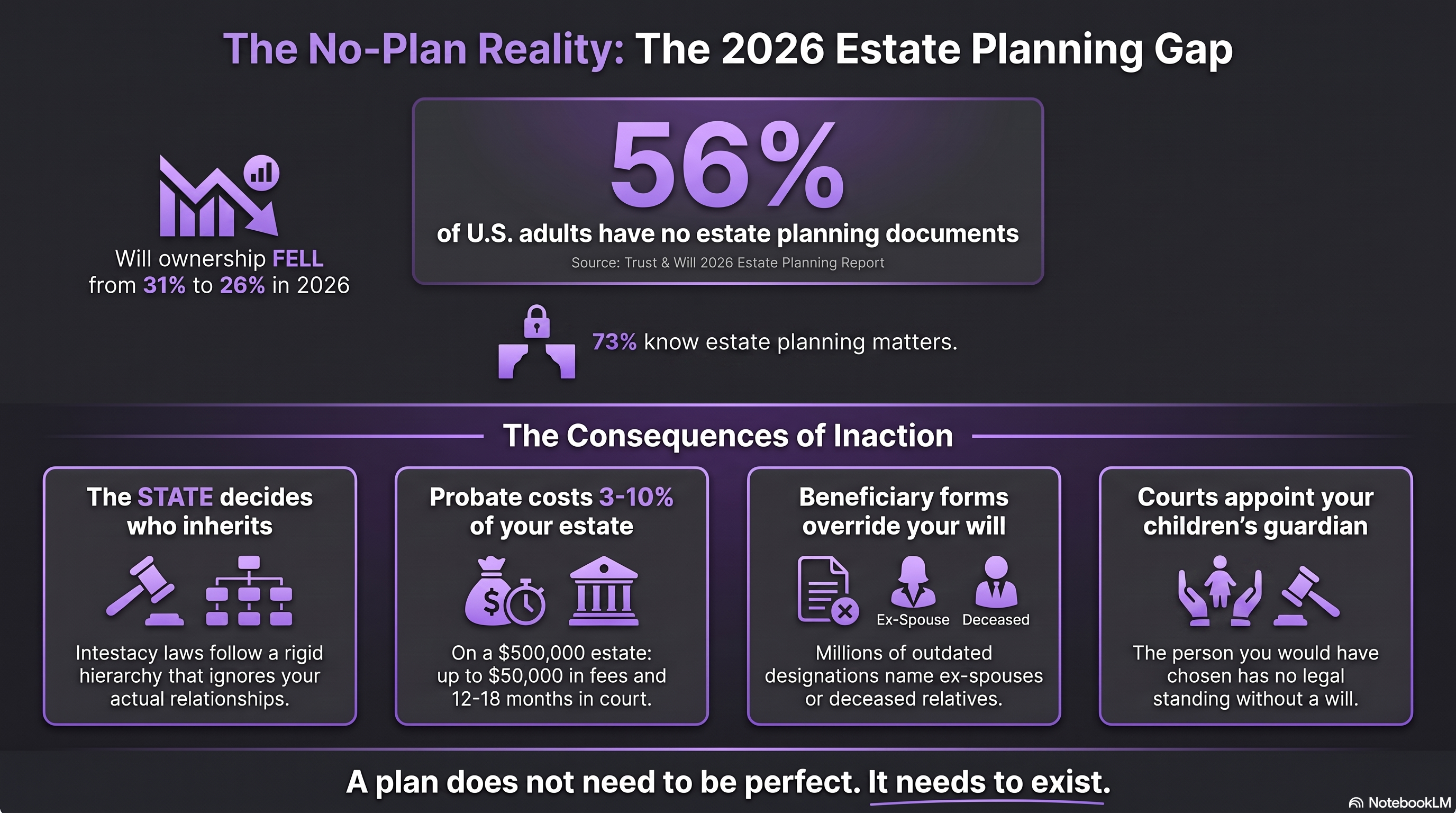
56% of American adults have no estate planning documents whatsoever — no will, no trust, no power of attorney, no healthcare directive. Nothing. And will ownership actually declined in 2026, falling from 31% to 26% despite broader awareness and cheaper digital tools. Without a plan, the state decides who inherits your assets, courts may appoint strangers as guardians for your children, probate can consume 3-10% of your estate in fees and take years to resolve, and outdated beneficiary designations on retirement accounts can override everything your family thought they knew about your wishes. This is not a problem for wealthy families. It is the problem every family with anything to protect faces — and more than half of them are not protected.
Nobody builds a financial life intending to leave a mess behind.
The 54-year-old who has spent 30 years contributing to a 401(k), building home equity, maintaining life insurance, and saving carefully — they do not intend for that wealth to pass through a courthouse, get consumed by legal fees, or end up in the hands of people they would not have chosen. They intend for it to go to the people they love, efficiently, with minimal friction, exactly as they would have wanted.
But intention without documentation is not a plan. It is a wish.
According to Trust & Will's 2026 Estate Planning Report, released in April 2026, 56% of U.S. adults have no estate planning documents in place. No will. No trust. No powers of attorney. Nothing. Even more concerning, will ownership declined from 31% in 2025 to just 26% in 2026 — despite increased access to low-cost digital planning tools and broader consumer awareness.
That declining number tells a specific story. People are not unaware that estate planning matters. 73% of Americans already agree it is important. What the data surfaces is the practical and emotional distance between that belief and the decision to act.
This article closes that distance — not by explaining what estate planning documents are, but by showing exactly what happens to real wealth when a real person dies without them. The consequences are specific, predictable, and entirely avoidable.
What "No Plan" Actually Means
When someone dies without an estate plan, they do not die without a plan. They die with the state's plan — a set of default rules called intestacy laws that determine who gets what, regardless of what the deceased person would have wanted.
Every state has intestacy laws. They follow a rigid hierarchy: spouse first, then children, then parents, then siblings, then extended family. If no family exists, assets may escheat to the state itself.
The problem is that the state's hierarchy rarely matches the complexity of real family relationships. The blended family where a spouse has children from a prior relationship. The unmarried couple who have lived together for 15 years and share a home, finances, and a life — but have no legal standing under intestacy rules. The estranged sibling who inherits alongside the close sibling who provided years of care. The lifelong friend who was like a sibling but receives nothing because the law does not recognize that relationship.
If someone dies without a will, state intestacy laws determine who inherits, courts may appoint guardians for minor children, and assets often pass through probate — a process that can take time and incur legal fees.
The state's plan is not wrong in the abstract. It is simply indifferent to the specific reality of your life.
The Five Things That Go Wrong Without a Plan
Problem 1: Probate — The Public, Slow, Expensive Process Nobody Plans For
Probate is the court-supervised process for validating a will and distributing assets. Even with a will, most estates go through probate. Without a will, probate is unavoidable and significantly more complex.
Probate costs include attorney fees, executor fees, court filing fees, and appraisal costs — typically 3-7% of the gross estate value. On a $500,000 estate, that is $15,000-$35,000 in fees before a single dollar reaches a beneficiary. On a $1 million estate, the range is $30,000-$70,000.
The time cost is equally significant. Probate proceedings routinely take 12-18 months for straightforward estates and years for contested ones. During that period, assets are frozen. The surviving spouse may be unable to access joint accounts. The family home may be tied up in court while the mortgage continues to accumulate. Business interests may be paralyzed.
Probate proceedings are generally public record. Once an estate enters probate, information surrounding assets, debts, beneficiaries, and distributions may become accessible through court filings. Real estate holdings, account values, creditor claims, and inheritance details can all become part of the public domain.
The family that spent decades carefully building financial security discovers that the absence of a simple legal document makes that security visible to anyone who looks — neighbors, distant relatives, creditors, and anyone who might have a claim.
A revocable living trust avoids probate entirely. Revocable trusts cost $2,000 to $5,000 but protect everything comprehensively. The cost of not having one is measured in probate fees, legal delays, and public exposure of everything the family built.
Problem 2: Beneficiary Designations Override Everything — Including Your Will
This is the most common and most expensive estate planning mistake — and it happens to people who do have wills.
Your will has no power over retirement accounts (401k, IRA), life insurance, annuities, or transfer-on-death accounts. Those go directly to whoever is named on the beneficiary form — even if your will says otherwise. Outdated beneficiary forms are one of the most common and expensive estate planning mistakes. Millions of people have outdated designations naming ex-spouses or deceased relatives.
The 401(k) that was opened in 1998 and listed the first spouse as beneficiary. The divorce happened in 2003. The remarriage in 2007. The new spouse assumes they will inherit the retirement account — it is the largest asset in the estate. Nobody updated the form.
The ex-spouse inherits the 401(k).
This is not hypothetical. It happens regularly, and the courts almost always uphold the beneficiary designation regardless of the circumstances. A will written in 2015 explicitly leaving the retirement account to the current spouse does not override a beneficiary form from 1998. The form controls.
52% of Americans 55 and over say dying without an estate plan would be irresponsible. Most of them have not checked their beneficiary designations since the account was opened.
Problem 3: No Guardian Named for Minor Children
For parents of minor children, the guardian designation is the most important sentence in any estate document — and it cannot appear anywhere except a will.
Without a named guardian, the court appoints one. The court will consider the best interests of the child based on available family members. The parents may have strong feelings about which family members are appropriate guardians and which are not. Those feelings, unwritten and unverified, carry no legal weight.
The estranged sibling who petitions for guardianship because they are the closest available relative. The well-meaning grandparent who is loving but not equipped for full-time childcare of young children. The friend who was the obvious choice in every conversation the parents ever had — but who has no legal standing because no document was ever signed.
Only 46% of will executors were aware of a will. The will that exists but nobody knows about is not meaningfully better than the will that was never written.
Guardian designations must be in a will. The will must be accessible. The people named must know they are named and must have accepted the responsibility. All three conditions are necessary. Most families have none of them.
Problem 4: No Power of Attorney — The Problem That Arrives Before Death
Estate planning is not only about what happens after death. It is about what happens if you become incapacitated and cannot make financial or medical decisions.
A durable power of attorney for finances designates someone to manage your financial affairs — pay bills, manage investments, make tax decisions — if you cannot. Without it, your family cannot act on your behalf without going to court to establish a guardianship or conservatorship — a process that can take months, cost thousands in legal fees, and require ongoing court oversight for as long as the incapacity continues.
A healthcare directive — also called a living will or advance directive — documents your wishes for medical treatment if you cannot communicate them. Without it, medical decisions fall to whoever the hospital recognizes as next of kin, in a hierarchy that may not match your relationships, your values, or your expressed wishes.
The power of attorney and the healthcare directive are not death planning documents. They are incapacity planning documents. They become relevant during your lifetime — during a serious illness, a sudden accident, a cognitive decline that arrives gradually and then suddenly. The family that needs these documents and does not have them faces a legal and medical crisis on top of the personal crisis already underway.
Problem 5: The Family Conflict That the Plan Would Have Prevented
The financial cost of dying without a plan is real and calculable. The relational cost is harder to quantify and often larger.
Contested estates generate family conflict that outlasts the legal proceedings by years or decades. The sibling who believed they understood the parent's wishes and discovers the assets distributed differently than expected. The adult children from a first marriage and a second spouse with competing claims on assets that were never clearly designated. The family member who provided years of caregiving and receives the same inheritance as the family member who was largely absent.
31% of people say leaving loved ones without enough money is the most damaging result of a poorly planned estate strategy. What most people undercount is the relational damage — the family that was close before the death and is fractured afterward because the person who could have clarified everything left nothing in writing.
A plan does not guarantee family harmony. It eliminates the ambiguity that allows conflict to fill the space where clarity should have been.
Who Thinks They Do Not Need a Plan — And Why They Are Wrong
56% of Americans feel they do not have enough assets to justify creating an estate plan, or stress that creating one is low on their priority list.
This is the most persistent misconception in personal finance. Estate planning is not for wealthy families with complex portfolios and estate tax exposure. It is for anyone who has:
A retirement account with a beneficiary designation that may be outdated. A home with a mortgage that a surviving spouse needs to access. Minor children who need a guardian named. A preference about medical treatment if incapacitated. A specific person they want to make financial decisions on their behalf. Any opinion at all about who should receive their assets.
That description covers nearly every adult in America. The family with $80,000 in a 401(k), a $220,000 home, and two young children has more at stake in an estate plan than they realize — because without one, the 401(k) goes to whoever is on the beneficiary form, the home goes through probate, and the children's guardian is decided by a court.
The estate tax threshold in 2026 is $15 million per individual. The overwhelming majority of Americans will never owe a dollar of federal estate tax. They still need an estate plan — not for tax reasons, but for all the other reasons listed above.
The Five Documents Everyone Needs
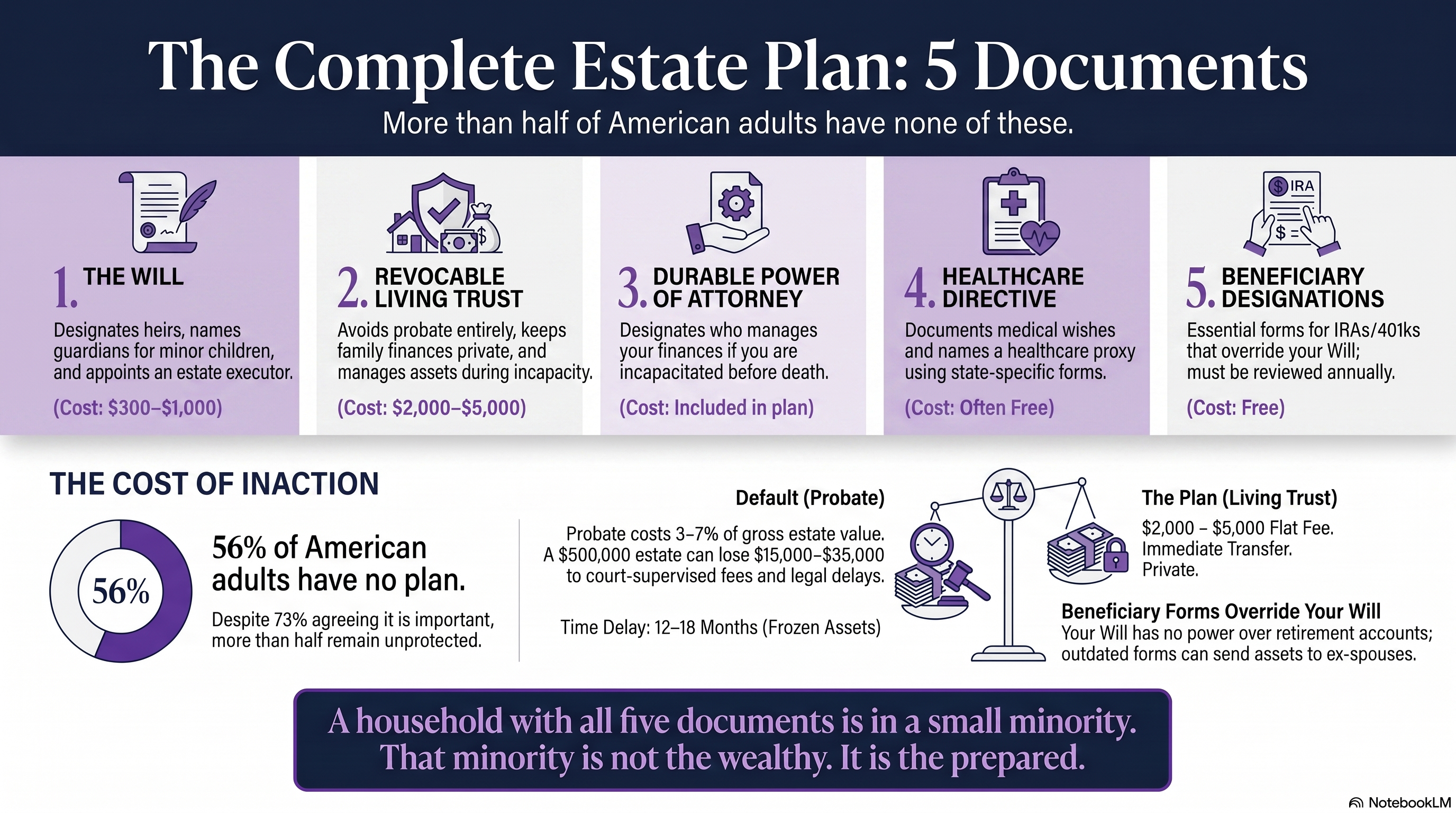
A complete estate plan is not a complex or expensive undertaking. It is five documents, ideally drafted with an estate attorney but available in simpler form through digital planning platforms for straightforward situations.
Document 1: Will Designates who receives your assets, names a guardian for minor children, and names an executor to manage the estate. Without a will, the state decides all three.
Document 2: Revocable Living Trust Holds assets during your lifetime and transfers them to beneficiaries without probate at death. More comprehensive than a will alone, avoids the public exposure of probate, and can provide management of assets during incapacity. For anyone with meaningful assets or a desire to keep family financial matters private, a trust is worth the investment.
Document 3: Durable Power of Attorney for Finances Designates someone to manage your financial affairs if you become incapacitated. Without it, your family cannot act on your behalf without court involvement. This document becomes relevant during your lifetime — not just after death.
Document 4: Healthcare Directive Documents your wishes for medical treatment if you cannot communicate them, and designates a healthcare proxy to make medical decisions on your behalf. State-specific forms are required. A generic document from another state may not be recognized.
Document 5: Updated Beneficiary Designations Not technically a document — a set of forms that need to be reviewed and updated on every retirement account, life insurance policy, annuity, and bank account. These designations override your will. They need to reflect your current family situation, not the situation that existed when the account was opened.
The most honest takeaway from the 2026 estate planning data is that most Americans already know estate planning matters. What it surfaces is the practical and emotional distance between that belief and the decision to act.
When to Review — and What Triggers an Update
An estate plan is not a document you complete once and file away. It is a living set of documents that needs to be reviewed when circumstances change.
The life events that require an immediate review:
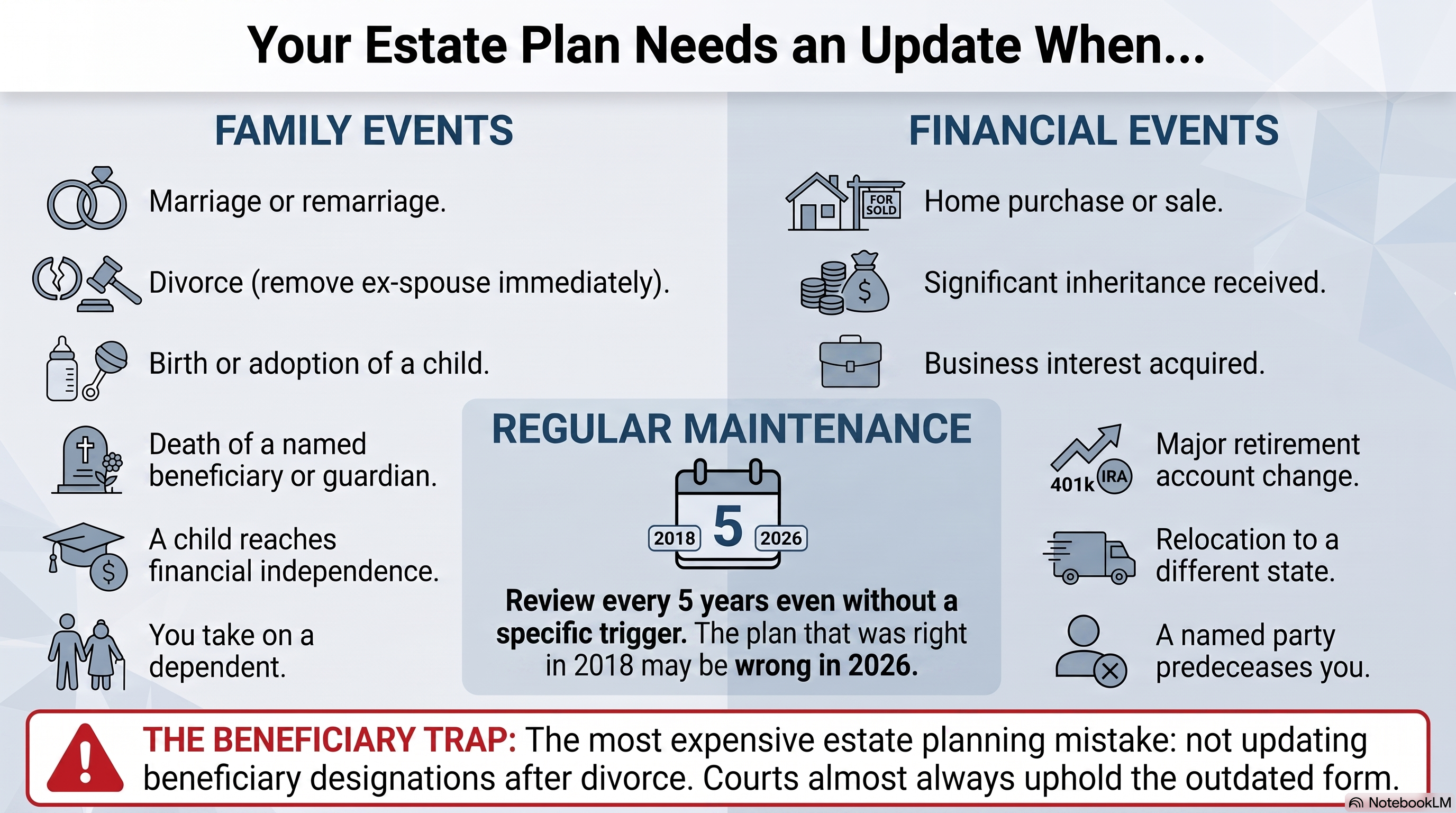
Marriage or remarriage — the beneficiary designations, the will, and the power of attorney all need to reflect the new relationship.
Divorce — outdated designations naming a former spouse need to be removed immediately. Courts will not automatically remove an ex-spouse from a beneficiary designation because of a divorce decree.
Birth or adoption of a child — guardian designation added to the will, the child potentially added as a beneficiary.
Death of a named beneficiary, guardian, executor, or power of attorney — all named parties need to be current and living.
Significant change in assets — a home purchase, inheritance, business interest, or major investment account change may require updating the trust or will to reflect the new picture.
Relocation to another state — state laws vary significantly on what documents are required and what forms are valid.
Move across a decade — a general review every five to ten years ensures the plan still reflects current wishes, current relationships, and current assets even if no specific life event has triggered an update.
What Arthavita's Legacy Planning Module Does
For users in the Legacy Planning section of the Arthavita platform, the estate document tracker surfaces exactly which documents exist, which are current, and which are missing — and provides the Legacy Readiness Score that reflects the completeness of the picture.
The beneficiary review feature prompts users to verify that every named beneficiary on every account is current — the step most people skip and the one with the largest consequences.
The Legacy Vault stores the complete financial picture in a documented, organized form that named executors and legacy contacts can access through Journey Partners — time-limited, secure token access that does not require a full Arthavita account. The family member who needs to act on your behalf has the information they need without a frantic search through filing cabinets and online portals during the most difficult moments of their lives.
The Wealth Transfer Strategy feature models the tax and distribution implications of different legacy approaches — annual gifting, 529 contributions, Roth IRA inheritance, trust structures, and charitable giving — so the legacy intent described in the Arthavita Framework is not just an aspiration but an executed plan.
The Conversation Nobody Has Until They Have To
Most families have this conversation once — in the aftermath of a death, when the consequences of not having a plan have already arrived.
The 401(k) that went to the wrong person. The home that spent 18 months in probate while the surviving spouse managed on a single income. The siblings who stopped speaking because nobody documented what the parent intended. The children whose guardianship was decided by a court rather than by the parents who knew exactly who they wanted.
The conversation that prevents all of those outcomes is uncomfortable. It requires thinking about death, incapacity, and the distribution of things that have deep emotional meaning. It requires having explicit conversations with the people named in the documents. It requires deciding, clearly and in writing, what you want to happen to everything you have built.
Most people put it off. The discomfort is immediate. The consequences are deferred — sometimes by decades. The assumption is that there is more time.
Most people do not put off estate planning because they are unaware it matters. They put it off because thinking about mortality, legal paperwork, and worst-case scenarios is deeply uncomfortable.
The cost of that discomfort is borne by the people left behind. The family that spent months fighting over an estate that could have been settled in weeks. The surviving spouse who discovered that the retirement account — the largest asset — had the wrong name on the beneficiary form. The children whose guardian was assigned by a court rather than chosen by the parents who loved them.
The plan does not need to be perfect. It needs to exist.
A household with even one document — typically a will or a healthcare directive — is already ahead of more than half of American adults. A household with all five documents, current beneficiary designations, and an organized financial picture that the family can access is in a small minority.
That minority is not the wealthy. It is the prepared.
Frequently Asked Questions
I have a will. Is that enough?
A will is the foundation but not a complete plan. A will goes through probate — a public, time-consuming, potentially expensive process. It does not control retirement accounts, life insurance, or transfer-on-death accounts — those go to whoever is on the beneficiary form regardless of what your will says. A complete plan includes a will, a revocable living trust for probate avoidance, a durable power of attorney, a healthcare directive, and current beneficiary designations on every account.
Does estate planning only matter if I have a lot of money?
No. The federal estate tax threshold in 2026 is $15 million per individual — the overwhelming majority of Americans will never owe a dollar of federal estate tax. But estate planning is not primarily about taxes. It is about ensuring your retirement accounts go to the right people, your home does not spend 18 months in probate, your children's guardian is the person you would have chosen, and your family can access your financial picture when they need it most. A $200,000 estate needs a plan as much as a $2 million estate.
What happens to my 401(k) if I die without a named beneficiary?
If no beneficiary is named, the retirement account typically goes through the estate and into probate. This eliminates the ability to stretch distributions over time and creates immediate ordinary income tax consequences for whoever inherits. It also subjects the account to estate creditors. Naming a primary and contingent beneficiary on every retirement account is one of the simplest and most important financial actions available — and it takes 15 minutes.
Can I do estate planning without an attorney?
For straightforward situations — a single person with no minor children, no complex assets, no blended family dynamics — digital platforms offer will and power of attorney documents that are legally valid in most states. For anyone with minor children, significant assets, a blended family, a business interest, a dependent with special needs, or any complexity in family relationships, an estate attorney is worth the cost. The document that seems fine from a template but has a jurisdiction-specific issue or a missing provision can create the exact problems it was supposed to prevent.
How often should I update my estate plan?
Review it after every major life event — marriage, divorce, birth of a child, death of a named party, significant change in assets, or move to a different state. Beyond specific triggers, a general review every five years ensures the plan still reflects current wishes and current relationships. The most common lapse is not updating beneficiary designations after a divorce or remarriage — a mistake that courts almost always uphold regardless of intent.
What is a Legacy Vault and why does it matter?
A Legacy Vault is a documented, organized record of your complete financial picture — accounts, documents, insurance policies, beneficiary designations, estate attorney contacts, and instructions for what to do first when something happens. Arthavita's Legacy Vault, accessible to named executors and legacy contacts through Journey Partners, gives your family the information they need without a frantic search through filing cabinets and online accounts at the most difficult moment of their lives. The plan that exists but cannot be found is not meaningfully better than the plan that was never written.
Have a question this article didn't answer?
Estate planning situations vary enormously — blended families, business interests, dependent children, charitable intent, and state-specific rules all create planning questions that generic guidance cannot fully address. If something here raised a question about your specific situation, send us a note at support@arthavita.co and we will do our best to address it directly or in a future post.
Arthavita is an educational and planning platform. This article is for informational purposes only and does not constitute personalized financial, legal, or tax advice. Estate planning involves legal documents that vary by state and individual circumstance. For personalized guidance, consult a qualified estate attorney.
Ketan Patel
Founder, Arthavita
Ketan Patel is the founder of Arthavita and a multi-industry entrepreneur with 30+ years of experience in technology and business operations. He built Arthavita to bring institutional-quality financial intelligence to individual investors.
LinkedIn ↗This article is for educational purposes only and does not constitute financial, tax, or legal advice. Arthavita is a recommendation-only platform. Always consult a qualified professional before making financial decisions.