
The Tax Torpedo: The Retirement Tax Trap That Hits the People Who Saved the Most
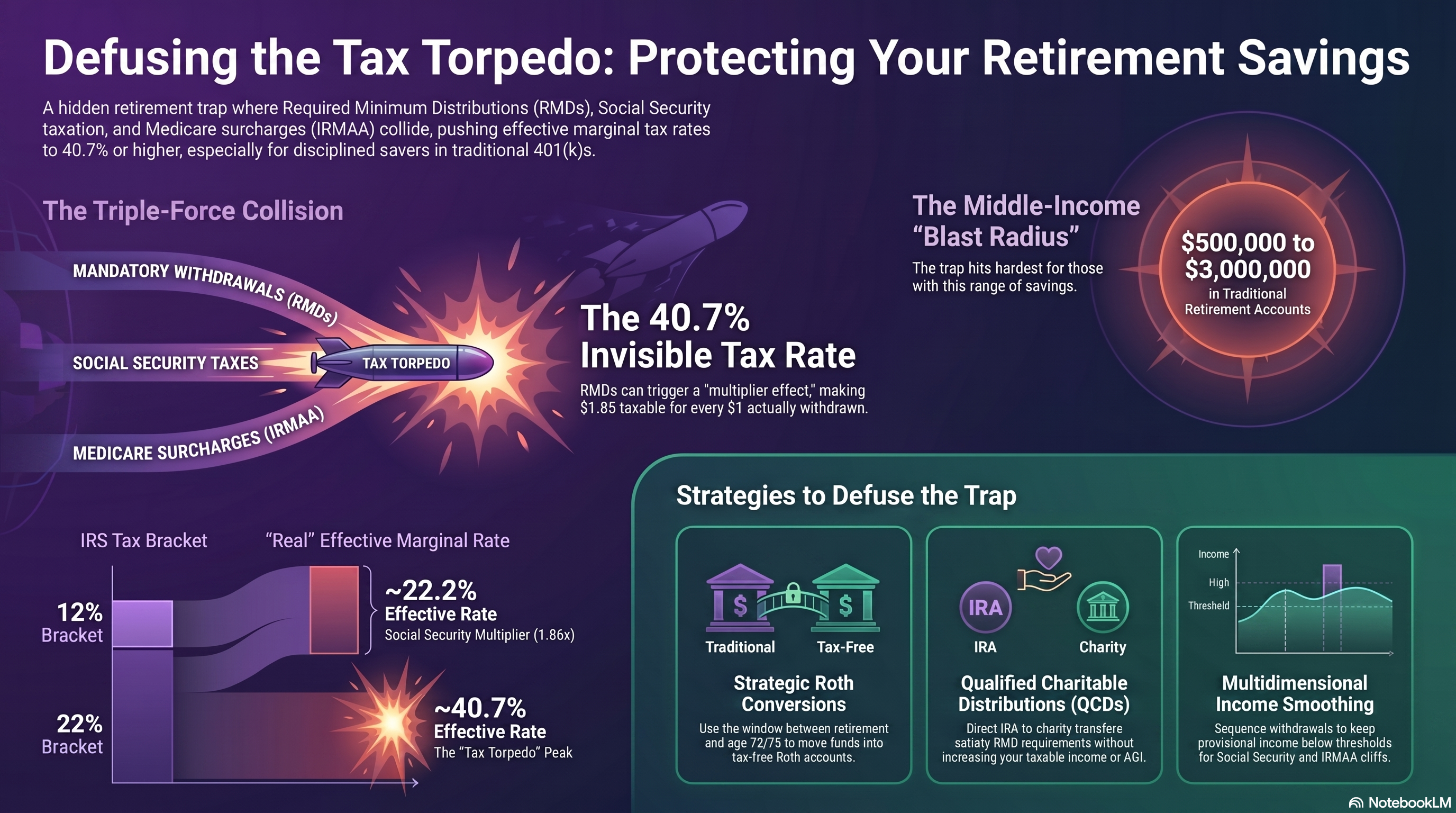
The Tax Torpedo is a hidden tax mechanism that can push your effective marginal tax rate to 40.7% or higher in retirement — not because you earned too much, but because of how RMDs, Social Security taxation, and IRMAA surcharges stack on top of each other. It hits hardest on middle-income retirees with $500K to $3M in traditional retirement accounts. The window to defuse it closes when RMDs begin — at 73 if you were born before 1960, at 75 if you were born in 1960 or later.
Here is something the financial industry rarely tells you: the Tax Torpedo is not a wealthy person's problem.
It is a problem for people who did everything right.
Americans in their 60s have an average retirement savings balance of $1,228,196. Most of that money — built over 30 or 40 years of disciplined 401(k) contributions — sits in traditional, tax-deferred accounts. It has never been taxed. And when it starts coming out, the U.S. tax code has a mechanism that punishes the very people who saved the most into these accounts.
Roughly 654,000 Americans have more than $1 million in tax-deferred retirement accounts. Many of those people are heading toward a tax event they have never modeled and were never warned about.
This is the Tax Torpedo. And it is one of the most consequential — and least discussed — financial planning problems in America.
What the Tax Torpedo Actually Is
The Tax Torpedo is not a single tax. It is what happens when three separate retirement income mechanisms collide simultaneously, each one amplifying the others, pushing your effective marginal tax rate far beyond what the IRS table suggests.
The mechanism works like this: when you withdraw money from a traditional IRA or 401(k), it counts as ordinary income. That additional income causes more of your Social Security benefit to become taxable — up to 85 cents of additional taxable income for every dollar you withdraw. At the same time, that higher income can push you over an IRMAA threshold, increasing your Medicare premiums. And if you have any capital gains, dividends, or bond interest in a taxable account, those stack on top of everything else.
The result is an effective marginal tax rate that has nothing to do with the bracket printed on the IRS table.
If you are in the 12% bracket, your real marginal rate on that IRA withdrawal is not 12%. It is 12% times 1.85, or about 22.2%. In the 22% bracket, the same arithmetic produces an effective rate north of 40%.
Every additional dollar from the IRA drags another $0.85 of Social Security into taxable income, so each new dollar of withdrawal produces $1.85 of new taxable income. Once you cross into the 22% bracket — which begins at $50,400 of single taxable income in 2026 — that multiplier produces an effective marginal rate of roughly 40.7%.
That is the tax torpedo. And it sits inside what looks, on paper, like an ordinary middle-income retirement.
The Real Case Study: What Happens at Age 73
Consider a single retiree — call her Margaret. She is 73, widowed, living in Michigan. She has $620,000 in a traditional IRA, receives $30,000 per year in Social Security, and has modest savings in a taxable brokerage account earning about $4,000 per year in interest and dividends.
Margaret worked her whole life. She contributed faithfully to her 401(k). She did everything right.
Her provisional income lands near $52,000, so 85% of her $30,000 benefit — or $25,500 — now counts as taxable income. After the IRA distribution and taxable Social Security, less a standard deduction of $18,150 for a single filer over 65 in 2026, her taxable income lands near $44,331. Her federal tax comes in around $5,072, entirely inside the lower brackets.
So far, manageable. But here is where the torpedo detonates.
If Margaret needs to take a slightly larger withdrawal — to replace a car, pay for home repairs, cover an unexpected medical bill — every additional dollar she withdraws from her IRA is not taxed at 12% or even 22%. It is taxed at an effective rate of roughly 40.7% because of the Social Security multiplier.
She does not see this on her statement. Her statement shows her balance, not what it costs to use it. The 40.7% rate is invisible until the tax bill arrives.
And Margaret is not unusual. She is the median.
The Three Forces That Create It
Force 1: Required Minimum Distributions — Income You Did Not Ask For
Under SECURE 2.0, the RMD starting age depends on your birth year.
Born between 1951 and 1959: RMDs begin at age 73 Born in 1960 or later: RMDs begin at age 75
Either way, once that age arrives, you must withdraw a calculated amount from your traditional IRA and 401(k) every single year — whether you need the money or not. The amount is determined by dividing your total tax-deferred balance by an IRS life expectancy factor that decreases each year, forcing larger and larger withdrawals as you age.
Here is the math that catches most people off guard:
A $700,000 traditional IRA at age 73 generates an RMD of roughly $26,900 in 2026.
At $800,000, the RMD is approximately $30,200.
At $1,000,000, it exceeds $37,700.
These are not unusual balances for someone who maxed their 401(k) contributions through a 30-year career. And they produce mandatory income events that interact with everything else in your financial picture.
If you miss an RMD, the penalty is 25% of the amount you should have withdrawn. The IRS has been waiting decades to tax this money. It is not patient about it.
Strong market performance in 2024 and 2025 has pushed many IRA balances significantly higher than retirees projected. Many people heading into 2026 are discovering their first RMD is larger than expected. That surprise does not just affect their tax bill — it affects their Medicare premiums two years from now.
Force 2: The Social Security Taxation Cascade
Most people believe their Social Security benefit is either tax-free or taxed at a fixed rate. Neither is accurate.
The IRS uses a formula based on "provisional income" — your adjusted gross income, plus non-taxable interest, plus half of your Social Security benefit — to determine how much of your benefit is taxable.
The Social Security taxation thresholds as of 2026:
| Provisional Income (Single) | Provisional Income (Married) | Benefit Taxable |
|---|---|---|
| Below $25,000 | Below $32,000 | Generally 0% |
| $25,000 to $34,000 | $32,000 to $44,000 | Up to 50% |
| Above $34,000 | Above $44,000 | Up to 85% |
These thresholds have not changed since 1983. They were never indexed for inflation.
Benefits rise with inflation — the 2026 cost-of-living adjustment alone was 2.8% — while the thresholds stay put. Each year, a little more of the retired population crosses a line that was drawn in 1983 and never moved. Today, the majority of Social Security recipients pay some tax on their benefits — the exact opposite of what the original legislation intended.
What makes this particularly damaging is the interaction with RMDs. Your RMD increases your AGI, which increases your provisional income, which causes more of your Social Security to become taxable, which increases your AGI further, which may push you over an IRMAA threshold. All from a single withdrawal decision.
Force 3: IRMAA — The Medicare Surcharge With a Two-Year Delay
IRMAA — Income-Related Monthly Adjustment Amount — is a surcharge on your Medicare Part B and Part D premiums, applied when your income exceeds certain thresholds. It operates on a two-year lookback.
In 2026, IRMAA surcharges apply when your MAGI exceeds:
$109,000 for single filers $218,000 for married filing jointly
Crossing a threshold by a single dollar can add more than $1,000 per year to your Medicare costs. The tiers are cliffs, not slopes. And because IRMAA looks at your income from two years prior, a decision you make today shows up in your Medicare bill in 2028 — long after you have forgotten the decision that caused it.
This is the torpedo's time-delay mechanism. The financial consequences of a 2026 income decision arrive in 2028. By then, the connection is almost impossible to trace without someone who was modeling it in advance.
Force 4: The Stacking Problem
None of these forces exist in isolation. They all respond to the same input — your gross income — and they interact with each other in ways that standard financial planning tools rarely model simultaneously.
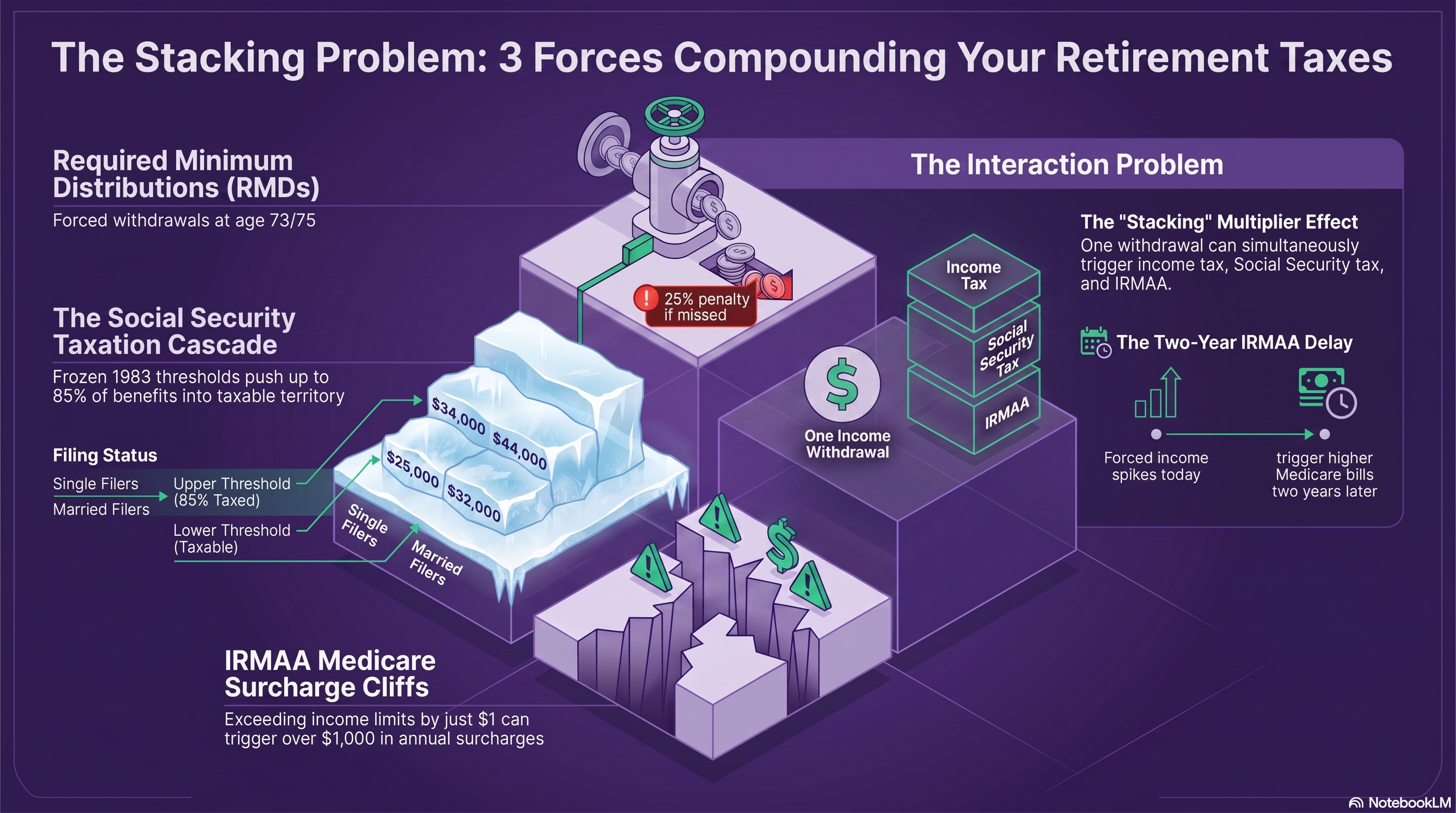
Your RMD increases income. That income pushes more Social Security into taxable territory. That increases your AGI. That AGI may cross an IRMAA tier. Those IRMAA surcharges increase your Medicare costs two years later. Meanwhile, any capital gains or dividends in a taxable brokerage account stack on top of all of it.
One dollar. Four consequences. None of them visible on your statement.
Who Is Most at Risk
The Tax Torpedo is often described as a problem for wealthy retirees. That framing misses the point entirely. The torpedo hits hardest in the $500,000 to $3,000,000 range of traditional retirement account balances.
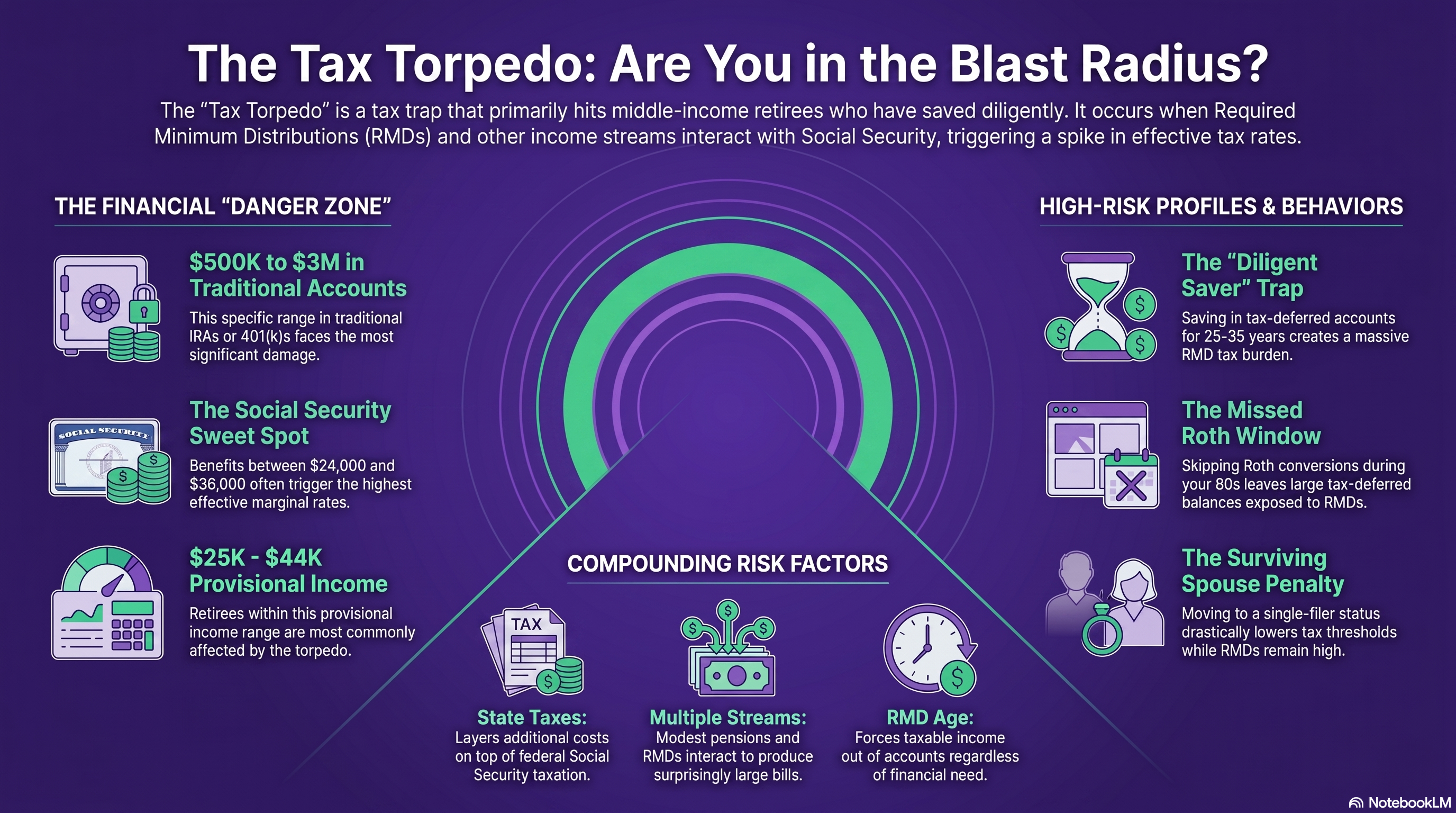
People who saved diligently into traditional 401(k)s for 25 to 35 years
The 401(k) was the right tool for accumulation. The tax deferral made sense while they were working. Nobody told them what the withdrawal phase would look like.
People with Social Security benefits in the $24,000 to $36,000 range
This is the range where the provisional income calculation creates the highest effective marginal rates. Benefits below this range often do not trigger the full 85% taxation threshold. Benefits above it have already absorbed the impact.
People who did not do Roth conversion planning in their 60s
Every dollar that sits in a traditional IRA at RMD age is a dollar that will be forced out as taxable income. The people who converted — even partially — arrive at RMD age with a smaller tax-deferred balance and a smaller torpedo.
People in states that still tax retirement income
While Michigan fully phased out state income tax on most retirement benefits in 2026, many states still impose state income tax on IRA withdrawals, pension income, or Social Security benefits. State taxes layer on top of the federal torpedo and can push combined effective rates significantly higher.
People with multiple income sources that seem modest individually
A pension of $18,000, Social Security of $28,000, and an RMD of $22,000 each seems manageable. Together, they interact in ways that can produce a tax bill that surprises even financially sophisticated people.
The Frozen Threshold Problem Nobody Talks About
The Social Security taxation thresholds — $25,000 and $34,000 for single filers, $32,000 and $44,000 for married filers — were set in 1983. They have never been adjusted for inflation. Not once in 43 years.
Every year, Social Security benefits go up. Every year, retirement account balances grow. Every year, more retirees cross these thresholds that were originally designed to apply to a small percentage of high-income recipients. The torpedo grows more powerful every year without Congress passing a single new law, simply because the thresholds are frozen while everything else inflates.
There is one new piece on the board for 2026. The 2025 tax law created a temporary additional deduction of $6,000 for each taxpayer who is 65 or older, available for tax years 2025 through 2028. This deduction reduces AGI, which lowers provisional income and can reduce or eliminate taxable Social Security for some retirees. It does not eliminate the torpedo — but it moves the blast radius for some households.
If tax brackets revert toward pre-2018 levels after current provisions expire, the torpedo becomes significantly more damaging. Many middle-income retirees would face a federal marginal rate of 46.25% — 25% statutory rate multiplied by 1.85 — on a wide range of income.
The torpedo is not going away. For most middle-income retirees, it is getting worse.
The Five Most Expensive Mistakes
Mistake 1: Treating the IRA like a savings account
"It is my money. I will take it when I need it." This is the instinct. It is also costly. Every dollar you take from a traditional IRA is taxed as ordinary income, compounded by the Social Security taxation multiplier. Taking money when you need it without modeling the provisional income impact is how otherwise careful people end up paying 40% effective rates on withdrawals they thought would be taxed at 12%.
Mistake 2: Delaying Social Security without drawing down the IRA first
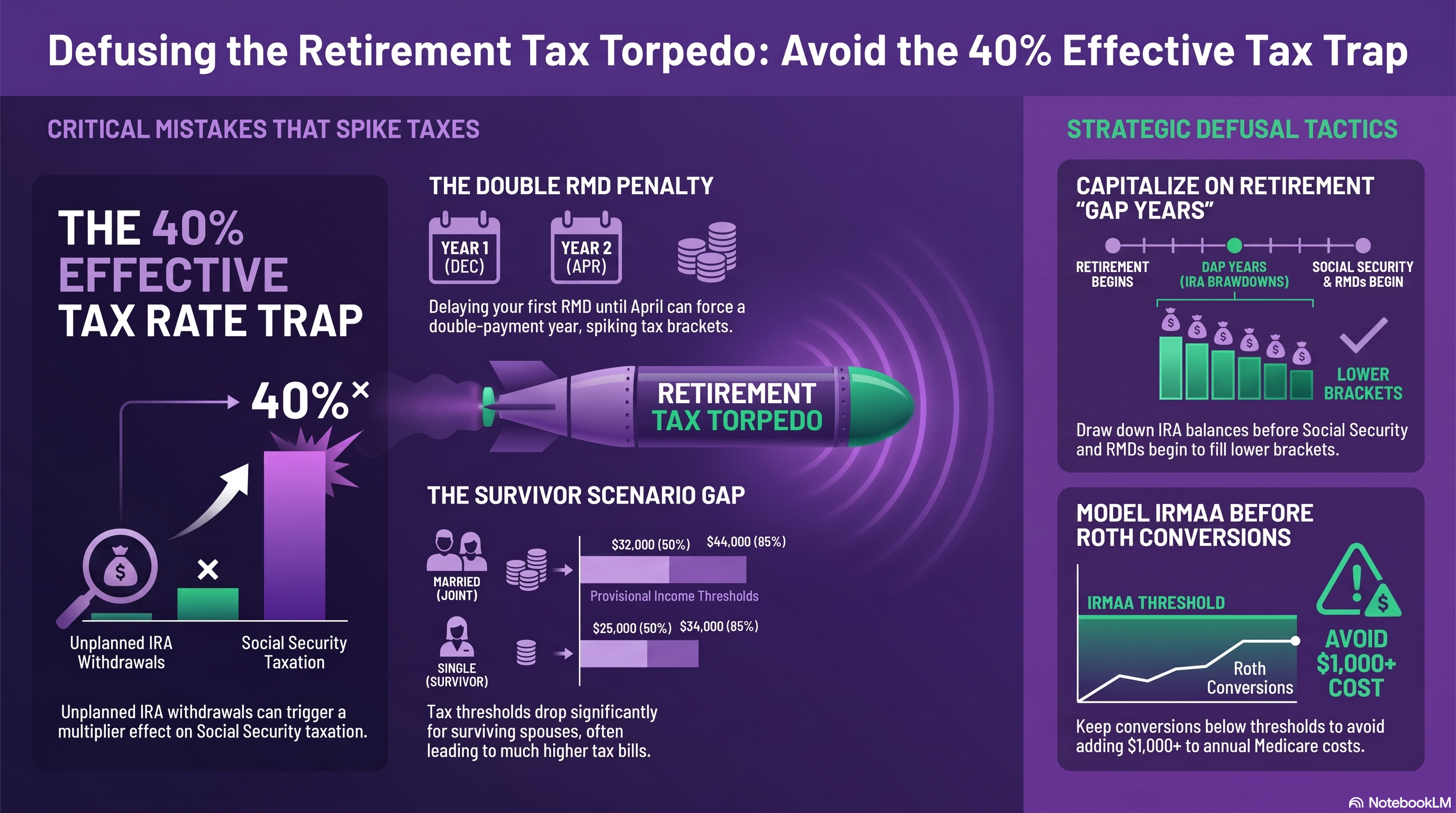
Delaying Social Security is almost always the right strategy for the higher earner in a couple. But the years between retirement and Social Security claiming are a window most people do not use. Those years are optimal for drawing down traditional IRA balances or converting them to Roth, deliberately filling the lower tax brackets before RMDs force income higher and before Social Security multiplies its effect.
Mistake 3: Taking two RMDs in the first year
You can delay your first RMD until April 1 of the year after you turn 73 or 75. But if you delay it, you must take two RMDs in that second year. Two RMDs in one year can spike your income dramatically, triggering higher tax rates, higher Social Security taxation, and potentially crossing an IRMAA tier. The short-term deferral almost always costs more than it saves.
Mistake 4: Doing a Roth conversion without modeling IRMAA
Roth conversions are the single best tool for defusing the torpedo. But a conversion that is too large in a single year can push you over an IRMAA threshold — adding more than $1,000 to your Medicare costs two years later. The optimal conversion amount is often the maximum that keeps you below the next IRMAA threshold, not the maximum that fills your current tax bracket.
Mistake 5: Ignoring the survivor scenario
For married couples, the torpedo often hits hardest after one spouse dies. When the survivor files as single, the Social Security taxation thresholds drop immediately — from $32,000 and $44,000 down to $25,000 and $34,000. The same income that was manageable for a married couple now crosses the thresholds at a lower level. Meanwhile, the survivor may inherit an even larger IRA, producing larger RMDs. The surviving spouse frequently pays significantly more in taxes than the couple did — and this is rarely modeled in advance.
The Three Tools That Defuse It
Tool 1: Bracket-Aware Roth Conversions Before RMDs Begin
The most powerful intervention available. Convert deliberately each year during the gap between retirement and your RMD start age — filling your current tax bracket without crossing into the next, and without crossing an IRMAA threshold.
The math matters here. Converting $30,000 per year for ten years reduces your traditional IRA balance by $300,000. That means your future RMD is calculated on a balance that is $300,000 smaller. Those converted dollars generate no future RMDs, no future provisional income, and no future IRMAA exposure.
For someone born in 1965 who retires at 62, the Roth conversion window extends to age 75 — thirteen years of relatively low-income tax space to convert strategically. That is the window the torpedo's structure left open. Using it deliberately is the single highest-leverage retirement tax decision most people never make.
Tool 2: Qualified Charitable Distributions
Anyone age 70.5 or older can make a Qualified Charitable Distribution directly from an IRA to a qualifying charity — up to $108,000 per individual in 2026. A QCD satisfies RMD requirements without counting as taxable income. It does not increase your AGI. It does not add to provisional income. It does not contribute to IRMAA calculations.
For a retiree who is charitably inclined, a QCD is essentially donating pre-tax dollars directly to charity. The IRA would have been taxed eventually — the QCD eliminates that tax event entirely while satisfying the RMD obligation.
QCDs are often the single most tax-efficient charitable giving tool available for retirees in the Social Security tax torpedo zone.
Tool 3: Income Smoothing and Strategic Withdrawal Sequencing
Rather than allowing income to spike when RMDs begin, model your income across multiple years and manage it deliberately. This includes:
Drawing down traditional IRA balances voluntarily in your early 60s, before RMDs are required, to reduce the future mandatory withdrawal amount Sequencing account withdrawals to keep provisional income below the thresholds that trigger Social Security taxation and IRMAA.
Coordinating Social Security claiming with RMD onset to avoid compressing two high-income events into the same year Timing capital gains realizations in lower-income years — a retiree who realizes $50,000 in capital gains in a year with little other income pays 0% federal capital gains tax; the same gain in a high-income year can be taxed at 15% or higher
The principle is income smoothing: deliberately distributing taxable events across years to keep annual income in a zone that minimizes the torpedo's impact.
Why This Requires More Than a Spreadsheet
Every variable in the Tax Torpedo interacts with every other variable. The optimal Roth conversion amount depends on your current bracket, your future RMD size, your IRMAA tier, your Social Security benefit, your spouse's income, your state's tax treatment, and your charitable intentions — all simultaneously.
A rule of thumb cannot optimize a problem with this many interacting variables.
What Arthavita's Monte Carlo retirement simulation does is run 25,000 different scenarios against your actual numbers — varying market returns, inflation rates, withdrawal sequences, conversion amounts, Social Security timing, and IRMAA thresholds at the same time — and show you the probability-weighted outcome of each decision before you make it.
Not just "you have an 84% chance of success." But: here is what your tax burden looks like under 25,000 scenarios, here are the three decisions that reduce it most, and here is the year-by-year action plan that gets you from where you are to where you want to be.
The torpedo does not announce itself. But it can be modeled. And what can be modeled can be managed.
The Question Worth Asking Right Now
The magic number Americans think they need to retire comfortably in 2026 is $1.46 million. Millions of people are working toward that number. Very few are modeling what it costs to actually use it.
The accumulation phase has an entire industry behind it. The 401(k) system, the financial media, the retirement calculators — all of them are built around the question "how much will I have?"
The withdrawal phase is largely uncharted. And the people who arrive at retirement with the most savings — the ones who did everything right — are the ones most likely to walk into the torpedo's blast radius without knowing it exists.
If you are between 55 and 70, the most important retirement planning question is not "do I have enough?" It is: "what will the IRS take — and have I modeled it?"
The window to plan around the Tax Torpedo is open right now. For those born in 1960 or later, it stays open until age 75. That is meaningful time — if you use it deliberately.
The torpedo does not arrive when you retire. It arrives the year your first RMD is due. Plan before then, not after.
Frequently Asked Questions
What is provisional income?
Provisional income is the formula the IRS uses to determine how much of your Social Security benefit is taxable. It equals your adjusted gross income, plus any tax-exempt interest, plus half of your annual Social Security benefit. It is not the same as your AGI or your taxable income — it is a separate calculation used only for Social Security taxation purposes.
Does the Tax Torpedo apply to Roth IRA withdrawals?
No. Qualified Roth IRA withdrawals do not count as income for federal tax purposes. They do not increase your AGI, they do not add to provisional income, and they do not contribute to IRMAA calculations. This is the core reason why Roth conversions before RMDs begin are the most powerful tool for defusing the torpedo.
What if I am already taking RMDs — is it too late?
It is not too late, but the options narrow. QCDs become available at age 70.5 and are one of the most effective tools for retirees already in RMD territory. Income smoothing — timing other income sources around the RMD — still helps. And converting portions of the remaining traditional IRA to Roth while you are still alive reduces the RMD burden on your surviving spouse.
Does the Tax Torpedo affect my state taxes too?
It depends on your state. Michigan fully phased out state income tax on most retirement income in 2026 — a significant change for Michigan retirees. But many states still tax IRA withdrawals, some tax Social Security, and others impose surcharges that interact with the federal torpedo. The combined federal and state effective rate can be substantially higher than the federal figure alone.
What is the IRMAA lookback and how do I avoid triggering it?
IRMAA surcharges for your current year are based on your tax return from two years prior. Before any large income event — a Roth conversion, a capital gains realization, a property sale, or an unusually large RMD — model what that income does to your MAGI. If you are near a threshold, consider spreading the income event across two tax years rather than taking it all in one year.
How do I know if I am in the torpedo's blast radius?
The torpedo most commonly affects retirees with provisional income between $25,000 and $44,000 and traditional IRA balances large enough to generate RMDs that push into that range. If you have a traditional IRA or 401(k) balance above $400,000 and you receive Social Security, you should model the torpedo scenario before it arrives — not after.
Arthavita is an educational and planning platform. This article is for informational purposes only and does not constitute personalized financial, tax, or legal advice. All financial decisions remain with you. For personalized guidance, consult a qualified financial or tax professional.
Ketan Patel
Founder, Arthavita
Ketan Patel is the founder of Arthavita and a multi-industry entrepreneur with 30+ years of experience in technology and business operations. He built Arthavita to bring institutional-quality financial intelligence to individual investors.
LinkedIn ↗This article is for educational purposes only and does not constitute financial, tax, or legal advice. Arthavita is a recommendation-only platform. Always consult a qualified professional before making financial decisions.