
The Pre-Retirement Checklist: 10 Years Out, What to Do First
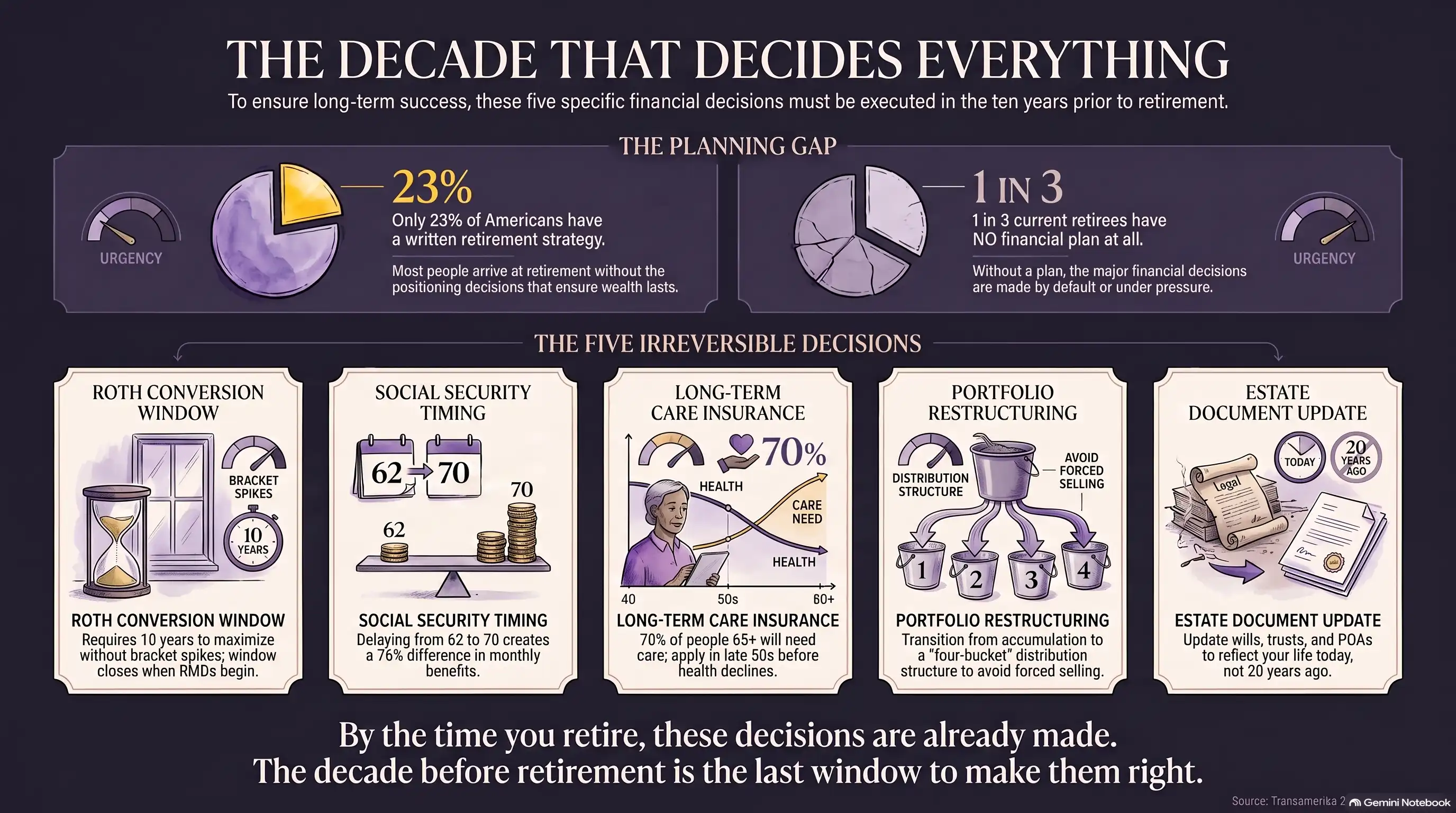
Only 23% of Americans have a written retirement strategy. One in three current retirees have no financial plan at all. The decade before retirement is the last window where the major decisions that determine retirement outcomes can still be made — Roth conversions, Social Security modeling, portfolio restructuring, long-term care insurance, and estate document updates. By the time you retire, most of these decisions are already made or severely constrained. This checklist tells you what to do, in what order, starting today. Not in five years. Today.
The financial industry has a retirement problem — and it is not the one most people think.
The problem is not that people do not save enough, though many do not. The problem is not that people make bad investment choices, though some do. The problem is that the financial system is almost entirely oriented toward accumulation — and almost entirely silent about what to do in the critical decade before retirement when the decisions that determine retirement outcomes are actually being made.
Only 23% of Americans have a written retirement strategy, according to Transamerica's 2025-2026 research. One in three current retirees report having no financial plan at all. Most people arrive at retirement having made the accumulation decisions and having made almost none of the pre-retirement positioning decisions that determine whether the accumulated wealth actually lasts.
The decade before retirement — ages 55 to 65 for most people — is the last window where meaningful action is still possible. The Roth conversion window is open but closing. The Social Security timing decision can still be modeled before the pressure of an actual retirement date forces a premature answer. Long-term care insurance is still available before health conditions make it impossible or unaffordable. The portfolio can still be restructured for distribution before the first withdrawal is needed.
This is not a checklist for the year before retirement. It is a checklist for the decade before retirement — because most of what matters must be addressed before retirement arrives.
Why the Decade Before Retirement Is Uniquely Important
Retirement is execution. Pre-retirement is strategy.
By the time you retire, the major financial decisions are already made or severely constrained. The account structure — how much is in traditional, how much in Roth, how much in taxable — reflects decades of contribution decisions. The Social Security benefit amount reflects 35 years of earnings. The long-term care insurance coverage either exists or it does not, because by 65 most people cannot get it at any reasonable price. The estate documents either reflect current wishes or they do not.
The pre-retirement decade is the last time you have flexibility to change these outcomes. Not unlimited flexibility — but meaningful flexibility, with 10-15 years of compounding still available and enough time to execute multi-year strategies that require time to work.
The five decisions that are uniquely pre-retirement — that cannot be meaningfully addressed after retirement begins — are the organizing framework of this checklist:
One: the Roth conversion window, which requires years of careful sizing to maximize without triggering IRMAA or bracket spikes.
Two: Social Security timing, which requires modeling before the retirement date rather than under pressure at the retirement date.
Three: long-term care insurance, which requires applying before health conditions develop that make coverage unavailable.
Four: portfolio restructuring from growth-oriented accumulation to distribution-ready income, which requires years to execute without forcing the sale of positions at inopportune times.
Five: estate and legacy documentation, which requires updating every document to reflect the life as it actually exists at 60, not as it existed when the documents were first drafted.
Everything else on this checklist matters. These five are the ones that cannot wait.
Years 10-7 Out: Build the Foundation
Check 1: Know Exactly Where You Stand
The starting point of every pre-retirement planning conversation is a complete, accurate picture of the financial reality — not an approximate sense of where things are, but actual numbers.
Total investable assets by account type: traditional IRA, Roth IRA, 401(k), taxable brokerage, HSA. The distinction matters because each account type has different tax treatment in retirement, different RMD requirements, and different roles in the withdrawal sequencing strategy.
Projected Social Security benefit at three claiming ages: 62, full retirement age, and 70. The Social Security Administration provides this estimate at ssa.gov. The difference between claiming at 62 and claiming at 70 is typically 76% in monthly benefit — for the same earnings record. That difference, which compounds over 20-30 years of retirement, is one of the largest financial decisions most people make.
Pension income if applicable: the benefit amount, the survivor benefit options, and how it interacts with Social Security and portfolio withdrawals.
Current spending and projected retirement spending. Healthcare costs almost always increase at retirement even as some work-related expenses decrease. Modeling the realistic retirement budget — not assuming a 20% decrease because you will spend less — is the foundation of every other calculation.
Net worth complete — including home equity, which is not investable without a transaction but which represents a potential distribution resource through downsizing, reverse mortgage, or sale.
Check 2: Model the Retirement Income Gap
The retirement income gap is the difference between what guaranteed income sources provide — Social Security, pension — and what the retirement spending plan requires. The portfolio is responsible for funding the gap.
This calculation, run with accurate numbers against a realistic retirement date and a realistic life expectancy of 90+ years, tells you whether you are on track, how far ahead or behind you are, and what the required contribution rate looks like to close any gap.
It also sets the context for every other pre-retirement decision. A 55-year-old who models this calculation for the first time and discovers they are significantly behind has 10 years to adjust — a fundamentally different situation than discovering the same shortfall at 63.
Check 3: Begin the Roth Conversion Assessment
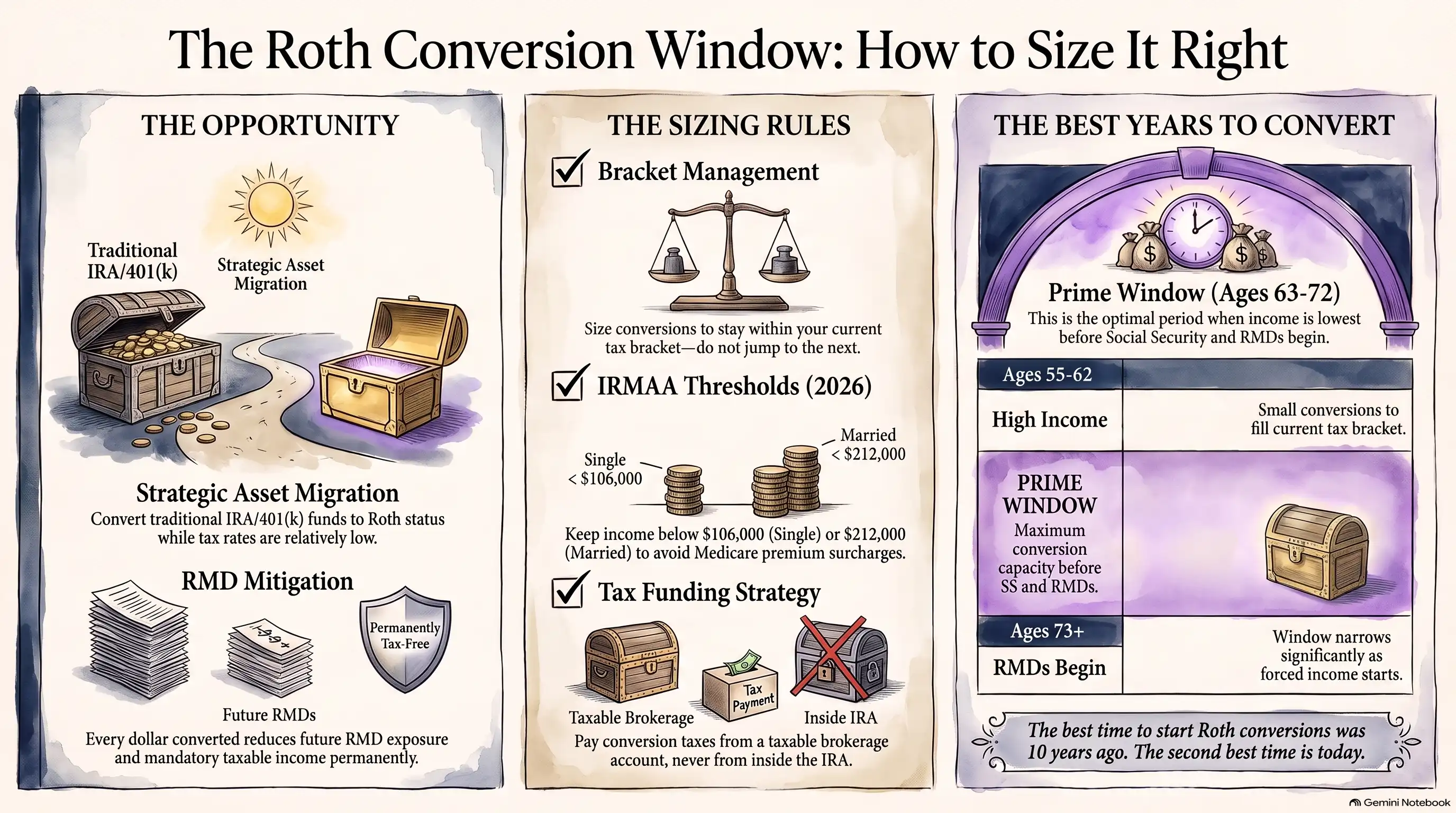
The Roth conversion window — the period between the end of peak earnings and the beginning of Required Minimum Distributions — is the most valuable tax planning opportunity available to pre-retirees. For most people, that window runs from roughly age 55-60 through age 72, with the most favorable years often being 63-72 when income is lowest before RMDs begin.
The assessment at 10 years out is not about executing conversions yet — it is about understanding the opportunity and beginning to quantify it.
How large is the traditional IRA/401(k) balance that will eventually become subject to RMDs? What does the projected RMD look like at age 73 or 75 based on current balances and expected growth? At what tax rate will those RMDs land — and how do they interact with Social Security taxation and IRMAA thresholds?
The answers to these questions determine how aggressively to pursue Roth conversions over the next decade, how much to convert each year, and which years represent the best conversion opportunities.
Check 4: Evaluate Long-Term Care Insurance
The actuarial reality of long-term care is one of the most underplanned risks in personal finance. About 70% of people over 65 will need some form of long-term care. The median annual cost of a semi-private nursing home room in 2026 is approximately $95,000. Medicare covers very little of custodial care. Medicaid requires near-complete asset depletion before coverage begins.
Long-term care insurance is ideally purchased in the late 50s — before health conditions that commonly develop in the early 60s make coverage unavailable or priced prohibitively. A person who applies at 58 with no significant health conditions can typically obtain meaningful coverage at a manageable premium. The same person at 65 with a diagnosed condition may find coverage unavailable at any price.
The evaluation at 10 years out involves: understanding the probability and cost of long-term care for your specific situation; reviewing whether existing assets could self-fund care without depleting the portfolio to Medicaid levels; comparing traditional long-term care insurance, hybrid life/LTC policies, and self-funding strategies; and making an application decision while health is still on your side.
Years 7-5 Out: Build the Levers
Check 5: Execute the Roth Conversion Strategy
With the assessment complete and the opportunity quantified, the conversion strategy moves from assessment to execution. The size of each annual conversion is determined by three constraints: staying within the current tax bracket without jumping to the next, avoiding the IRMAA Medicare premium surcharge thresholds, and not creating taxable income that pushes Social Security into higher taxation.
In 2026, the IRMAA threshold for single filers is $106,000 and for married filers $212,000. A Roth conversion that crosses this line adds $81.20 per month to Medicare Part B premiums for the following year — a cost that erases a meaningful portion of the conversion's value. Sizing conversions to stay just below IRMAA thresholds is one of the highest-value details in the conversion strategy.
Pay the conversion taxes from taxable brokerage accounts, not from within the IRA. Every dollar of tax withheld from the conversion amount is a dollar that never arrives in the Roth — reducing the efficiency of the conversion permanently.
Check 6: Model Social Security Timing Explicitly
The Social Security timing decision is too often made under pressure — at the moment of retirement, when one income has already stopped and the urgency of starting another feels acute. Making the decision in advance, with modeling, eliminates that pressure and typically produces a better outcome.
The modeling should address: the break-even age between early and delayed claiming; the interaction between Social Security timing and portfolio withdrawal sequencing in the early retirement years; the survivor benefit implications for married couples; and the tax implications of different Social Security start dates in combination with other income sources.
For married couples, the standard guidance — that the higher earner should delay as long as possible to maximize the survivor benefit — is usually correct but depends on the specific benefit amounts and the couple's health history. The lower earner's claiming strategy is a separate analysis.
Check 7: Begin Portfolio Restructuring
The portfolio that has been accumulation-oriented for 35 years — concentrated in equities, focused on long-term growth, tolerant of short-term volatility — is not the right portfolio for the five years before and after retirement.
The retirement risk zone — roughly ages 58 to 72 — is when sequence of returns risk is at its maximum. A market decline of 30% in the first two years of retirement depletes the portfolio far more than a 30% decline five years after retirement. The structural protection against this risk is building the distribution-ready portfolio before the first withdrawal is needed.
The four-bucket structure — cash for years 0-2, conservative income for years 3-5, balanced growth for years 6-10, and pure growth for year 10+ — needs to be funded from the accumulation portfolio gradually, not in a single rebalancing event that might occur at an inopportune market moment.
Check 8: Maximize Contributions — Including Catch-Up
Workers 50 and older can contribute an additional $8,000 to a 401(k) in 2026 — a standard catch-up that raises the total limit to $31,500. Workers ages 60-63 qualify for the SECURE 2.0 super catch-up of $11,250, for a total of $34,750.
The HSA catch-up for those 55 and older adds $1,000 to the standard family limit of $8,550, for a total of $9,550. For pre-retirees on a high-deductible health plan, the HSA is the most tax-efficient savings vehicle available — contributions are deductible, growth is tax-free, and withdrawals for qualified medical expenses are tax-free. After 65, HSA funds can be withdrawn for any purpose at ordinary income rates — functioning as a traditional IRA without the RMD requirement.
The decade before retirement is when the catch-up contributions have the most impact — both because the dollar amounts are larger and because the compounding time, while shorter than earlier years, still produces meaningful growth before retirement begins.
Years 5-2 Out: Pressure Test the Plan
Check 9: Run the Monte Carlo Against Your Actual Numbers
The retirement income projection run at 10 years out was necessarily approximate — the retirement date was still a decade away, the exact account balances were estimates, and the market environment was unknown. At five years out, the picture is clearer and the numbers are more precise.
Run the Monte Carlo simulation against current actual balances, current actual Social Security estimates at the chosen claiming age, current actual spending projections, and the current four-bucket portfolio structure. The result is a probability of success across 25,000 possible market sequences — not a single projected outcome, but a range that shows the probability the money lasts to the planned end of the analysis period.
If the probability is below 85%, the plan needs adjustment — either retirement date, spending level, Social Security claiming age, or some combination. If the probability is above 90%, the plan is on strong footing but should still be reviewed annually as circumstances evolve.
Check 10: Address the Healthcare Bridge
For anyone retiring before 65 — before Medicare eligibility — the healthcare bridge is one of the most expensive and most overlooked pre-retirement planning problems.
In 2026, silver plan premiums can exceed 8.5% of annual income for many pre-Medicare individuals. The ACA premium tax credit is still available, but the subsidy cliff at $84,600 for a two-person household means that crossing that income threshold by even one dollar eliminates all premium assistance for the entire year. Income management in the pre-Medicare years — keeping income below the cliff through careful Roth conversion sizing, taxable withdrawal management, and spending level — can produce healthcare premium savings of $10,000 or more per year.
COBRA is available for 18 months after leaving employer coverage. For someone who retires at 63½, COBRA bridges to 65 — to Medicare. For someone who retires at 60, COBRA covers 18 months and the marketplace covers the remaining 3.5 years. Each scenario requires specific planning.
Check 11: Update Every Estate Document
The will, the trust, the durable power of attorney, the healthcare directive, and every beneficiary designation need to reflect the life as it actually exists at 60-63, not as it existed when the documents were first drafted in the 30s or 40s.
The guardian designations that named people who have since moved, aged out of the role, or passed away. The executor who was the right choice 20 years ago and is now dealing with their own health challenges. The power of attorney that named a sibling who is no longer capable. The beneficiary designations on retirement accounts that predate a marriage, a divorce, the birth of children, or the death of the originally named beneficiary.
Review every document. Every designation. Every named party. Update anything that does not accurately reflect current wishes and current relationships.
Check 12: Plan the Social Security Timing Execution
The decision is made. Now execute it properly.
If claiming at full retirement age or 70: ensure there is sufficient portfolio liquidity to cover expenses during the bridge period without being forced to sell equities in a down market. The four-bucket structure handles this — but the bucket needs to be funded before the retirement date, not as an emergency measure after.
If claiming before full retirement age: model the reduced benefit against the portfolio withdrawal rate. Early Social Security reduces the portfolio withdrawal need but at the cost of a permanently reduced benefit. Ensure the arithmetic holds across a 30-year retirement, including the survivor benefit implications.
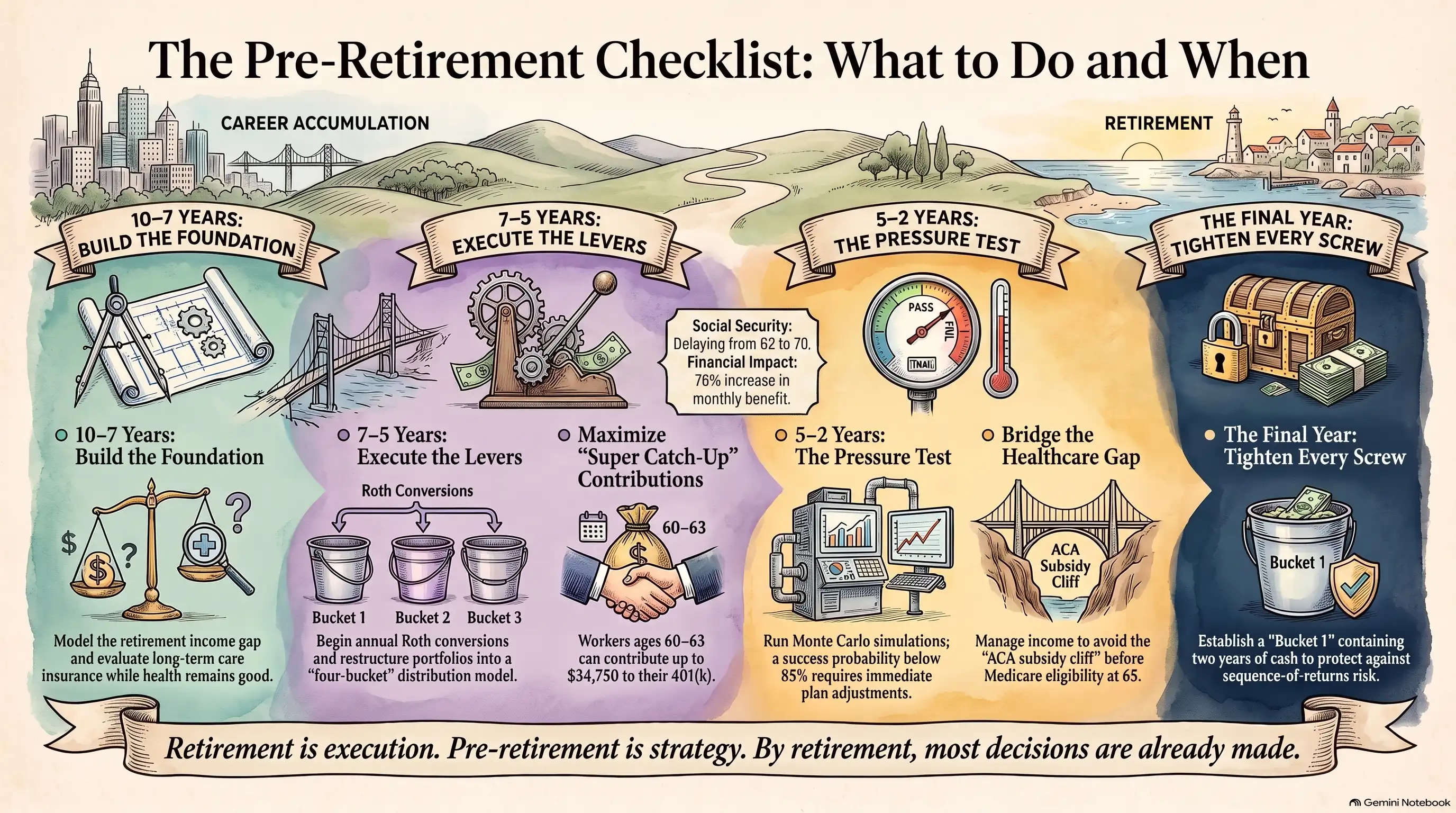
The Year Before Retirement: Tighten Every Screw
The final 12 months before retirement are for verification, not for new decisions. The major decisions have been made. This year is for ensuring the execution is correct.
Run a final Monte Carlo with the actual retirement date, actual balances, and the final Social Security claiming decision locked in. The result should be above 90% success probability.
Test the retirement budget against actual spending for 6-12 months before retiring — to confirm the modeled spending is realistic and to identify areas where the model and reality diverge.
Confirm Medicare enrollment timing. Medicare Part B requires active enrollment — it does not happen automatically for most people. Missing the enrollment window results in permanent premium surcharges of 10% per year for each year of late enrollment.
Confirm the QDRO for any pension or 401(k) that needs to be divided — not relevant for everyone, but essential for those who have received assets from a spouse's plan in a divorce or who are dividing a pension as part of a separation.
Establish the first bucket in cash — two years of living expenses in a high-yield savings account or money market, available immediately without any market exposure. This is the structural protection against sequence of returns risk in the first two years of retirement.
What Arthavita's Pre-Retirement Dashboard Shows
For users in the Pre-Retirement life stage, Arthavita's Wealth Journey Dashboard surfaces a completely different set of priorities than it shows for accumulation-stage users.
The three AI-prioritized action items for a pre-retiree typically address the most urgent gap in the planning picture — the underfunded Roth conversion opportunity, the Social Security timing decision that has not been modeled, the estate documents that have not been updated since the 40s.
The Roth Conversion Optimizer models the optimal annual conversion amount — sized to stay within bracket limits, below IRMAA thresholds, and coordinated with the Social Security timing strategy — across the full pre-retirement window.
The Social Security Optimizer shows the lifetime income impact of every claiming age from 62 to 70, including survivor benefit scenarios for married couples and divorced-spouse benefit scenarios for those who qualify.
The Monte Carlo simulation runs against your actual numbers — every account, every income source, every planned retirement date — and shows the probability your money lasts across 25,000 possible market sequences, including the bad ones that generic planning tools ignore.
The Legacy Readiness Score shows exactly which estate documents are current and which need attention — so the document review becomes a specific, actionable task rather than a vague intention.
The Checklist in Summary
Years 10-7 Out:
- Know exactly where you stand — every account, every benefit, every projection
- Model the retirement income gap with accurate numbers
- Begin the Roth conversion assessment
- Evaluate long-term care insurance before health conditions develop
Years 7-5 Out: 5. Execute the annual Roth conversion strategy 6. Model Social Security timing explicitly — before the retirement date pressure 7. Begin portfolio restructuring toward the four-bucket distribution structure 8. Maximize catch-up contributions including the super catch-up (ages 60-63)
Years 5-2 Out: 9. Run the Monte Carlo against actual numbers — know the probability, not just the projection 10. Address the healthcare bridge for pre-Medicare years 11. Update every estate document and every beneficiary designation 12. Plan the Social Security timing execution with liquidity
Final Year: Verify. Test. Confirm Medicare enrollment. Establish the first cash bucket. Tighten every screw.
Frequently Asked Questions
Is 10 years enough time to make a meaningful difference if I am behind?
Yes — but the required actions are more aggressive. A 55-year-old who is significantly behind the checkpoint benchmarks has 10 years of potential catch-up contributions, Roth conversion opportunities, and portfolio growth before retirement. The key is starting the analysis immediately rather than waiting until the picture feels more comfortable. The uncomfortable analysis at 55 produces options. The same analysis at 63 produces fewer of them.
What is the most common mistake pre-retirees make?
Not modeling Social Security timing before retirement arrives. Most people claim Social Security at or shortly after retirement because the retirement date creates immediate income pressure. The claiming decision made under that pressure is almost never optimized for lifetime income. Modeling Social Security timing at 58-60, with a clear plan for the bridge period, almost always produces a better outcome than making the decision at 63-65 under pressure.
I have most of my retirement savings in a traditional 401(k). Should I be worried?
You should be aware of what that means for your retirement tax picture. A large traditional balance will generate RMDs starting at 73 or 75 — forced taxable income regardless of spending need. Those RMDs interact with Social Security taxation and IRMAA Medicare surcharges in ways that can push effective marginal tax rates significantly above the printed bracket. The Roth conversion strategy over the next 10 years is specifically designed to manage this. The earlier you start, the more flexibility you have.
My employer does not offer a Roth 401(k). Can I still do Roth conversions?
Yes. Roth conversions are separate from Roth contributions. You convert existing traditional IRA or 401(k) balances to Roth by paying the tax in the conversion year. The conversion can be executed at any amount, timed to stay within bracket and IRMAA limits. For high earners above the Roth IRA income limit, the Backdoor Roth remains available for new contributions — and systematic conversions of existing traditional balances are available to anyone, regardless of income.
When should I start Medicare planning?
At least 18-24 months before age 65. The Medicare decision — specifically the choice between Medicare Advantage and traditional Medicare with a Medigap supplement — has significant long-term cost implications and cannot be changed without medical underwriting once you leave the initial enrollment period. The initial enrollment period begins 3 months before your 65th birthday and ends 3 months after. Missing it results in permanent premium surcharges.
How do I know if my retirement plan is actually on track?
Run a Monte Carlo simulation against your actual numbers at your actual planned retirement date. Not a generic online calculator that uses average return assumptions. A simulation that tests your specific situation against 25,000 possible market sequences, including sequences where bad returns arrive in the first five years of retirement. A result above 90% success probability suggests the plan is on solid footing. Below 85% suggests meaningful adjustment is needed — either retirement date, spending level, Social Security timing, or portfolio structure.
Have a question this article didn't answer?
Pre-retirement planning is genuinely specific to your situation — your account mix, your Social Security history, your health, your spouse's situation, and your state's tax treatment all shape what the right checklist looks like for you. If something here raised a question about your specific numbers, send us a note at support@arthavita.co and we will do our best to address it directly or in a future post.
Arthavita is an educational and planning platform. This article is for informational purposes only and does not constitute personalized financial, tax, or legal advice. All financial decisions remain with you. For personalized guidance, consult a qualified financial or tax professional.
Ketan Patel
Founder, Arthavita
Ketan Patel is the founder of Arthavita and a multi-industry entrepreneur with 30+ years of experience in technology and business operations. He built Arthavita to bring institutional-quality financial intelligence to individual investors.
LinkedIn ↗This article is for educational purposes only and does not constitute financial, tax, or legal advice. Arthavita is a recommendation-only platform. Always consult a qualified professional before making financial decisions.