
The Longevity Problem: Why Your Retirement Plan Is Probably 10 Years Too Short
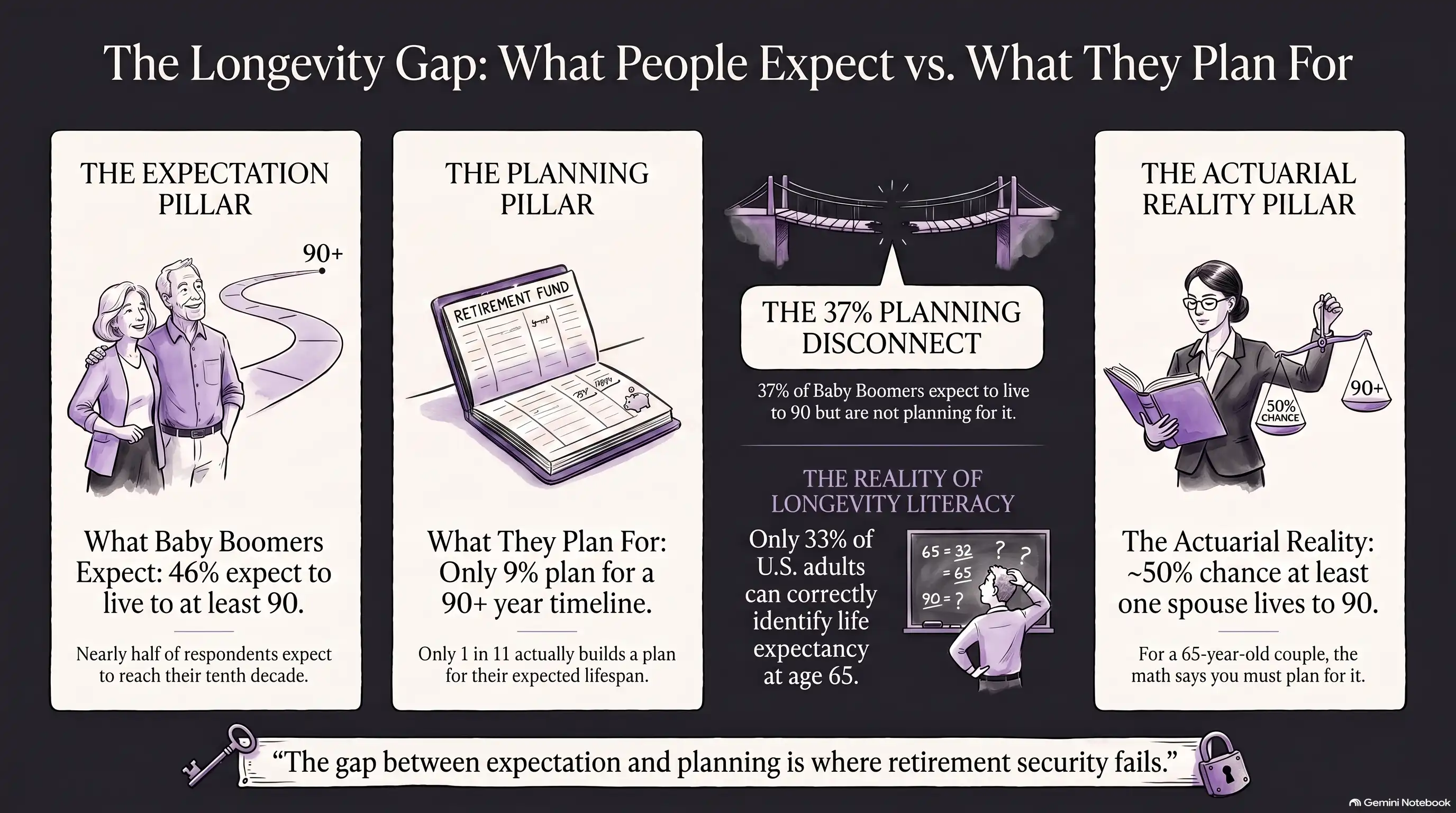
If you are 65 today and in reasonably good health, there is roughly a 1-in-3 chance you will live past 90\. Most retirement plans end at 85\. That 5-to-10 year gap — between when most plans run out and when many people actually die — is not a planning detail. It is the difference between financial security and financial crisis in the final years of life, when health costs are highest, when cognitive capacity to manage finances is declining, and when there is no longer time to recover from the shortfall. Only 9% of Baby Boomers who expect to live to 90 are actually planning for that timeline. This article is for the other 91%.
Here is the retirement planning question almost nobody asks correctly.
Not "how much do I need to retire?" Not "what is a safe withdrawal rate?" Not "when should I claim Social Security?"
The question that precedes all of those — and that determines whether any of the answers actually matter — is: how long does the plan need to last?
Most people answer this question badly. Not because they are careless, but because human beings are systematically poor at estimating their own longevity, and because the financial planning industry has historically built retirement projections to convenient endpoints rather than realistic ones.
The TIAA Institute's 2026 longevity literacy research is specific about the scale of the problem: only 33% of U.S. adults can correctly identify life expectancy at age 65. 32% underestimate it. 22% admit they simply do not know. And in a finding that captures the core of the planning failure, 46% of Baby Boomer respondents expected to live to at least 90 — but only 9% were actually planning for that timeline.
The gap between what people expect and what they plan for is where retirement security fails. Not dramatically, not all at once, but gradually — in the 87th year when the portfolio has run short of projections, in the 89th year when healthcare costs have exceeded every estimate, in the 91st year when the money the plan said would be there is not.
This article is about that gap — what creates it, what it costs, and what planning looks like when longevity is taken seriously as the organizing risk of retirement.
The Numbers That Change How Long You Plan For
The average life expectancy at birth in the U.S. is 79.6 years in 2026. That number is not useful for retirement planning. It is a population average that includes people who die young — from accidents, from childhood illness, from conditions that do not apply to a healthy 65-year-old who has made it to retirement.
The numbers that matter are conditional life expectancy — life expectancy given that you have already reached a specific age. They are significantly higher than the at-birth figures and significantly higher than most people's intuition.
A 65-year-old man today can expect to live to approximately 84. A 65-year-old woman can expect to live to approximately 86. Those are the averages — but averages conceal the distribution that matters for planning.
A meaningful share of healthy 65-year-olds will live into their 90s. A significant minority will reach 95. For a married couple both aged 65, the probability that at least one spouse is still alive at 90 is approximately 50%. The probability that at least one reaches 95 is meaningful enough to warrant planning consideration.
These are not worst-case scenarios. They are statistically normal outcomes for healthy people who reach retirement age.
The planning implication is direct. A plan that ends at 85 — the most common planning horizon in generic retirement calculators — has a meaningful probability of running short for an individual and a high probability of running short for a married couple where one spouse has typical longevity.
Planning to 90 is more honest. Planning to 95 is prudent for anyone in reasonable health with family history of longevity. Planning to 95 or 100 for high-income earners, as many advisors now recommend, accounts for the correlation between income, access to healthcare, and longer life.
Why Longevity Risk Is Different From Every Other Retirement Risk
Market risk is visible. A 30% portfolio decline shows up immediately in the account balance and triggers an emotional response that leads to either panic or deliberate adjustment. The risk is present, quantifiable, and impossible to ignore.
Longevity risk is invisible until it is not. Each additional year of life is not an event — it is the gradual accumulation of years that the plan did not model. The portfolio does not announce that it is ten years from running out. The healthcare costs do not spike visibly until they do. The cognitive decline that makes financial management harder does not arrive with a warning label.
This asymmetry — market risk visible and immediate, longevity risk gradual and cumulative — means that longevity risk is consistently underweighted in financial planning even when the statistical case for taking it seriously is overwhelming.
The practical consequence is specific. A portfolio designed to last 25 years that actually needs to last 35 years does not fail dramatically at year 25. It fails gradually — through a withdrawal rate that was sustainable at 65 and is no longer sustainable at 80, through healthcare costs that were modeled at current rates and have grown significantly over 20 years, through the accumulated consequence of small shortfalls that were managed individually but compound over a decade into a structural problem.
The failure mode of longevity risk is not running out of money suddenly. It is arriving at 88 with a portfolio that is 40% of what the plan projected — and no time, no earnings capacity, and possibly reduced cognitive capacity to address it.
The Four Ways Longevity Changes Every Retirement Calculation
1. The Safe Withdrawal Rate Is Lower Than You Think
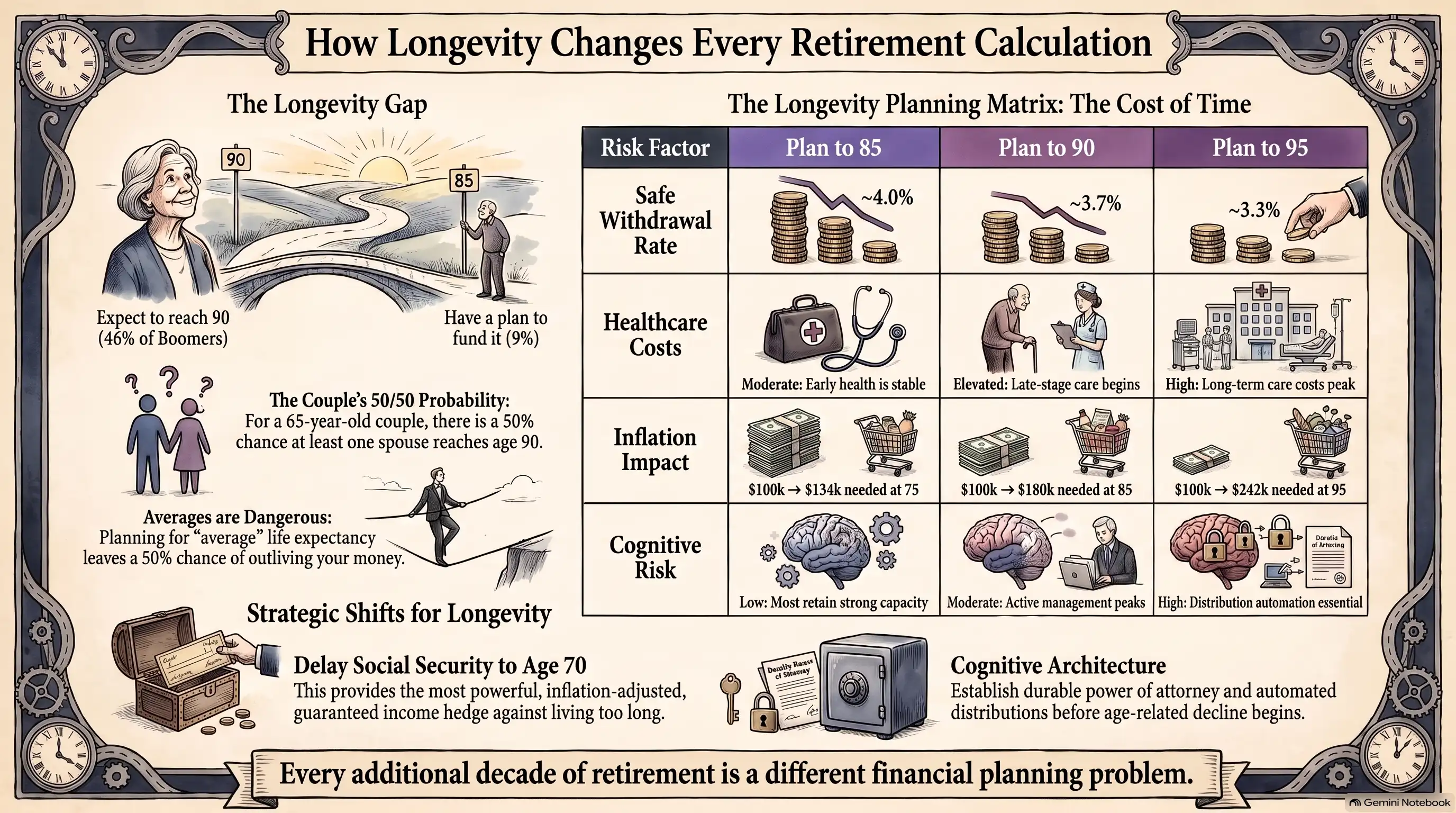
The 4% rule — withdraw 4% of the portfolio in year one, then adjust for inflation — was derived from research on 30-year retirement horizons. For a 35-year horizon, the safe starting withdrawal rate is approximately 3.3-3.5% for a balanced portfolio. For a 40-year horizon, it drops further.
Morningstar's 2026 retirement income research puts the base-case safe withdrawal rate for a 30-year horizon at 3.9% — already below the familiar 4% rule. For retirees planning to 95 or beyond, the sustainable rate for a balanced portfolio is lower still.
The difference between a 4% withdrawal rate and a 3.5% withdrawal rate on a $1 million portfolio is $5,000 per year. Over 30 years of retirement, that $5,000 per year difference either extends the portfolio significantly or represents a meaningful lifestyle adjustment. Which direction it goes depends on whether the planning horizon was set honestly or conveniently.
2. Healthcare Costs Are a Longevity-Amplified Problem
Healthcare costs in retirement are not linear. They do not simply grow with inflation each year. They grow slowly in the early retirement years — when most retirees are relatively healthy and Medicare plus a supplemental plan covers most needs — and accelerate dramatically in the final years, when long-term care costs, specialized care, and end-of-life expenses arrive together.
Fidelity's 2026 estimate for the average 65-year-old couple's lifetime healthcare costs is $315,000 — and that figure does not include long-term care. The Stanford Center on Longevity estimates that a retiree who reaches 85 will spend approximately twice as much on healthcare in years 85-95 as they spent in years 65-75.
A retirement plan designed to 85 models perhaps 5-7 years of elevated healthcare costs. A retirement plan designed to 95 models 15-20 years of elevated costs, with the highest-cost period clustered in the final years. The difference in healthcare cost modeling alone can change the required retirement portfolio by hundreds of thousands of dollars.
3. Inflation Has More Time to Compound
Inflation's effect on purchasing power is not an annual irritant — it is a compounding erosion that becomes significant over long time horizons.
At 3% annual inflation, $100,000 of retirement spending at 65 requires $134,000 at 75 to buy the same things. At 85, it requires $180,000. At 95, it requires $242,000. A retirement plan designed for 20 years models two doublings of the price level. A retirement plan designed for 30 years models three.
The portfolio withdrawal that was sized for $100,000 of spending at 65 will not, by year 30, be sufficient to fund the inflation-adjusted equivalent of that spending — unless the plan explicitly models this and maintains adequate growth assets to outpace inflation across the full planning horizon.
Healthcare inflation compounds on top of general inflation. Medical costs have historically risen at 2-3 percentage points above general inflation. The intersection of general price increases and above-average healthcare inflation over a 30-year retirement produces planning math that many retirees and many retirement plans have never actually run.
4. Cognitive Decline Arrives Before the Money Runs Out
The financial planning conversation about longevity almost exclusively focuses on the portfolio — will the money last? It rarely addresses the equally important question of who will manage the money if the original planner cannot.
Financial decision-making ability peaks in the mid-50s and declines gradually from there. By 80, a meaningful percentage of the population has some measurable cognitive impairment. By 85 and beyond, the percentage with significant impairment is substantial.
A 30-year retirement plan — for someone who retires at 65 — runs through the years when cognitive management of the portfolio becomes progressively more challenging. The plan that was built by a financially sophisticated 62-year-old and is managed optimally at 70 may be managed sub-optimally at 80 and may not be manageable at all at 88.
This is not a reason to be pessimistic about longevity. It is a reason to build the financial plan to be manageable as cognitive capacity changes — simplified account structures, trusted contacts on every account, clear successor decision-making authority through durable power of attorney, and distribution automation that does not require active optimization decisions every year.
What Longevity-Aware Planning Actually Looks Like
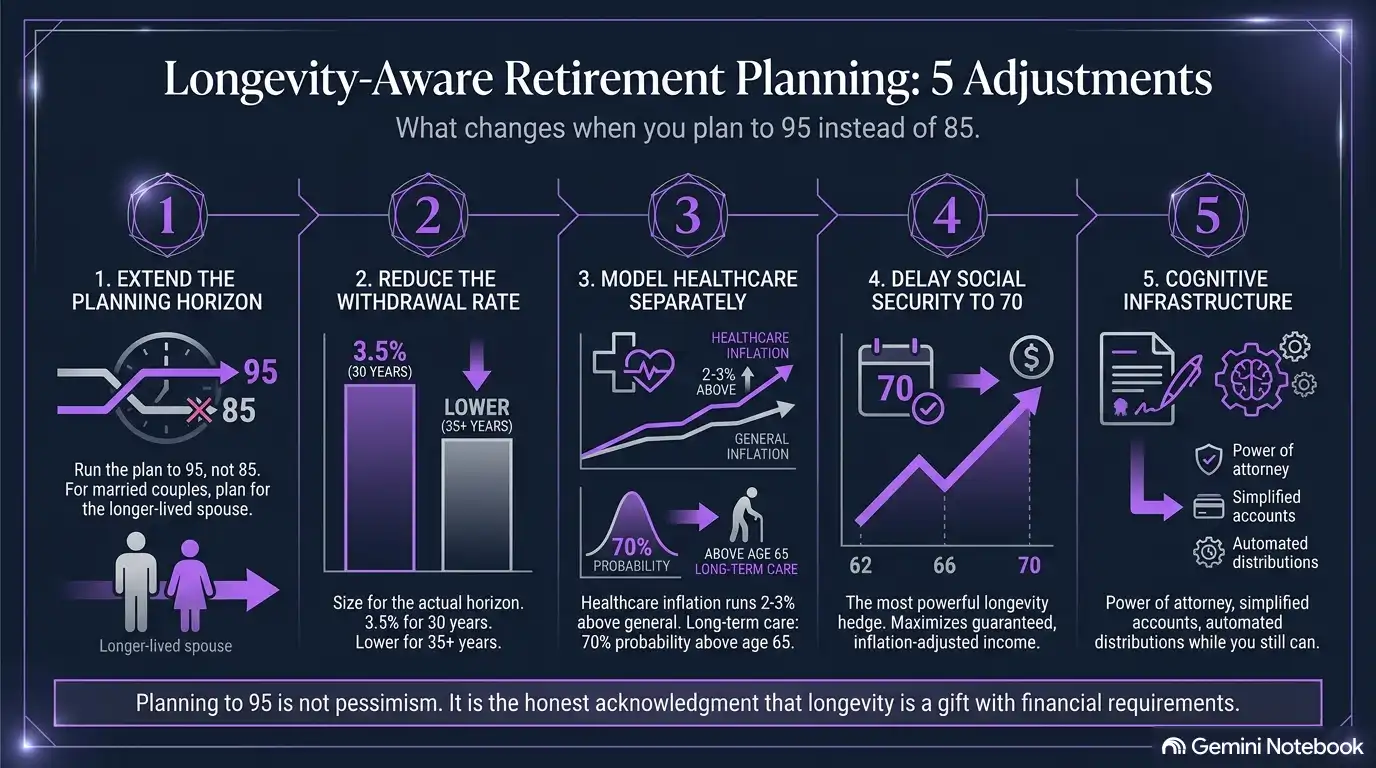
Planning honestly for longevity requires adjusting five specific elements of the retirement plan.
One: The Planning Horizon
Run the plan to 95, not 85. For married couples, run to the age where the probability of both spouses having passed away is high — typically 95-97 for couples where both are currently healthy and in their mid-60s. For someone with strong family history of longevity, consider 100.
A plan that succeeds to 95 and has money left over is a good problem. A plan that runs out at 88 is not recoverable.
Two: The Withdrawal Rate
Size the initial withdrawal rate for the actual planning horizon. A 3.5% withdrawal rate on a $1 million portfolio produces $35,000 per year. A 4% withdrawal rate produces $40,000. The $5,000 difference matters — but less than the difference between a plan that lasts 30 years and one that lasts 35.
Use a flexible guardrails approach rather than a fixed withdrawal rate. When portfolio performance is above target, spending can increase. When it is below, spending adjusts — typically by 10% — to preserve the portfolio. The flexibility to reduce spending in bad years is the mechanism that allows higher starting withdrawal rates without increasing the probability of running out.
Three: Healthcare Cost Modeling
Model healthcare costs with a separate budget line that grows at healthcare inflation — historically 2-3 points above general inflation — rather than folding it into a general spending projection adjusted by general inflation. The difference is significant over 25-30 years.
Include a long-term care scenario. The probability of needing some form of long-term care above age 65 is approximately 70%. The median annual cost of a semi-private nursing home room in 2026 is $95,000. A plan that does not model this scenario — even as a probability-weighted cost — is incomplete.
Four: Social Security Optimization for Longevity
Delaying Social Security to 70 is the most powerful longevity hedge available to most retirees. The benefit grows by approximately 8% per year between full retirement age and 70. At 85, the cumulative lifetime Social Security income from claiming at 70 versus claiming at 62 is substantially higher for someone who lives a normal lifespan.
More importantly, Social Security is inflation-adjusted guaranteed income that does not run out. A larger Social Security benefit reduces the portfolio withdrawal rate required in early retirement and provides a more durable income floor in the later years when the portfolio is smaller and longevity risk is highest.
For a married couple, the higher earner delaying to 70 also maximizes the survivor benefit — the benefit the surviving spouse receives after the first death. In the late retirement years, the Social Security income floor provided by the maximized benefit may be the difference between financial security and financial vulnerability.
Five: The Legacy and Cognitive Decline Architecture
A longevity-aware plan includes the legal and organizational infrastructure for the years when active financial management becomes difficult.
Durable power of attorney for finances — designating someone who can manage financial affairs if cognitive capacity declines. Simplified account structure — consolidating accounts where possible to reduce the complexity of ongoing management. Trusted contacts on investment accounts — giving financial institutions someone to contact if they have concerns about the account holder's capacity. Automated distributions — setting up systematic withdrawals that do not require active decision-making each month.
These are not end-of-life considerations. They are mid-retirement infrastructure that needs to be established while the person has full capacity to make deliberate, legally unambiguous choices.
The Monte Carlo Lens on Longevity
The retirement calculators most people use model one scenario — a single projection based on average returns and average life expectancy. This approach systematically underweights longevity risk because it models the average outcome rather than the distribution of outcomes.
A Monte Carlo simulation does something categorically different. It runs 25,000 scenarios — 25,000 different possible sequences of market returns — against the actual retirement plan. The result is not a single projected outcome but a probability distribution: what percentage of scenarios result in the portfolio lasting to 85? To 90? To 95? To 100?
The question that longevity-aware planning asks of the Monte Carlo is specific: what is the probability of success at age 95, not at age 85? A plan that shows 90% success probability to age 85 may show only 60% success probability to age 95 — because the additional 10 years expose the portfolio to additional sequence risk, additional healthcare costs, and continued inflation erosion.
The 60% success probability to 95 is not acceptable. It means that in 40% of possible scenarios, the money runs out before age 95. For a healthy 65-year-old, that is a 40% probability of financial crisis in the final decade of life.
Arthavita's 25,000-scenario Monte Carlo simulation allows users to set the analysis end point — to run the simulation to 85, to 90, to 95, to 100 — and see how the success probability changes. The gap between the success probability at 85 and the success probability at 95 is the longevity gap in the plan: the amount of additional risk the portfolio carries for each additional year of life beyond the convenient planning endpoint.
Closing that gap requires adjusting one or more of the inputs — the withdrawal rate, the Social Security claiming age, the portfolio allocation, the retirement date — until the success probability at the honest planning horizon reaches an acceptable level.
What 95 Actually Looks Like — The Human Reality
There is something worth acknowledging directly about what planning to 95 involves.
It is not planning for a decade of robust activity and travel. For most people, the late 80s and 90s involve some combination of reduced mobility, increasing healthcare dependence, cognitive change, and the accumulated losses of a long life — friends, siblings, sometimes children. The financial planning for these years is not about abundance. It is about security, dignity, and not becoming a financial burden on the people who will be managing their own lives and their own families.
The person who runs out of money at 88 in failing health, with children who are themselves in their 60s, does not have the options that existed at 65. The window for correction has long closed. The only question is who absorbs the shortfall — the person themselves, through reduced care and diminished dignity, or the children, through financial support they may or may not be able to provide without damage to their own retirement.
Planning to 95 is not pessimistic. It is the honest acknowledgment that longevity is a gift with financial requirements — and that the requirements of the final decade are specific, significant, and very different from the requirements of the first decade of retirement.
The plan that extends to 95 gives the 88-year-old options. The plan that ended at 85 gives them none.
Frequently Asked Questions
If average life expectancy is 84-86, why should I plan to 95?
Because average life expectancy is the age at which half the population has already passed away — meaning half live longer. For a healthy person reaching retirement, the probability of living significantly past the average is substantial. For a married couple, the probability that at least one spouse lives to 90 is approximately 50%. Planning to average life expectancy means a roughly 50% chance of outliving the plan.
Won't I naturally spend less as I get older?
In the early stages of aging, yes — research on the retirement spending smile shows real, inflation-adjusted spending declining through the 70s as travel and activity decrease. But this decline reverses in the late 80s and 90s as healthcare costs accelerate. The net effect over a full 30-year retirement is not a meaningful reduction in total spending — healthcare cost increases offset the spending reductions in most scenarios.
How do I close the longevity gap in my retirement plan?
The most powerful single lever is delaying Social Security to 70 — it provides the largest guaranteed, inflation-adjusted income for the years when the portfolio is under maximum pressure. Beyond that: reducing the initial withdrawal rate, maintaining adequate growth assets to outpace inflation over the full horizon, purchasing long-term care insurance before health conditions develop, and running the retirement plan to 95 rather than 85 to identify the structural gaps before retirement rather than after.
I am already retired. Is it too late to address longevity risk?
No — but the options are different. The Roth conversion window may still be partially open. Social Security claiming, if not yet started, can still be optimized. Long-term care insurance may still be available if health conditions have not developed. And the structural changes — simplified accounts, trusted contacts, legal documents, automated distributions — can be implemented at any point while cognitive capacity remains strong. The earlier the better, but not too late until it is genuinely too late.
What should I plan to if I have family history of long life?
If your parents or grandparents regularly lived into their 90s, planning to 95 is appropriate for most people. Planning to 100 is worth stress-testing for high earners with strong family history. The cost of planning to 100 and dying at 88 is money left to heirs. The cost of planning to 85 and dying at 95 is financial crisis in the final decade of life. The asymmetry strongly favors planning for longer.
Have a question this article didn't answer?
Longevity planning is specific to your health, your family history, your account structure, and your income sources. If something here raised a question about your specific situation, send us a note at support@arthavita.co and we will do our best to address it directly or in a future post.
Arthavita is an educational and planning platform. This article is for informational purposes only and does not constitute personalized financial, tax, or legal advice. All financial decisions remain with you. For personalized guidance, consult a qualified financial or tax professional.
Ketan Patel
Founder, Arthavita
Ketan Patel is the founder of Arthavita and a multi-industry entrepreneur with 30+ years of experience in technology and business operations. He built Arthavita to bring institutional-quality financial intelligence to individual investors.
LinkedIn ↗This article is for educational purposes only and does not constitute financial, tax, or legal advice. Arthavita is a recommendation-only platform. Always consult a qualified professional before making financial decisions.