
The Healthcare Bridge: What Nobody Tells You About Medicare at 65
Medicare is not free, does not cover everything, and the decisions you make when you first enroll cannot easily be undone. The standard Part B premium in 2026 is $202.90 per month — but higher-income retirees pay up to $628.90 per month based on income from two years prior. The choice between Original Medicare with a Medigap supplement and Medicare Advantage is one of the largest financial decisions of retirement, and most people make it in the 7-month enrollment window with incomplete information. Missing the enrollment window results in permanent 10% per year late enrollment penalties for Part B. And the Roth conversion you execute at 63 shows up in your Medicare premiums at 65\. These decisions do not live in isolation. This article explains the complete healthcare bridge.
Nobody prepares you for the healthcare conversation at 65.
Not the financial advisor who managed the portfolio. Not the HR department at the company you retired from. Not the Medicare.gov website, which is accurate but assumes familiarity with a four-part system that most people encounter for the first time three months before their 65th birthday.
What most people know about Medicare at 64: it starts at 65, it covers most things, and it is probably free or close to it.
What is actually true: Medicare has four separate parts, each with its own premium, deductible, and coverage scope. The standard Part B premium is $202.90 per month in 2026 — and higher-income retirees pay up to $628.90 per month based on income they reported two years ago. There is no out-of-pocket maximum in original Medicare without a supplement. The choice between coverage paths — made once in a 7-month window — is difficult to reverse. And late enrollment, even by a single month, triggers permanent penalty surcharges that never go away.
The healthcare bridge is the period between retirement and — for most people who retire before 65 — Medicare eligibility. It is also the Medicare decision itself: understanding how the system works, which coverage path is right for your specific situation, and how Medicare premiums interact with the Roth conversions, taxable income, and Social Security decisions that are being made in the same years.
This article is the explanation nobody gave you.
The Four Parts — What Each One Does
Medicare's four-part structure is the source of most of the confusion that surrounds the program. Each part covers different services, has different premiums, and comes from different sources.
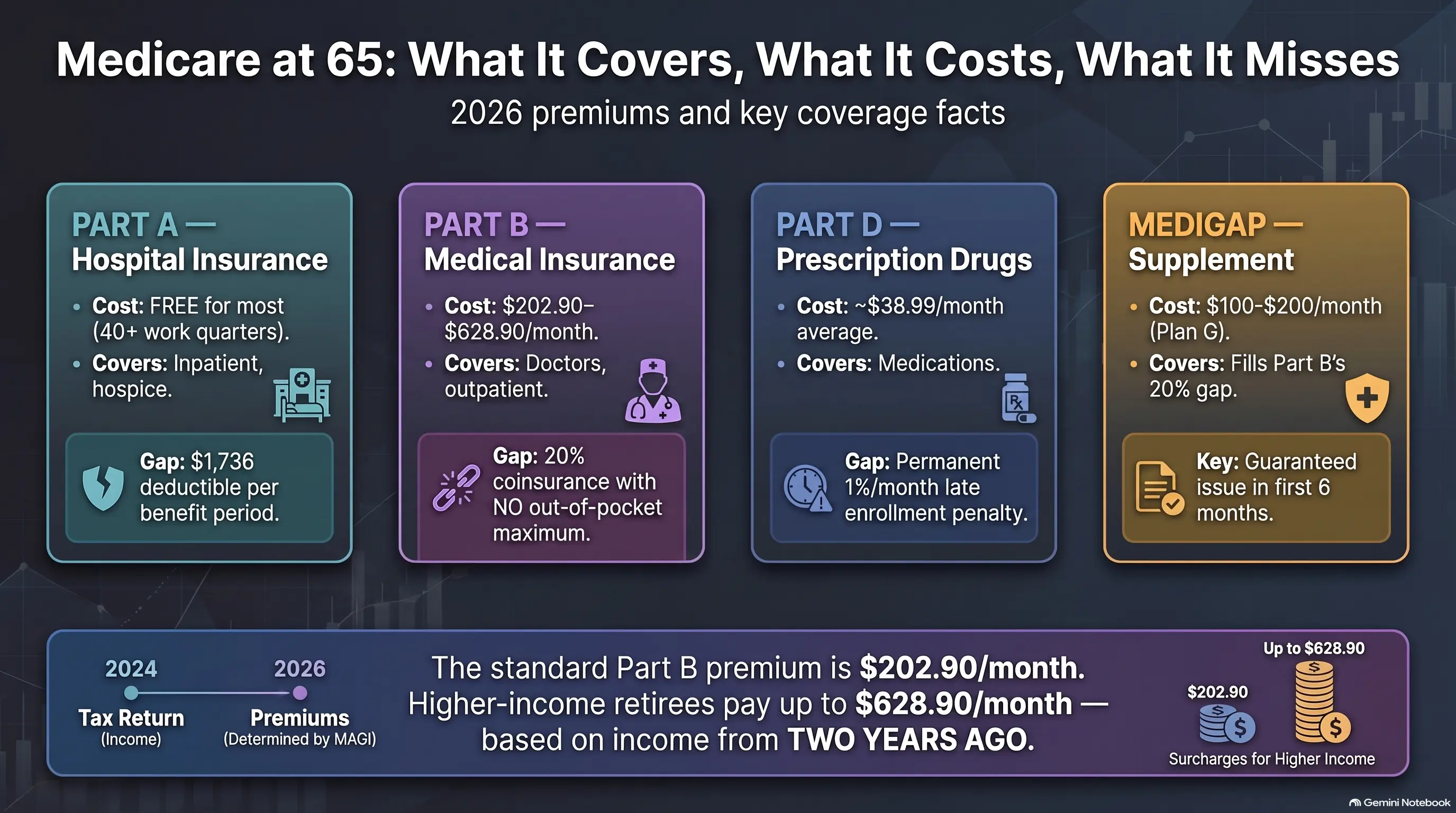
Part A — Hospital Insurance Part A covers inpatient hospital care, skilled nursing facility care following a qualifying hospital stay, hospice care, and some home health services.
Most people receive Part A premium-free — if you or your spouse have at least 40 quarters (10 years) of Medicare-covered work, Part A has no premium. The Part A deductible in 2026 is $1,736 per benefit period — not per year, but per hospital admission separated by 60 days. A person hospitalized twice in one year with more than 60 days between stays pays the deductible twice.
Part B — Medical Insurance Part B covers outpatient medical services: doctor visits, preventive care, diagnostic tests, durable medical equipment, and outpatient mental health services.
Part B is optional — but declining it without qualifying coverage triggers permanent penalties. The standard premium in 2026 is $202.90 per month. The Part B deductible is $283 per year, after which Medicare pays 80% of approved charges and the beneficiary pays 20% with no annual out-of-pocket maximum.
That uncovered 20% with no cap is the reason most people add supplemental coverage. A single major hospitalization or surgical procedure can leave a beneficiary with tens of thousands in 20% coinsurance without any ceiling.
Part C — Medicare Advantage Part C is not a separate coverage layer. It is an alternative delivery mechanism — private insurance plans that replace original Medicare (Parts A and B) and typically include Part D drug coverage. Medicare pays a fixed amount to the private plan; the plan provides Medicare-covered benefits, often with additional benefits like dental, vision, and hearing, typically through a network of providers.
Medicare Advantage plans may have $0 premiums, which can make them appear significantly cheaper than original Medicare plus a Medigap supplement. The trade-offs — provider networks, prior authorization requirements, out-of-pocket maximums that can reach $8,850 or more, and geographic restrictions — are less visible at enrollment.
Part D — Prescription Drug Coverage Part D covers prescription medications through private plans. The national base beneficiary premium is $38.99 per month in 2026. Actual plan premiums vary significantly by plan and by the drugs covered.
Part D enrollment is critical even for people who currently take few or no medications. Failing to enroll in Part D during the initial enrollment window — or maintaining creditable drug coverage through another source — triggers a permanent late enrollment penalty of 1% of the national base premium for each month without coverage. A 36-month gap creates a permanent 36% surcharge on the Part D premium for as long as the beneficiary is enrolled.
The IRMAA Problem — Why Your 2026 Income Affects Your 2028 Medicare Premiums
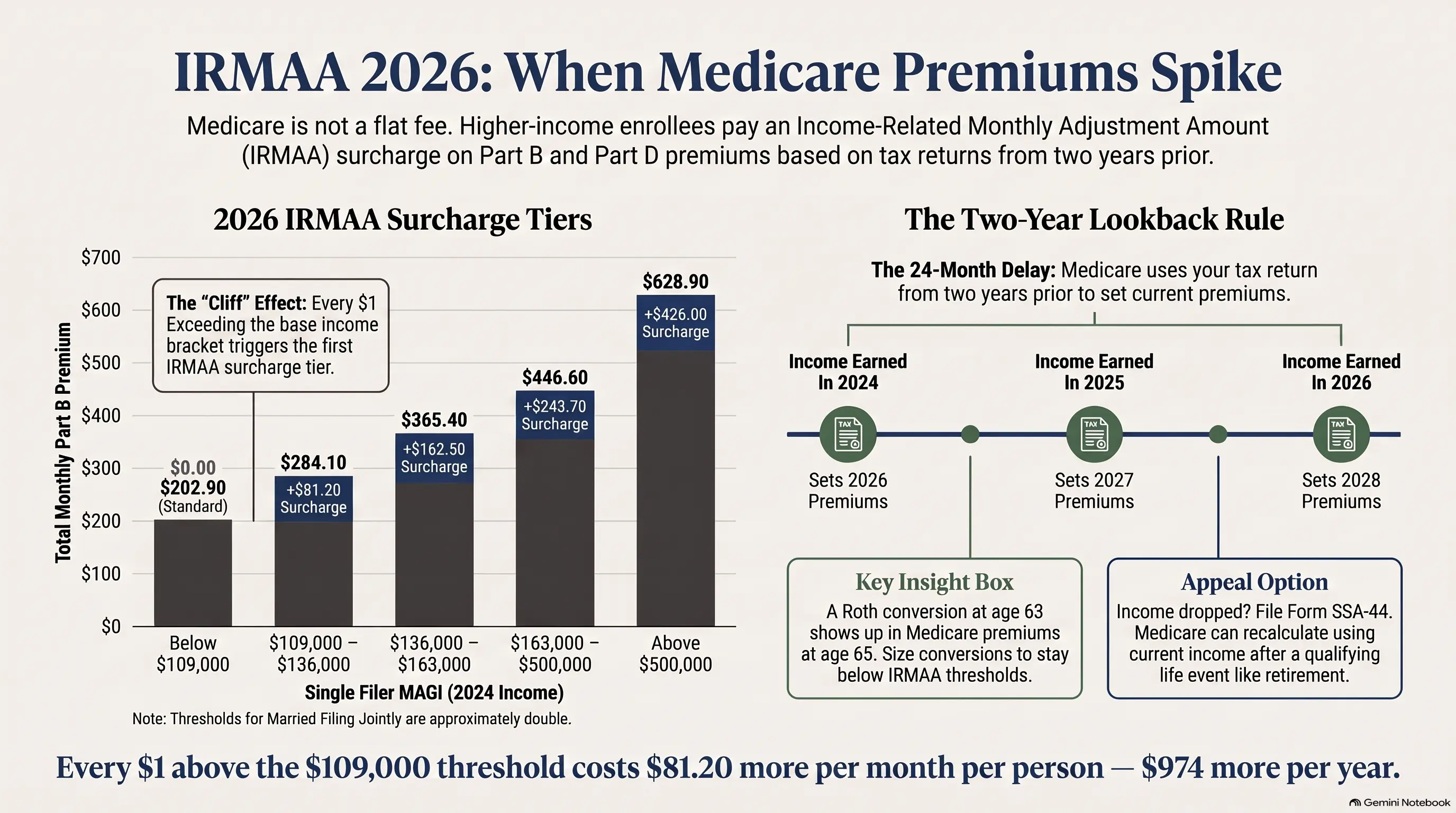
IRMAA — the Income-Related Monthly Adjustment Amount — is a surcharge added to Medicare Part B and Part D premiums when income exceeds certain thresholds. In 2026, IRMAA begins at $109,000 of Modified Adjusted Gross Income for single filers and $218,000 for married filing jointly.
The surcharge is significant. At the first IRMAA tier, the Part B premium jumps from $202.90 to $284.10 per month — an increase of $81.20 per month per person. At the highest tier, the Part B premium reaches $628.90 per month. For a married couple, doubling these amounts gives the household impact.
The critical planning nuance: Medicare uses income from two years prior to set premiums. The MAGI reported on your 2024 tax return determines your 2026 Medicare premiums. Your 2025 MAGI determines your 2027 premiums.
This two-year lookback has a specific implication that most pre-retirees do not know: a Roth conversion executed at age 63 shows up in Medicare premiums at age 65. An aggressive conversion strategy that generates a large taxable income in year one of retirement can trigger IRMAA surcharges in year three of retirement — a delayed penalty that many people never anticipate.
The planning implication: income management in the years before Medicare begins — specifically at ages 63 and 64 — requires modeling not just the immediate tax cost but the IRMAA consequence two years later. A Roth conversion that seems optimal based on current-year taxes may produce Medicare premium surcharges that reduce its net benefit substantially.
For someone who experiences a qualifying life change — retirement, divorce, death of a spouse — that reduces income after the base year, IRMAA can be appealed using Form SSA-44. The appeal allows the Social Security Administration to use a more recent income year for the determination. This appeal process is underused because it is not prominently explained.
The Coverage Decision — Original Medicare vs. Medicare Advantage
The most consequential Medicare decision most people make is the choice between original Medicare with a Medigap supplement and Medicare Advantage. This decision is made once — during the initial enrollment window — and is significantly more difficult to reverse than most people realize.
Original Medicare with Medigap:
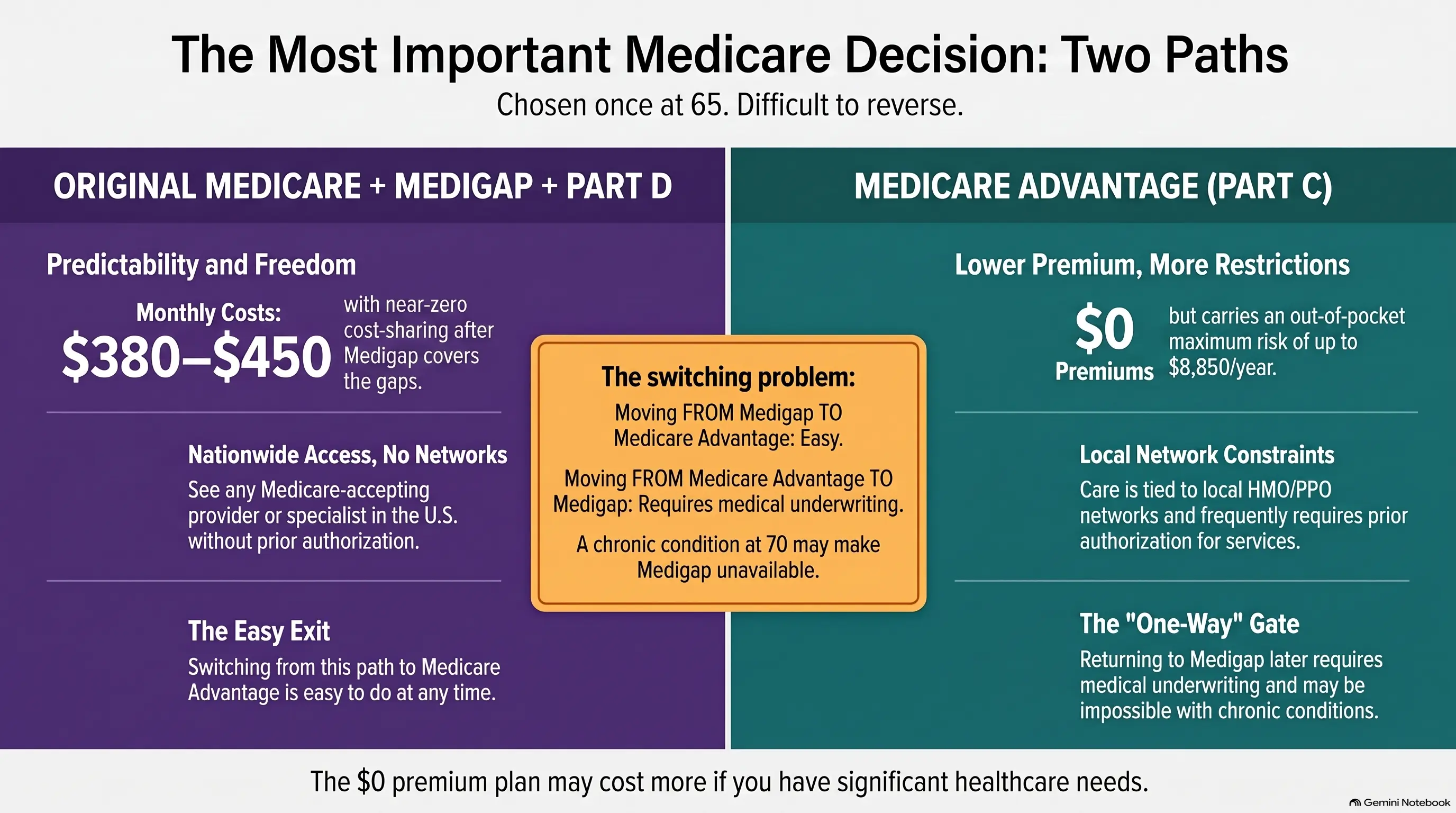
Original Medicare (Parts A and B) covers 80% of approved charges after deductibles, with no out-of-pocket maximum. A Medigap plan — specifically Plan G, which is the most comprehensive option for new Medicare enrollees in 2026 after Plan F was eliminated for new enrollees — covers most of the remaining 20%, including the Part A deductible, the Part B excess charges, and foreign travel emergency coverage.
The cost: Part B premium ($202.90 standard) plus Medigap Plan G premium (typically $100-$200 per month depending on age and location) plus Part D premium. Total monthly cost at standard income for a typical enrollee: approximately $380-$450 per month.
The benefit: predictable costs, no provider networks, access to any Medicare-accepting provider anywhere in the United States — which matters for people who travel, split time between states, or live in rural areas with limited plan networks. There is no prior authorization requirement for most services.
Medicare Advantage:
Medicare Advantage plans often have $0 premiums, which creates an appearance of significant cost advantage over original Medicare plus Medigap. The actual cost comparison requires understanding the plan's out-of-pocket maximum and the probability of reaching it.
Medicare Advantage plans often use HMO or PPO structures with provider networks. Care outside the network is typically more expensive or not covered for non-emergency situations. Prior authorization for certain procedures adds administrative friction. Out-of-pocket maximums for Medicare Advantage plans can reach $8,850 per year for in-network care and higher for out-of-network.
The $0 premium Medicare Advantage plan may ultimately cost more than a $200/month Medigap plan if the enrollee has significant healthcare needs — because the Medigap plan's higher premium comes with near-total coverage of cost-sharing, while the Medicare Advantage plan's low premium comes with meaningful cost-sharing exposure.
The switching problem:
During the initial enrollment period, anyone can choose either path. The difficulty arises when someone enrolled in Medicare Advantage wants to switch to original Medicare with Medigap.
Medigap plans have medical underwriting outside of guaranteed issue periods. A person who enrolled in Medicare Advantage at 65 with a $0 premium and wants to switch to a Medigap plan at 70 may find that health conditions developed in the intervening years make Medigap coverage unavailable or priced prohibitively.
The guaranteed issue period — when Medigap insurers must offer coverage without medical underwriting — lasts 6 months from when Part B coverage begins. After that window closes, Medigap is available only at the insurer's discretion and at medically underwritten rates.
This asymmetry — easy to move from Medigap to Medicare Advantage, difficult to move back — creates a risk that is invisible at enrollment and significant in hindsight. The person who chose Medicare Advantage at 65 for the $0 premium and develops a chronic condition at 70 may find themselves permanently in Medicare Advantage, with its network and prior authorization constraints, because the Medigap market is no longer available to them.
For people who prioritize provider flexibility and predictable costs, choosing original Medicare with Medigap at 65 — while guaranteed issue is available — is the conservative decision that preserves options. For people who are comfortable with provider networks and whose healthcare needs are currently minimal, Medicare Advantage may provide meaningful value.
The Healthcare Bridge Before 65
For anyone who retires before 65 — before Medicare eligibility — the healthcare bridge is a specific financial planning problem that deserves explicit treatment.
COBRA: COBRA allows continuation of employer health coverage for up to 18 months after leaving employment. The cost is the full premium plus a 2% administrative fee — typically $600-$1,200 per month for an individual, $1,500-$2,500 or more for a family. COBRA is expensive but provides continuity of coverage and network without requiring new enrollment decisions.
COBRA's 18-month maximum creates a specific timing problem. Someone who retires at 63 uses COBRA for 18 months, reaches 64.5, and then needs marketplace coverage for 6 months before Medicare begins. The marketplace transition requires an active decision and may involve network changes.
ACA Marketplace: The ACA marketplace provides individual health insurance outside of employer coverage. Premium tax credits are available based on income — but the subsidy cliff at $84,600 for a two-person household in 2026 is the critical constraint.
Crossing the subsidy cliff by even one dollar of income eliminates all premium assistance for the entire year. A household carefully managing income to stay below $84,600 to receive marketplace premium credits must model every income source — Social Security if claimed, Roth conversion amounts, taxable investment income, part-time earnings — against the cliff.
The ACA enhanced subsidies that had been in place since 2021 expired at the end of 2025. In 2026, silver plan premiums can exceed 8.5% of annual income for many pre-Medicare households — a significantly higher cost than was available in recent years. Planning the income structure of the pre-Medicare years with awareness of the subsidy cliff is now more financially consequential than it was in prior years.
HSA strategy in the bridge years: If enrolled in a High Deductible Health Plan (HDHP) during the pre-Medicare bridge years, HSA contributions provide a triple tax advantage — deductible contribution, tax-free growth, tax-free withdrawal for medical expenses.
One critical rule: HSA contributions must stop 6 months before Medicare enrollment begins, because Medicare enrollment triggers retroactive Part A coverage for 6 months. Contributing to an HSA during those 6 months creates excess contribution penalties. Planning the Medicare enrollment timing relative to final HSA contributions requires explicit coordination.
The Enrollment Window — The Deadline That Never Goes Away
Medicare enrollment is not automatic for most people under 65. The Initial Enrollment Period begins 3 months before the month you turn 65 and ends 3 months after — a 7-month window.
Enrolling in Part B during this window protects against the late enrollment penalty. Missing the window without qualifying coverage triggers a 10% permanent surcharge on the Part B premium for each 12-month period without coverage. A 36-month gap creates a permanent 30% surcharge. On a $202.90 base premium, that permanent penalty adds $60.87 per month — for life.
The exception for people still working: If you or your spouse are actively employed and covered by qualifying employer group health insurance when you turn 65, you can delay Part B enrollment without penalty. The special enrollment period — when you can enroll without penalty — begins when the employer coverage ends.
The employer must have 20 or more employees for this exception to apply. COBRA, retiree coverage, and coverage from a spouse's employer may or may not qualify depending on the specific circumstances. Confirm with both the employer and Medicare before assuming the exception applies.
The Part D parallel: The same logic applies to Part D. Enrolling in a Part D plan during the initial enrollment window — or maintaining creditable prescription drug coverage through another source — prevents the permanent late enrollment penalty. The penalty is 1% of $38.99 (the 2026 national base premium) for each month without creditable coverage. It is permanent, it compounds on future premium increases, and it is widely underestimated because the monthly dollar amount seems small at first.
How Medicare Fits the Coordinated Retirement Income Plan
The Medicare guidance in isolation is important but incomplete. What makes the Medicare decision genuinely consequential is how it interacts with the other retirement income decisions being made in the same years.
The Roth conversion executed at 63 generates taxable income that appears in the 2025 tax return and sets the 2027 Medicare IRMAA determination. The Social Security claiming decision at 67 generates Social Security income that, combined with IRA withdrawals, affects provisional income and Medicare IRMAA. The asset allocation in retirement affects investment income, capital gains realizations, and therefore MAGI in each year.
These are not separate decisions. They are one coordinated income management problem across the pre-Medicare and early Medicare years — roughly ages 60 to 70 — where the interaction effects are significant and where getting one decision wrong ripples into others.
The framework for coordinating these decisions:
Model IRMAA exposure in every year from 63 onward. Know the thresholds — $109,000 single, $218,000 married for 2026 — and model whether Roth conversions, taxable income, and other sources push income above them.
Sequence Roth conversions to avoid IRMAA thresholds. A conversion that stays $10,000 below the IRMAA threshold saves $81.20 per month per person in Medicare premiums two years later — $1,946 per year per person. That is real money, and it should be modeled explicitly rather than discovered after the fact.
If income spikes in a prior year due to retirement, rollover, or asset sale, file Form SSA-44 to request IRMAA recalculation based on current income. Many retirees pay IRMAA surcharges they could have appealed.
Plan the Medicare enrollment date relative to HSA contribution timing. Final HSA contributions must stop 6 months before Medicare enrollment to avoid excess contribution penalties.
Arthavita's Medicare and Healthcare module — part of the Pre-Retirement life stage dashboard — models IRMAA exposure against current income projections, surfaces the Roth conversion sizing that stays below IRMAA thresholds, and integrates the healthcare cost projection into the full Monte Carlo simulation. The healthcare bridge is not a separate planning exercise. It is part of the coordinated retirement income plan.
The Numbers That Matter in 2026
Part B premium: Standard: $202.90/month IRMAA Tier 1 ($109,000-$136,000 single): $284.10/month IRMAA Tier 2 ($136,000-$163,000 single): $365.40/month IRMAA Tier 3 ($163,000-$500,000 single): $446.60/month IRMAA Tier 4 (above $500,000 single): $628.90/month
Part A deductible: $1,736 per benefit period Part B deductible: $283 per year Part D national base premium: $38.99/month Medicare Advantage out-of-pocket maximum: up to $8,850 in-network
Initial Enrollment Period: 7 months beginning 3 months before 65th birthday Part B late enrollment penalty: 10% per 12-month period without coverage — permanent Part D late enrollment penalty: 1% of national base per month without creditable coverage — permanent Medigap guaranteed issue period: 6 months from Part B effective date
Frequently Asked Questions
Is Medicare free at 65?
Part A is free for most people with 40 or more quarters of work history. Part B is not free — the standard premium is $202.90 per month in 2026, and higher-income retirees pay significantly more. Total Medicare costs — Part B plus Part D plus supplemental coverage — typically range from $3,000 to $6,000 or more per year for a single beneficiary, before healthcare utilization.
What is the difference between Medigap and Medicare Advantage?
Medigap is a supplemental policy that works alongside original Medicare — it fills in the cost-sharing gaps that original Medicare leaves (primarily the 20% coinsurance and the Part A deductible). Medicare Advantage replaces original Medicare entirely with a private plan that typically has networks, prior authorization requirements, and its own cost-sharing structure. The key practical difference: original Medicare with Medigap provides access to any Medicare-accepting provider with predictable costs; Medicare Advantage typically limits coverage to a provider network with more variable costs depending on healthcare utilization.
Can I switch from Medicare Advantage to a Medigap plan?
Yes, but not with guaranteed coverage. After the initial 6-month guaranteed issue period, Medigap insurers can deny coverage or charge higher premiums based on medical history. Someone who develops a chronic condition while enrolled in Medicare Advantage may find Medigap unavailable when they want to switch. This is the most important risk to understand about Medicare Advantage enrollment at 65.
My Roth conversion last year was large. Will it affect my Medicare premiums?
Yes, if your Modified Adjusted Gross Income crossed the $109,000 single or $218,000 married threshold. Medicare uses income from two years prior. A large Roth conversion in 2024 affects 2026 premiums. If you have since retired and your income has decreased, file Form SSA-44 to appeal the IRMAA determination using your current or estimated income.
When should I enroll in Medicare if I am still working at 65?
If you are covered by qualifying employer group health insurance from an employer with 20 or more employees, you can delay Part B without penalty. Enroll in Part A (which is typically free) immediately, and delay Part B until the employer coverage ends. When employer coverage ends, you have an 8-month special enrollment period to enroll in Part B without penalty. Do not rely on COBRA as qualifying coverage for purposes of delaying Part B — COBRA does not count.
How do I know which Medicare Advantage plan or Medigap plan to choose?
For Medicare Advantage: compare the provider network to your current doctors, review the prior authorization requirements, and model the out-of-pocket maximum against your likely healthcare utilization. For Medigap: in most states, Plan G is the most comprehensive plan available to new enrollees. Compare premiums among carriers — all Plan G policies offer the same benefits; price and carrier financial stability are the differentiating factors. The State Health Insurance Assistance Program (SHIP) in every state provides free, unbiased Medicare counseling.
Have a question this article didn't answer?
Medicare decisions depend heavily on your specific health situation, your provider relationships, your income, and your state's rules. If something here raised a question about your specific Medicare situation, send us a note at support@arthavita.co and we will do our best to address it directly or in a future post.
Arthavita is an educational and planning platform. This article is for informational purposes only and does not constitute personalized financial, tax, legal, or medical insurance advice. Medicare rules, premiums, and coverage details change annually. For personalized Medicare guidance, contact your State Health Insurance Assistance Program (SHIP) or a qualified Medicare insurance specialist. For personalized financial guidance, consult a qualified financial or tax professional.
Ketan Patel
Founder, Arthavita
Ketan Patel is the founder of Arthavita and a multi-industry entrepreneur with 30+ years of experience in technology and business operations. He built Arthavita to bring institutional-quality financial intelligence to individual investors.
LinkedIn ↗This article is for educational purposes only and does not constitute financial, tax, or legal advice. Arthavita is a recommendation-only platform. Always consult a qualified professional before making financial decisions.