
The Grandchildren Wealth Plan: 529s, Gifts, and the Tools Nobody Explains
Most grandparents who want to help their grandchildren financially know about 529 plans. Almost none know about the three tools that make 529 plans dramatically more powerful — or the one tool that is completely unlimited, requires no account, and is the most underused wealth transfer strategy available to any family in America. A married couple with four grandchildren can legally transfer $760,000 out of their taxable estate in a single day using 2026 rules — with no gift tax, no lifetime exemption used, and all of it growing tax-free for education. This is what the grandchildren wealth plan actually looks like when it is built correctly.

There is a conversation that happens in most families at some point — usually around a holiday dinner table, usually after the grandchildren have gone to bed.
The grandparents want to help. They have built something over a lifetime. They want to see it make a difference for the next generation, not just sit in an account until it transfers through an estate. They want to be part of their grandchildren's story — to have contributed something tangible to who those children become.
What most grandparents do not have is a clear picture of the tools available to make that contribution in the most tax-efficient, financially meaningful way possible.
They know about 529 plans — vaguely. They may have contributed $1,000 or $5,000 to a grandchild's account at birthday time. What almost none of them know is that the 529 plan, combined with three specific tools most financial advisors never explain clearly, is one of the most powerful wealth transfer mechanisms in the American tax code. And what virtually none of them know is that there exists a completely separate tool — no account required, no dollar limit, no gift tax — that is the single most efficient way to transfer wealth to a grandchild for education.
This article explains all of it. Not in financial jargon. In the specific, actionable terms that turn good intentions into a plan that actually works.
The Three Numbers Every Grandparent Needs to Know in 2026
Before any strategy discussion, three numbers anchor everything:
$19,000 — the annual gift tax exclusion per recipient in 2026. A grandparent can give any grandchild up to $19,000 per year with no gift tax, no reporting requirement, and no impact on the lifetime estate tax exemption. A married couple can combine for $38,000 per grandchild per year.
$95,000 — the 529 superfunding limit per grandchild in 2026. Using a special five-year election, a grandparent can front-load five years of annual exclusions into a 529 plan in a single contribution — $95,000 for one grandchild, $190,000 from a married couple. This contribution is removed from the taxable estate immediately.
Unlimited — the direct tuition payment exclusion under IRC Section 2503(e). Payments made directly to an educational institution for tuition are not gifts at all under federal tax law. No dollar limit. No gift tax. Does not count against the annual exclusion or the lifetime exemption. This tool has no ceiling and almost no awareness outside of estate planning circles.
These three numbers — $19,000, $95,000, and unlimited — are the foundation of the grandchildren wealth plan.
The 529 Plan: What Most Grandparents Know and What They Do Not
A 529 plan is a tax-advantaged savings account for education expenses. Contributions are made with after-tax dollars. Growth inside the account is tax-free. Withdrawals for qualified education expenses — tuition, fees, books, room and board, computers — are tax-free at the federal level and in most states.
Most grandparents who have contributed to a 529 have done so in modest annual amounts — $1,000 for a birthday, $2,000 for the holidays. That is fine. But it is not the most powerful way to use the tool.
What most grandparents do not know:
The state tax deduction. Many states allow the account owner a state income tax deduction for 529 contributions — but only for contributions to their own state's plan. A grandparent in Michigan who contributes to a Michigan 529 plan can deduct up to $10,000 per year ($20,000 for married couples) from Michigan taxable income. That deduction is worth real money in states with meaningful income tax rates. Grandparents who contribute to an out-of-state plan because it has better investment options may be leaving a state tax deduction on the table.
The account ownership question. A grandparent can open their own 529 account naming the grandchild as beneficiary, or contribute to a 529 account the parents already own. Each approach has trade-offs.
A grandparent-owned 529 gives the grandparent control of the account — they decide when distributions happen and for what purpose. Under FAFSA rules as of 2024, grandparent-owned 529 accounts no longer count against the grandchild's financial aid eligibility as long as the distribution is not reported on the grandchild's FAFSA. This is a significant change from prior rules that made grandparent-owned 529s a financial aid trap.
A parent-owned 529 is simpler — the parents manage it, it is already in the family's financial picture, and contributions from grandparents are treated as gifts to the account. Some states only allow the account owner to claim the state income tax deduction, so grandparents contributing to a parent-owned account may not get the state deduction.
The SECURE 2.0 Roth rollover option. If a 529 account has been open for at least 15 years and has unused funds, the beneficiary can roll over up to $35,000 of the unused 529 balance into a Roth IRA — subject to annual Roth IRA contribution limits. This provision, effective in 2024, eliminates one of the main objections to over-funding a 529 — the fear that unused funds would be trapped. Unused education savings can now become retirement savings, completely tax-free.
The Superfunding Strategy: Moving $760,000 Out of a Taxable Estate in One Day
For grandparents with meaningful wealth who want to accelerate their grandchildren's educational legacy and reduce their taxable estate simultaneously, 529 superfunding is one of the most efficient tools available.
The mechanics: a grandparent makes a lump-sum 529 contribution of up to $95,000 per grandchild — representing five years of the $19,000 annual exclusion — and elects on IRS Form 709 to treat it as if it were made ratably over five years. The entire $95,000 is removed from the taxable estate immediately. A married couple can superfund $190,000 per grandchild.
A married couple with four grandchildren can superfund all four in a single calendar year: $190,000 × 4 = $760,000 removed from the taxable estate, with no gift tax and no lifetime exemption used. All $760,000 grows tax-free for education.
For grandparents with six grandchildren, a married couple could transfer $190,000 to each grandchild's 529 in a single year, removing more than a million dollars from their taxable estate.
Three planning details that matter:
No additional annual exclusion gifts to the same grandchild during the five-year period. Superfunding accelerates five years of annual exclusions. If a grandparent superfunds $95,000 for a grandchild in 2026, they cannot make additional annual exclusion gifts to that same grandchild until 2031 without gift tax consequences. Gifts to other grandchildren are not affected.
File Form 709. The five-year election requires a federal gift tax return — Form 709 — even though no tax is owed. Filing is required to make the election properly. A tax professional should handle this.
The death during the five-year period. If a grandparent passes away during the five-year election period, the portion of the contribution allocated to the remaining years returns to the taxable estate. For grandparents with estates approaching the federal exemption threshold, this is a planning consideration — though for most families it does not change the fundamental calculus.
The most common mistake is treating superfunding as if it creates extra annual exclusions. It does not. It accelerates them. Understanding this distinction prevents errors that can create unintended gift tax liability.
The Most Powerful Tool Nobody Uses: Direct Tuition Payments
Here is the tool that most financial advisors never explain and most grandparents never use — not because it is complicated, but because it is so simple that it gets overlooked.
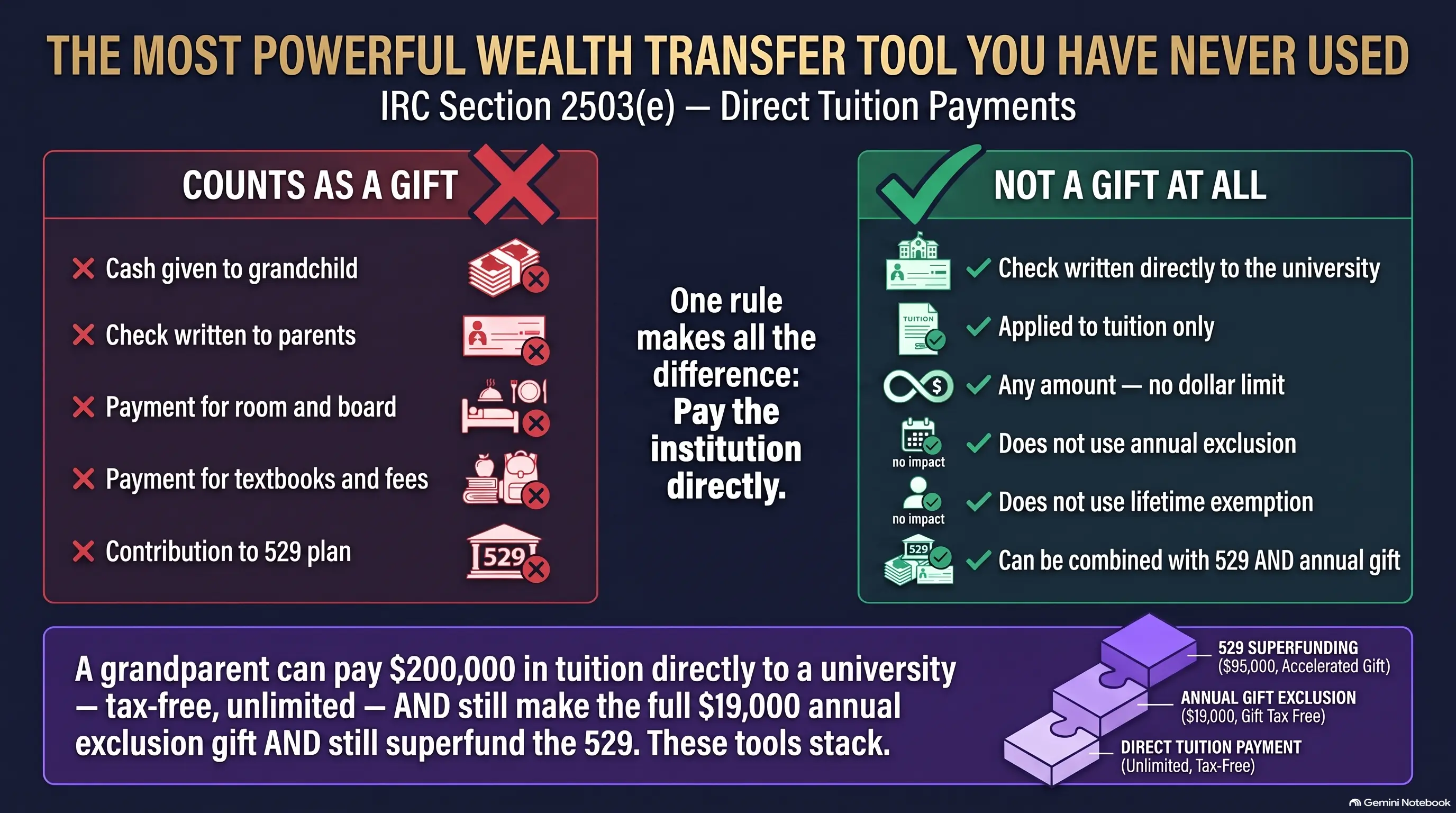
Under IRC Section 2503(e), payments made directly to an educational institution for tuition are not treated as taxable gifts — there's no dollar limit, and they don't count against the $19,000 annual exclusion or the lifetime exemption.
Read that again. Unlimited. No gift tax. Does not touch the annual exclusion or the lifetime exemption.
A grandparent who writes a check directly to a university for their grandchild's tuition can pay the entire four-year tuition bill — $200,000, $300,000, whatever it costs — and none of it is a taxable gift. It does not use a dollar of the $19,000 annual exclusion. It does not use a dollar of the lifetime gift and estate tax exemption.
The grandparent can then separately make the full $19,000 annual exclusion gift to the same grandchild in the same year. And separately superfund the 529. The direct tuition payment is entirely outside and on top of those tools.
Three important limitations:
Tuition only. The Section 2503(e) exclusion covers tuition — not room, board, textbooks, fees, or other education-related expenses. Make sure the billing office applies your contribution to the tuition portion of their bill, rather than housing or other related expenses. Otherwise, it will count as a gift for tax purposes.
Payment must go directly to the institution. The check goes to the university, not to the grandchild, not to the parents. Direct to the institution. Giving the grandchild money to pay tuition does not qualify — the payment must be made by the grandparent directly to the school.
Financial aid implications. Direct tuition payments may affect financial aid eligibility in ways that vary by institution. Before making a large direct payment, verify the financial aid impact with the specific institution's financial aid office.
The 529 covers room, board, books, and other qualified expenses. The direct tuition payment covers tuition with no limit. Together they provide a comprehensive, tax-efficient framework for funding a grandchild's entire college education.
The Annual Gifting Strategy: $19,000 Per Grandchild, Every Year
Beyond the 529 and the direct tuition payment, the annual gift tax exclusion is the simplest and most flexible tool for transferring wealth to grandchildren over time.
The payment doesn't count toward your annual gift tax exclusion ($19,000 per individual per beneficiary in 2026). Because it doesn't count toward your lifetime gift tax exemption, you can still give additional funds, like 529 contributions.
The annual exclusion applies per recipient — not per grandparent. A couple with four grandchildren can give $38,000 per grandchild per year: $152,000 total, every year, with no gift tax and no reporting requirement.
Over 10 years, that is $1.52 million transferred to the next generation — completely outside the estate, tax-free.
The annual exclusion is most powerful when used consistently and early. A grandparent who begins making $19,000 annual exclusion gifts to a newborn grandchild, and those gifts are invested in a 529 or taxable account at 7% average annual return, provides the grandchild with approximately $500,000 by age 18. Not from a large lump sum — from $19,000 per year, every year, compounding for 18 years.
The families that build generational wealth most effectively are the ones that use the annual exclusion systematically — not as an afterthought, but as a deliberate annual practice that begins as early as possible and continues consistently.
Beyond Education: The UTMA and the Roth
Not every grandchild will attend a traditional four-year college. And not every gift to a grandchild needs to be education-restricted.
UTMA/UGMA accounts — Uniform Transfers to Minors Act accounts — are custodial accounts that hold assets in a minor's name, managed by a custodian (typically a parent) until the child reaches the age of majority, typically 18 or 21 depending on the state.
UTMA accounts have no use restrictions. The funds can pay for education, a first home, business startup costs, or anything else. They are not tax-advantaged — growth is taxable at the child's rate — but they provide flexibility that 529 plans do not.
The trade-off: UTMA assets count more heavily against financial aid eligibility than 529 assets, and once the child reaches the age of majority, the funds become entirely theirs to use however they choose — without restriction. For grandparents who want the gift to go toward specific purposes, the UTMA's flexibility is also its risk.
The Roth IRA for working grandchildren. A grandchild who has earned income — from a summer job, a part-time position, any paid work — is eligible to contribute to a Roth IRA up to the lesser of their earned income or the annual IRA contribution limit ($7,500 in 2026).
A grandparent cannot contribute directly to a grandchild's Roth IRA — the contribution must come from the grandchild's own earned income. But a grandparent can give the grandchild money — up to the annual exclusion — and the grandchild can then contribute their own earned income to the Roth while using the grandparent's gift for living expenses.
A 16-year-old who earns $3,000 at a summer job and contributes that $3,000 to a Roth IRA has 49 years of tax-free compounding ahead of them before traditional retirement age. At 7% average annual return, that $3,000 becomes approximately $68,000 by age 65 — tax-free. If the grandparent funds this practice every year from age 16 through 22, the compounding result is transformative.
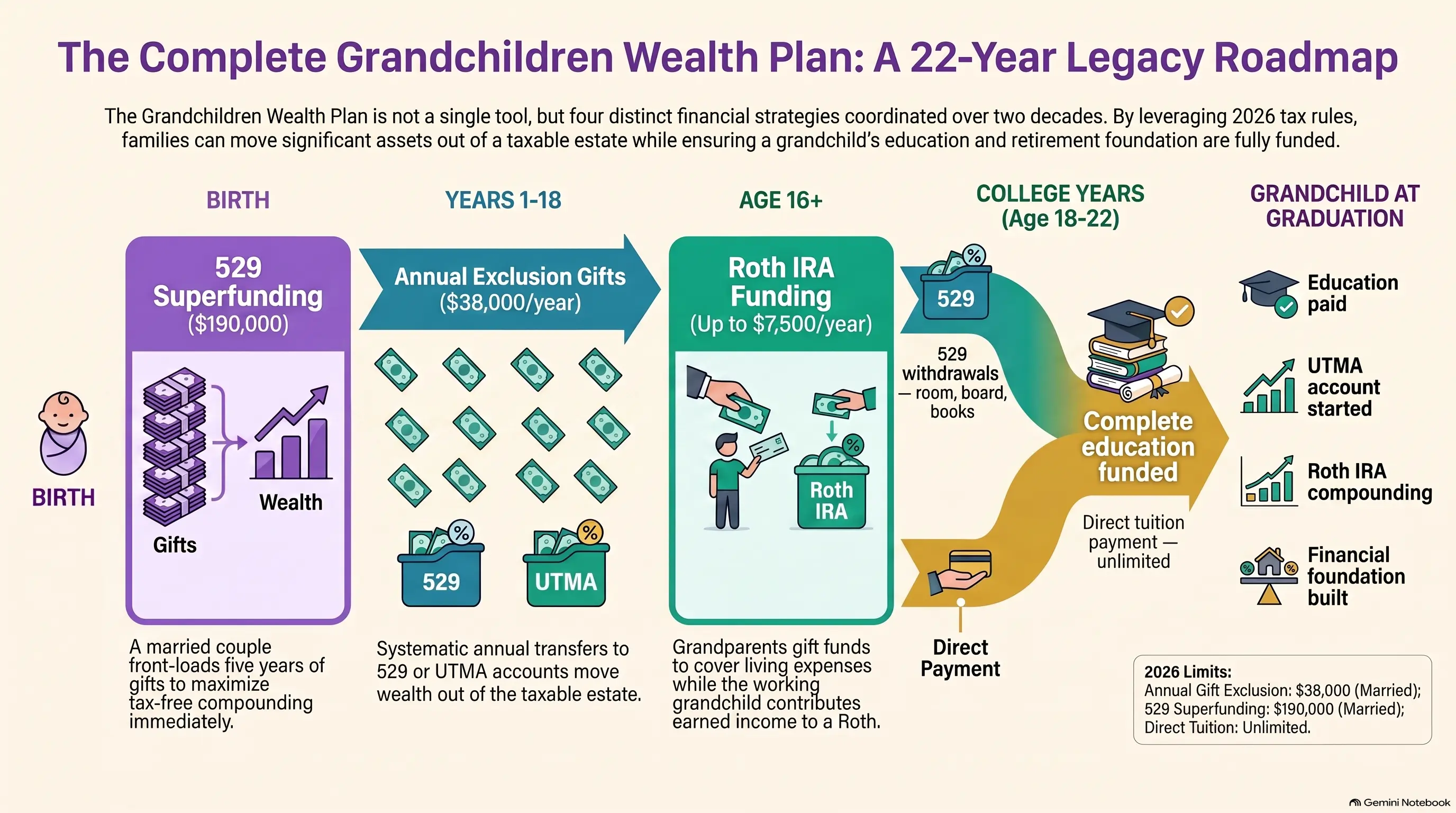
How the Tools Work Together: The Complete Grandchildren Wealth Plan
The most sophisticated grandparent wealth transfer plans do not use one tool — they coordinate all of them.
Year one — the foundation: A grandparent with a newborn grandchild superfunds the 529: $95,000 from one grandparent, $190,000 from a married couple. The contribution is removed from the taxable estate immediately. The 529 begins compounding tax-free.
Years one through eighteen — annual gifting: After the five-year superfunding election period ends, annual exclusion gifts resume: $19,000 per grandparent per year, every year. Some goes to the 529 for education. Some goes to a UTMA account for flexibility. Some funds the grandchild's Roth IRA when they start working.
College years — direct tuition payments: When the grandchild enrolls in college, the grandparent pays tuition directly to the institution. No dollar limit. No gift tax. The 529 covers room, board, books, and other qualified expenses. Together they cover the complete cost of education.
The result: A grandchild who benefits from this coordinated plan arrives at adulthood with an education paid in full, a meaningful start in a taxable account, and a Roth IRA that has been compounding for years. The grandparent has transferred significant wealth efficiently, reduced their taxable estate, and — most importantly — participated in the grandchild's financial foundation in a way that is felt for a lifetime.
What Arthavita's Legacy Planning Shows Grandparents
For users in the Distribution life stage — retirement age grandparents who are thinking about wealth transfer alongside their own retirement — Arthavita's Wealth Transfer Strategy feature models the tax and distribution implications of different approaches.
The annual gifting tracker shows how much has been transferred to each grandchild, tracks the five-year election status for superfunded 529 accounts, and alerts users when new annual exclusion gifts can resume. The Legacy Readiness Score includes grandchildren wealth planning as a component — specifically whether the family has a documented approach to education funding and generational wealth transfer.
The Generational Wealth Projection models the estate at death under different scenarios — different gifting strategies, different 529 funding approaches, different direct tuition payment amounts — so grandparents can see the lifetime impact of the decisions they are making today.
The Conversation That Makes It Real
The technical tools — 529 superfunding, direct tuition payments, annual exclusion gifting, UTMA accounts, Roth IRA funding — are available to any grandparent who wants to use them. The barrier is almost never legal or financial. It is almost always the conversation that has not been started.
Most grandparents have not told their adult children how much they intend to contribute to grandchildren's education, or when, or through what vehicle. Most adult children do not know what their parents' estate plan looks like, what the 529 balance is, or whether a direct tuition payment is something the grandparents have considered.
The family wealth plan that works is the one that has been communicated — where the grandparents have said explicitly: here is what we intend to contribute, here is the tool we are using, here is what we need from you to make it work.
That conversation is more important than the specific tool. A $95,000 superfunded 529 that nobody in the family knows about and that names a beneficiary nobody has updated in 15 years is less valuable than a $25,000 account that is part of a coordinated, communicated family plan.
The grandchildren wealth plan begins with the technical tools. It is completed by the conversation.
Frequently Asked Questions
Can I contribute to a 529 and also make an annual exclusion gift to the same grandchild in the same year?
Yes — as long as you are not in a superfunding election period. The 529 contribution counts toward the annual exclusion for that year. If you contribute $19,000 to a 529, that is your full annual exclusion for that grandchild for the year. If you contribute $10,000 to a 529, you can make an additional $9,000 gift for the year. During a five-year superfunding election period, additional annual exclusion gifts to the same grandchild may have gift tax consequences.
What happens to the 529 if my grandchild does not go to college?
Several options exist. The account can be transferred to another family member — a sibling, cousin, or even the grandparent themselves — who can use it for qualified education expenses. Under SECURE 2.0, up to $35,000 of a 529 that has been open for at least 15 years can be rolled into the beneficiary's Roth IRA. Non-qualified withdrawals are subject to income tax and a 10% penalty on the earnings — not on the contributions, which were made with after-tax dollars.
Does the direct tuition payment affect financial aid?
It may, depending on the institution. Some schools treat direct payments from third parties as resources that reduce need-based aid. Check with the specific institution's financial aid office before making a large direct payment. The FAFSA itself does not have a specific field for third-party tuition payments, but institutional aid calculations vary.
Should I open my own 529 or contribute to the parents' existing 529?
Both have advantages. A grandparent-owned account gives the grandparent control and may allow a state income tax deduction in states that require account ownership. A parent-owned account is simpler to coordinate and may already be established. The financial aid treatment of grandparent-owned 529 distributions improved significantly under 2024 FAFSA changes — distributions no longer automatically harm aid eligibility. Consult a tax professional before deciding, particularly if your state has meaningful income tax and a deduction available only to account owners.
How do I make a direct tuition payment correctly?
Contact the university's bursar or billing office directly. Ask to make a payment applied to the tuition portion of the student's bill for a specific semester. Get the payment address and any student ID or account number needed. Pay by check or wire directly to the institution — not to the student or the parents. Keep documentation of the payment for your records. Consult a tax professional to confirm the payment qualifies under IRC Section 2503(e) for your specific situation.
Have a question this article didn't answer?
Grandchildren wealth planning involves coordination between gift tax rules, financial aid implications, state tax laws, and family circumstances that vary significantly. If something here raised a question about your specific situation, send us a note at support@arthavita.co and we will do our best to address it directly or in a future post.
Arthavita is an educational and planning platform. This article is for informational purposes only and does not constitute personalized financial, legal, or tax advice. Gift tax rules, 529 plan regulations, and financial aid policies change and vary by state and institution. For personalized guidance, consult a qualified tax professional or estate planning attorney.
Ketan Patel
Founder, Arthavita
Ketan Patel is the founder of Arthavita and a multi-industry entrepreneur with 30+ years of experience in technology and business operations. He built Arthavita to bring institutional-quality financial intelligence to individual investors.
LinkedIn ↗This article is for educational purposes only and does not constitute financial, tax, or legal advice. Arthavita is a recommendation-only platform. Always consult a qualified professional before making financial decisions.