
The 6 Financial Moves Every 28 - Year - Old Should Make
The financial decisions you make between 22 and 35 will do more to determine your long-term wealth than anything you do in your 40s or 50s — not because of the amounts involved, but because of time. Six specific moves, made in the right order, change the entire trajectory. None of them require a high income. All of them require starting now.
Nobody sat you down and explained this.
Not in high school. Not in college. Not on your first day of work when HR handed you a stack of benefits forms and pointed you toward a 401(k) enrollment page. The assumption was that you would figure it out — that financial literacy would somehow arrive on its own, like driving a car or filing taxes, through a combination of osmosis and stress.
You probably did not figure it out. Most people do not. And the cost of that gap is not obvious at 28. It shows up at 55, when the math of delayed decisions becomes impossible to ignore.
This article is the conversation nobody had with you. Not a list of generic tips. Six specific moves, in a specific order, with the real numbers attached — so you can see exactly what you are building toward and why each decision matters more right now than it ever will again.
Why 28 Is the Most Financially Important Age Most People Ignore
Here is the thing about compound growth that nobody explains clearly enough.
The math is not linear. It is exponential. Which means the first dollars you invest do not just grow a little more than the dollars you invest later — they grow dramatically more. Obscenely more. In a way that makes catching up later genuinely difficult.
$5,000 invested at age 21, earning 9% annually, becomes more than $220,000 by age 65 — without adding another cent. The same $5,000 invested at age 35 becomes roughly $75,000. The same $5,000 invested at age 45 becomes roughly $29,000.
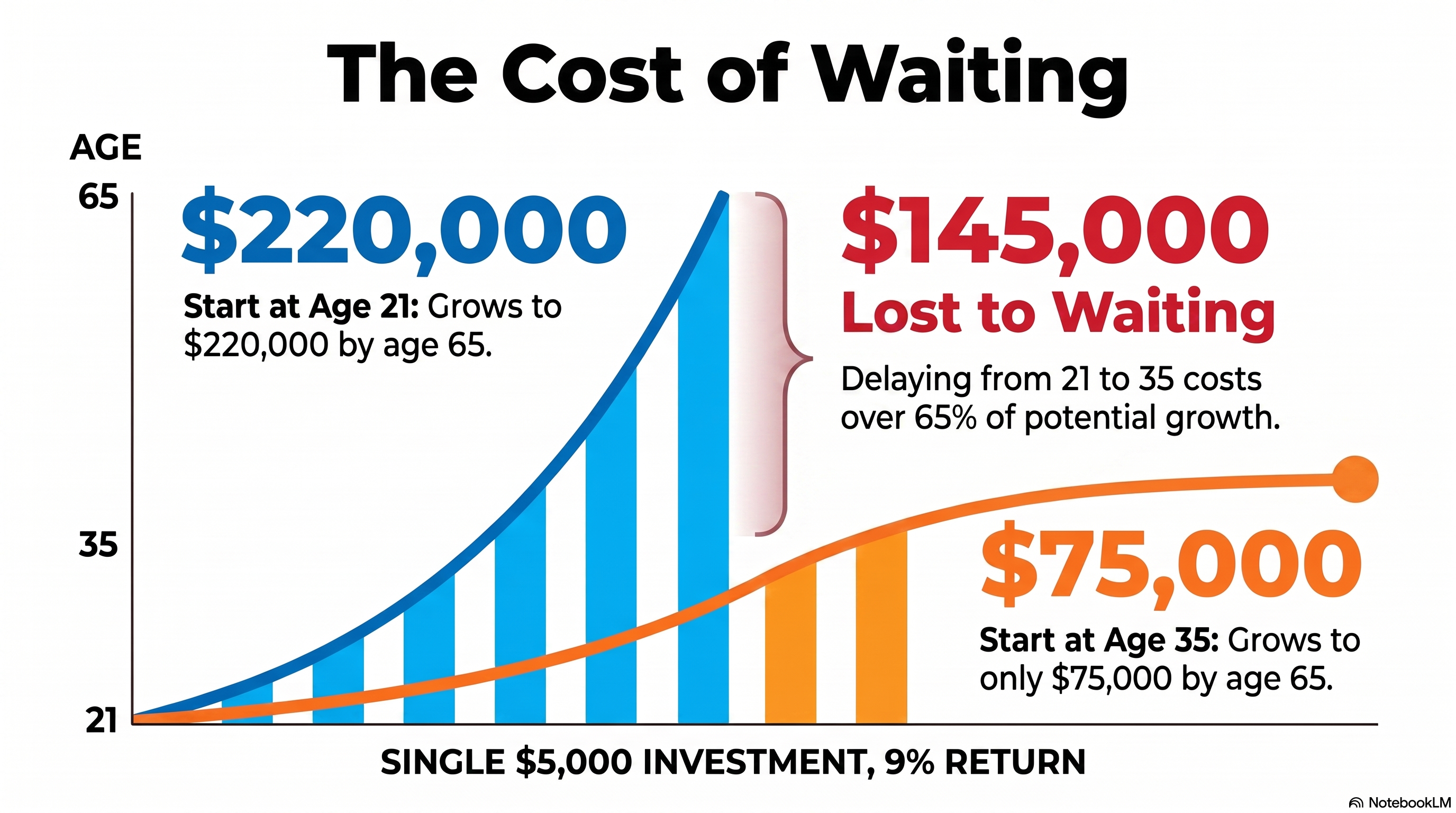
Same money. Same return. Fourteen years of difference in starting point: $191,000 in lost growth.
That is the cost of waiting. Not the cost of making bad investments. Not the cost of picking wrong funds. The cost of simply starting later.
The most important financial asset you have at 28 is not your salary. It is not your savings balance. It is the decades of compounding ahead of you — and that asset is depleting right now, one year at a time, whether you use it or not.
Here are the six moves that deploy it properly.
Move 1: Build a $1,000 Emergency Fund Before You Do Anything Else
This is the move almost everyone skips, and skipping it costs more than almost any other financial mistake you can make in your 20s.
More than two in five Americans — 43% — cannot cover a $1,000 emergency expense from savings. When the car breaks down, when the medical bill arrives, when the laptop dies, they put it on a credit card. That credit card charges 20-25% interest. The $800 car repair becomes a $1,200 debt that sits on the card for six months while the minimum payment barely touches the principal.
Meanwhile, they have $3,000 sitting in a 401(k) they cannot touch without penalty.
The emergency fund exists to protect every other financial decision you make. Without it, any unexpected expense becomes a financial crisis that cascades — into credit card debt, into paused retirement contributions, into the kind of financial anxiety that makes people give up on the whole system.
The first $1,000 is the most important. It is not the full emergency fund — that comes later, at three to six months of living expenses. But $1,000 handles the majority of genuine financial emergencies for most people in their 20s. Get that $1,000 into a high-yield savings account before you do anything else on this list.
In 2026, high-yield savings accounts are paying 4-5% APY. Your emergency fund earns real money while it waits. There is no excuse for keeping this money in a checking account earning 0.01%.
Move 2: Capture Every Dollar of Your Employer Match — It Is the Only Guaranteed 100% Return in Finance
Your employer offers to match your 401(k) contributions up to a certain percentage of your salary. Most people know this. Most people do not treat it with the urgency it deserves.
The employer match is a guaranteed, immediate, risk-free 100% return on your money. Nothing else in finance offers that. Not index funds. Not real estate. Not crypto. Your employer says: contribute 3% of your salary, and we will add another 3% on top. That is an instant doubling of your contribution before the market does anything.
Not capturing the full match is the equivalent of turning down a raise. Every dollar of match you leave on the table is a dollar you earned but chose not to take.
The 2026 401(k) contribution limit is $24,500. You do not need to hit that limit. You need to hit the match threshold — whatever percentage your employer matches up to. If your company matches 50% of contributions up to 6% of salary, you need to contribute 6%. Not 3%. Not 4%. The full 6% that captures every matching dollar.
For someone earning $60,000, contributing 6% means $3,600 per year. The employer adds $1,800. That $1,800 is free money that compounds alongside your own contribution for the next 30-40 years.
The math on captured employer matches, compounded over a 35-year career, regularly produces six-figure differences in retirement outcomes — for people who made identical investment decisions in every other respect.
Move 3: Open a Roth IRA This Year — Your Tax Rate Will Never Be This Low Again
You are almost certainly in the lowest tax bracket you will occupy for the rest of your working life. That is not a discouraging observation. It is a specific, time-limited opportunity.
A Roth IRA lets you contribute after-tax dollars now — while your tax rate is low — and then withdraw everything, including all growth, completely tax-free in retirement. You pay tax on the seed, not the harvest. The harvest, compounded over 35-40 years, is enormous.
The 2026 Roth IRA contribution limit is $7,500. The income phase-out for single filers begins at $150,000 — well above most 28-year-old incomes. You almost certainly qualify. The window to contribute at your current tax rate will not be open forever.
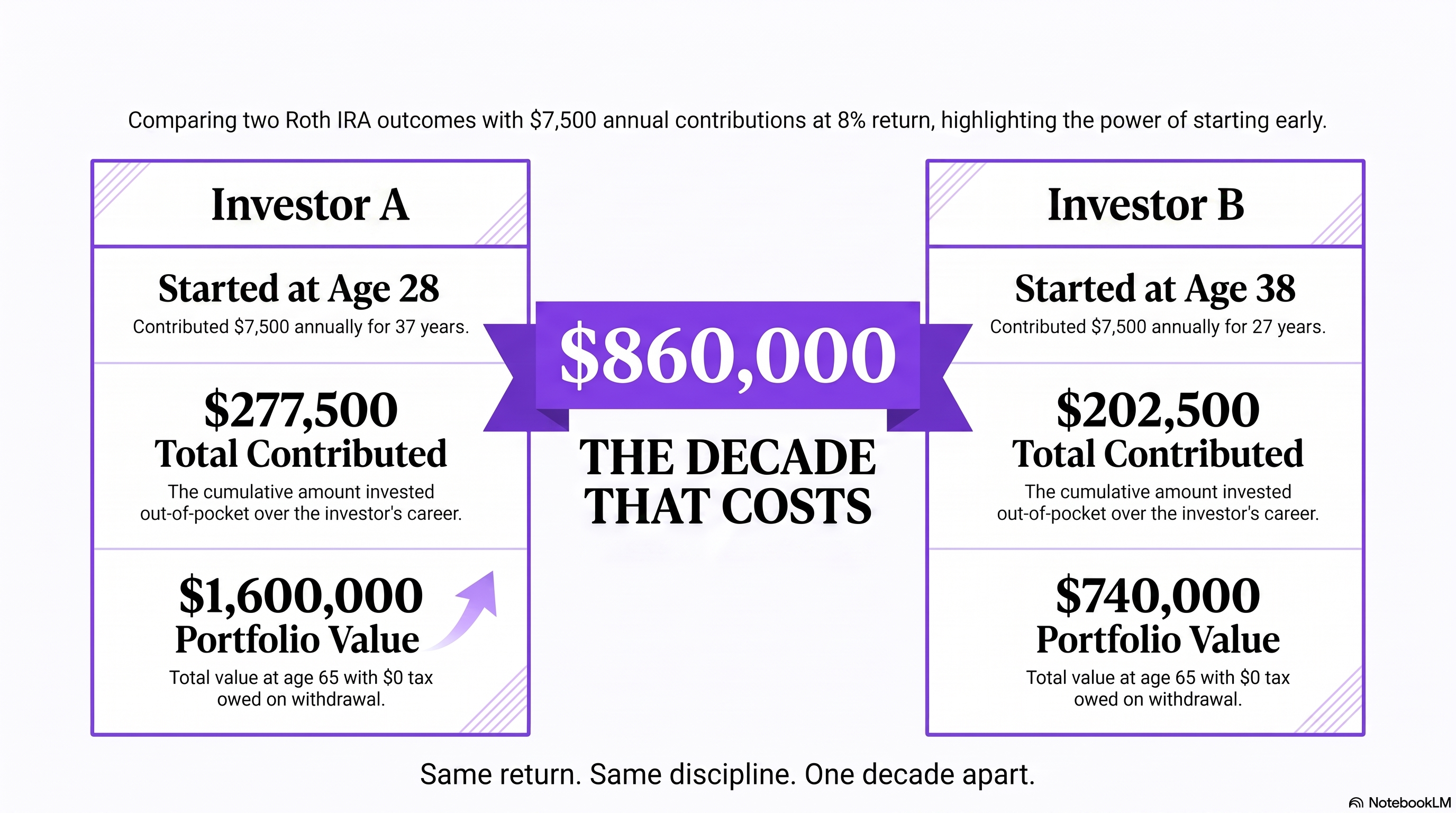
Here is what $7,500 per year in a Roth IRA, invested starting at 28 and earning 8% annually, looks like at 65:
37 years of contributions at $7,500 = $277,500 contributed Portfolio value at 65: approximately $1.6 million Tax owed on withdrawal: zero
The same $277,500 contributed starting at 38 instead of 28:
Portfolio value at 65: approximately $740,000 Tax owed on withdrawal: zero — but you lost $860,000 in growth by starting a decade later
The Roth IRA is the most powerful tax-advantaged account available to someone in their 20s. The time to open one is not when you have more money. It is now, with whatever you have, because the compounding clock is already running.
Move 4: Attack High-Interest Debt With the Intensity It Deserves
There is a specific hierarchy to debt in your 20s, and getting it wrong is expensive.
Credit card debt at 20-25% interest is financial cancer. No investment you can make will reliably outperform a 20% guaranteed return — because paying off a 20% debt is exactly that. Every dollar you put toward credit card principal is a dollar earning a 20-25% risk-free return. Nothing in the market comes close.
The order is clear: emergency fund first, employer match second, credit card debt third. Not student loans yet. Not investing beyond the match. Credit card debt, eliminated as fast as possible.
Student loans are a different calculation. The average graduate in 2026 carries about $37,000 in federal student loan debt. Federal student loan interest rates range from roughly 6-8% for current borrowers. The 2026 student loan landscape also changed significantly on July 1 — new repayment programs launched, SAVE ended, and millions of borrowers are navigating new payment structures.
The student loan decision requires actual math on your specific loans — the interest rate, the loan type, the repayment program you are in, and how those numbers compare to what you would earn investing the same money in a Roth IRA or 401(k). At 6% interest, you might invest beyond the match rather than aggressively paying down loans. At 8% or above, the debt payoff becomes more compelling. There is no universal answer — there is your specific number, modeled against your specific situation.
What is universal: high-interest consumer debt gets paid before investment, and the employer match gets captured before debt payoff. Everything else is case-specific.
Move 5: Insure the Asset That Funds Everything Else — You
At 28, you have one financial asset that dwarfs everything in your 401(k) or savings account.
Your earning capacity.
A 28-year-old earning $65,000 per year who works until 65 will earn approximately $2.4 million in lifetime income, assuming modest raises. That is not an investment. It is a human capital asset — and it is almost entirely unprotected.
Disability insurance replaces a portion of your income if illness or injury prevents you from working. The statistics are sobering: you are significantly more likely to become disabled during your working years than you are to die during them. Most people have life insurance and no disability insurance — which means they have protected against the less likely outcome while leaving the more likely one completely exposed.
If your employer offers group disability coverage, enroll. If not, an individual long-term disability policy is worth investigating, particularly if you are self-employed or in a profession with physical demands. The premiums are lower in your 20s than they will ever be again.
Life insurance is relevant if anyone depends on your income — a partner, a child, aging parents. If no one depends on you financially, life insurance is not urgent. If someone does, term life insurance is inexpensive in your 20s and provides meaningful protection for the people who would be affected by your loss.
Renter's insurance costs roughly $15-20 per month and covers your belongings against theft, fire, and water damage. If you are renting, you almost certainly need it. Most landlords do not require it. Most renters do not have it. Most renters discover they needed it after something goes wrong.
Move 6: Automate Everything — Remove the Decision From the Moment of Temptation
The research on this is consistent across every study ever done on personal finance behavior: people who automate their financial decisions accumulate significantly more wealth than people with identical incomes who manage their money manually.
It is not a discipline difference. It is a system difference.
When you have to actively decide each month to transfer money to savings or investments, you are making that decision under the full weight of every competing priority in your life — rent, groceries, social plans, the thing you have been meaning to buy. Most months, the competing priorities win. Savings loses.
When you automate the transfer — money moves to savings and investments before you see it, before you have a chance to spend it, before the competing priorities even have a chance to compete — the savings happen reliably and the spending adjusts around what is left.
Set up automatic contributions to your 401(k). Set up an automatic monthly transfer to your Roth IRA. Set up automatic contributions to your emergency fund until it reaches three to six months of living expenses. Set up automatic payments on your debt that go beyond the minimum.
Then, every time you get a raise, immediately increase your automatic contribution percentage before the new income appears in your checking account. This is the single behavioral trick that separates the people who successfully accumulate wealth in their 20s from the people who earn more and more but never seem to save more.
Lifestyle inflation is not inevitable. It is what happens when income rises and the default behavior is to spend more. Automating savings before income hits your checking account makes lifestyle inflation structurally harder.
The Order Matters More Than the Amounts
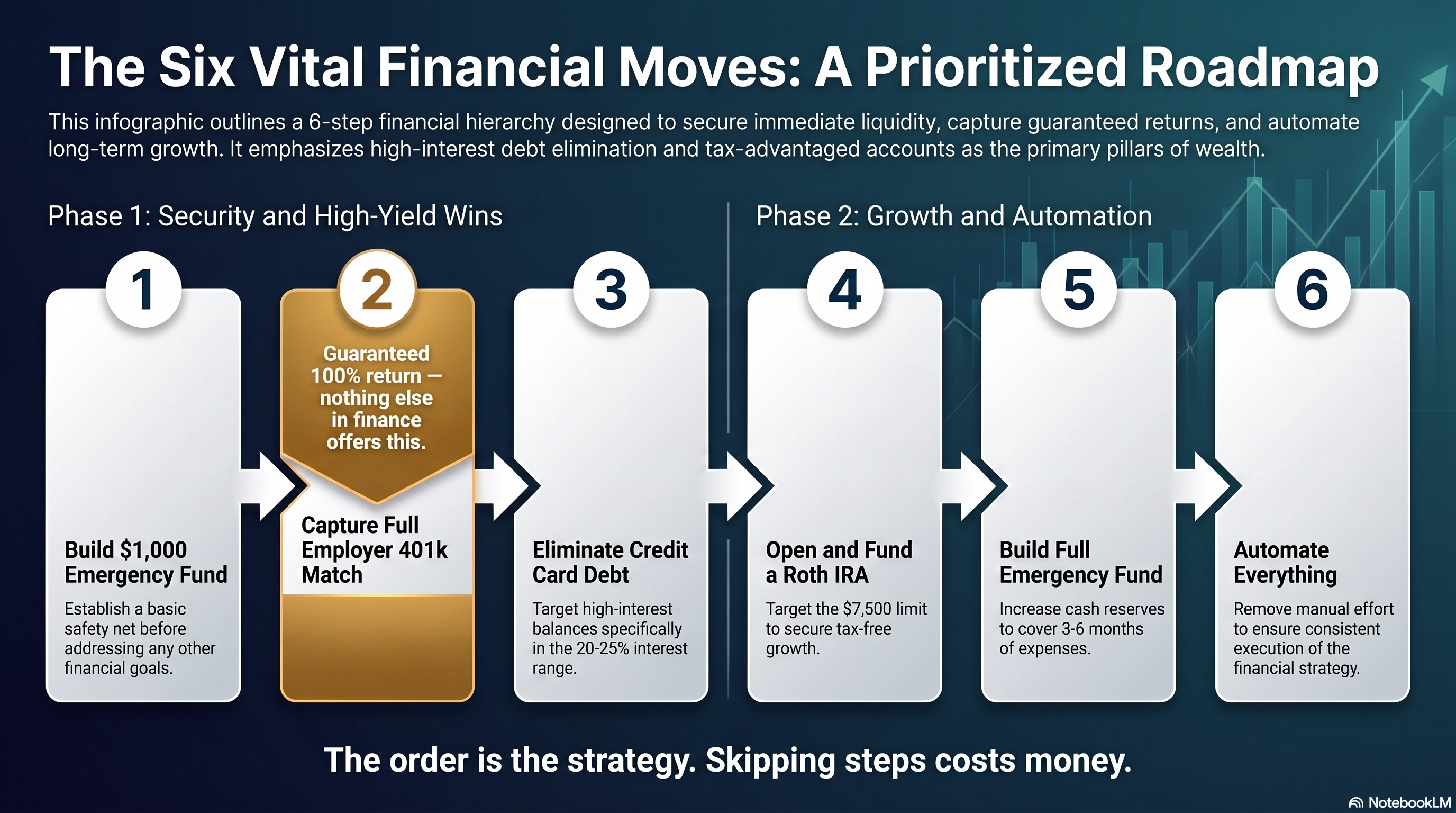
The six moves above work together in a specific sequence. Doing them out of order costs money.
First: $1,000 emergency fund. Without this, everything else is vulnerable to the next unexpected expense.
Second: 401(k) contributions to the full employer match. Guaranteed return, tax-deferred growth, too important to skip.
Third: Credit card debt eliminated. The 20-25% interest rate is a guaranteed negative return that nothing in your investment portfolio can overcome.
Fourth: Roth IRA funded to the maximum you can manage. Tax-free growth, starting now, at the lowest tax rate of your career.
Fifth: Build the full emergency fund to three to six months of living expenses. Now that the acute financial vulnerabilities are addressed, the buffer gets built out properly.
Sixth: Student loan strategy decided based on your specific interest rate. Pay aggressively if above 7-8%. Consider investing the difference if below 6%.
Seventh — which is really an ongoing habit, not a one-time move: automate everything, increase contributions with every raise, and protect your earning capacity with appropriate insurance.
What 28 Looks Like at 60 — The Two Paths
Path one: a 28-year-old who captures the full employer match, contributes $3,600 per year to a Roth IRA, eliminates credit card debt, builds a three-month emergency fund, and automates everything.
By 40, they have roughly $180,000 in retirement accounts and a clean financial foundation. By 50, compound growth is adding more annually than their contributions. By 65, the combination of 401(k), Roth IRA, and continued savings produces a retirement portfolio well above $1 million — with a significant portion growing entirely tax-free.
Path two: a 28-year-old who delays getting started — not dramatically, just by seven years, starting these same moves at 35 instead of 28.
By 65, the math produces roughly 40-50% less in accumulated wealth, despite identical contribution rates and identical investment returns for the years they did contribute. The seven years of missing compounding on the early contributions are simply gone. They cannot be recreated by contributing more later, because later dollars have less time.
The difference between these two paths is not income. It is not investment skill. It is seven years.
The Conversation Nobody Had With You
The financial industry talks to 28-year-olds through advertising, not education. It wants you to open accounts, buy products, and generate fees — not to understand the underlying mechanics well enough to make autonomous decisions.
The six moves described here are not products. They are decisions. None of them require a financial advisor, a premium app, or a sophisticated brokerage account. They require understanding the mechanics clearly enough to act on them.
$10,000 invested at age 25, earning 6% annually, becomes $109,000 at 65. Not because someone managed it brilliantly. Because it had time.
The most powerful financial tool available to a 28-year-old is not a stock pick or a market insight. It is the mathematical reality that money invested now compounds for 35-40 years, and money invested at 40 compounds for 25. That gap — those extra years — is worth more than any investment strategy, any market timing, any financial advice you will ever receive.
You are 28. The gap is open. The question is whether you are using it.
Frequently Asked Questions
I have student loans. Should I pay them off before investing?
It depends on the interest rate. If your student loans are above 7-8%, aggressive payoff may make more mathematical sense than investing beyond the employer match. If they are below 6%, the historical returns of a diversified stock portfolio suggest investing while making regular loan payments. The employer match is the exception — capture that regardless of loan interest rates, because a 50-100% guaranteed return beats any debt payoff calculation.
How much should I have saved by 28?
The benchmarks vary by source, but a reasonable target is one-half to one times your annual salary saved in retirement accounts by age 30. If you earn $60,000, a target of $30,000-$60,000 in 401(k) and Roth IRA combined by 30 keeps you on track for a comfortable retirement. If you are behind this benchmark, the most powerful correction is to increase your contribution rate now — the compounding window is still meaningfully open in your late 20s and early 30s.
What if I cannot afford to do all of these?
Do them in order and do as much of each as you can. The emergency fund and the employer match are the two that cannot be skipped. If your budget is genuinely constrained, start with $25 per month into savings and 1% into your 401(k). The amounts matter less than the habit and the starting date. A small amount invested at 28 outperforms a larger amount invested at 35 because of compounding, not because of the dollar figure.
Should I prioritize a Roth IRA or a traditional IRA?
For most 28-year-olds, the Roth IRA wins — because you are almost certainly in a lower tax bracket now than you will be later in your career. Paying tax on contributions now, at your current low rate, and withdrawing tax-free in retirement, when your tax rate may be higher, is the mathematically favorable trade for most young earners. The exception is if you are earning at a high income level where the traditional IRA's tax deduction provides immediate, meaningful tax savings.
What is the single most important thing on this list?
Start. Not perfectly, not with the full amount, not with complete understanding of every move. Start with the emergency fund. Start with the 401(k) enrollment form on your HR portal. Start with opening a Roth IRA account. The cost of starting imperfectly today is a fraction of the cost of starting perfectly at 35.
The financial system is not designed to explain itself to 28-year-olds. But the mechanics reward the people who figure it out early — disproportionately, exponentially, and permanently.
Have a question this article didn't answer?
Every financial situation is different. If something here raised a question specific to your numbers — your IRA balance, your Social Security timing, your tax picture — we'd like to hear it. Send us a note at support@arthavita.co and we'll do our best to address it, either directly or in a future post.
Arthavita is an educational and planning platform. This article is for informational purposes only and does not constitute personalized financial, tax, or legal advice. All financial decisions remain with you. For personalized guidance, consult a qualified financial or tax professional.
Ketan Patel
Founder, Arthavita
Ketan Patel is the founder of Arthavita and a multi-industry entrepreneur with 30+ years of experience in technology and business operations. He built Arthavita to bring institutional-quality financial intelligence to individual investors.
LinkedIn ↗This article is for educational purposes only and does not constitute financial, tax, or legal advice. Arthavita is a recommendation-only platform. Always consult a qualified professional before making financial decisions.