
Stop Treating Your Retirement Like One Big Pile of Money
The single biggest structural mistake in retirement planning is treating all your money the same way. The 4-bucket strategy organizes every dollar by when you actually need it — eliminating the need to sell growth assets at the worst possible time, protecting against the most dangerous risk in retirement, and giving you the psychological freedom to stay invested through market downturns without anxiety dictating your decisions.
Picture someone who did everything right.
They spent 35 years contributing faithfully to their 401(k). They stayed invested through the dot-com crash, through 2008, through every market scare that made their stomach drop. They resisted the urge to sell when everyone around them was panicking. They read the books, followed the advice, trusted the math. By the time they retired, they had built what they needed.
And then, six months after retiring, a market downturn arrived. They needed to pay their bills. So they sold some shares — at exactly the wrong time.
It happens more than most people realize. And it is not a failure of discipline or knowledge. It is a failure of structure. The money was built correctly. It just was not organized for the life it was supposed to fund.
That is the problem this article is about. And the solution — once you understand it — will change the way you think about every dollar you have saved.
The Hidden Risk Nobody Warns You About
Here is something that surprises almost everyone who hears it for the first time.
During your working years — the decades you spend building a portfolio — the sequence of market returns does not matter.
Read that again. Whether the market drops in year one of your investing life or year thirty, the math of accumulation is roughly the same. A 20% loss followed by a 25% gain produces a similar long-run result as the reverse, because you are not pulling money out. You are adding money in. The bad years are almost a gift — they let you buy more shares at lower prices.
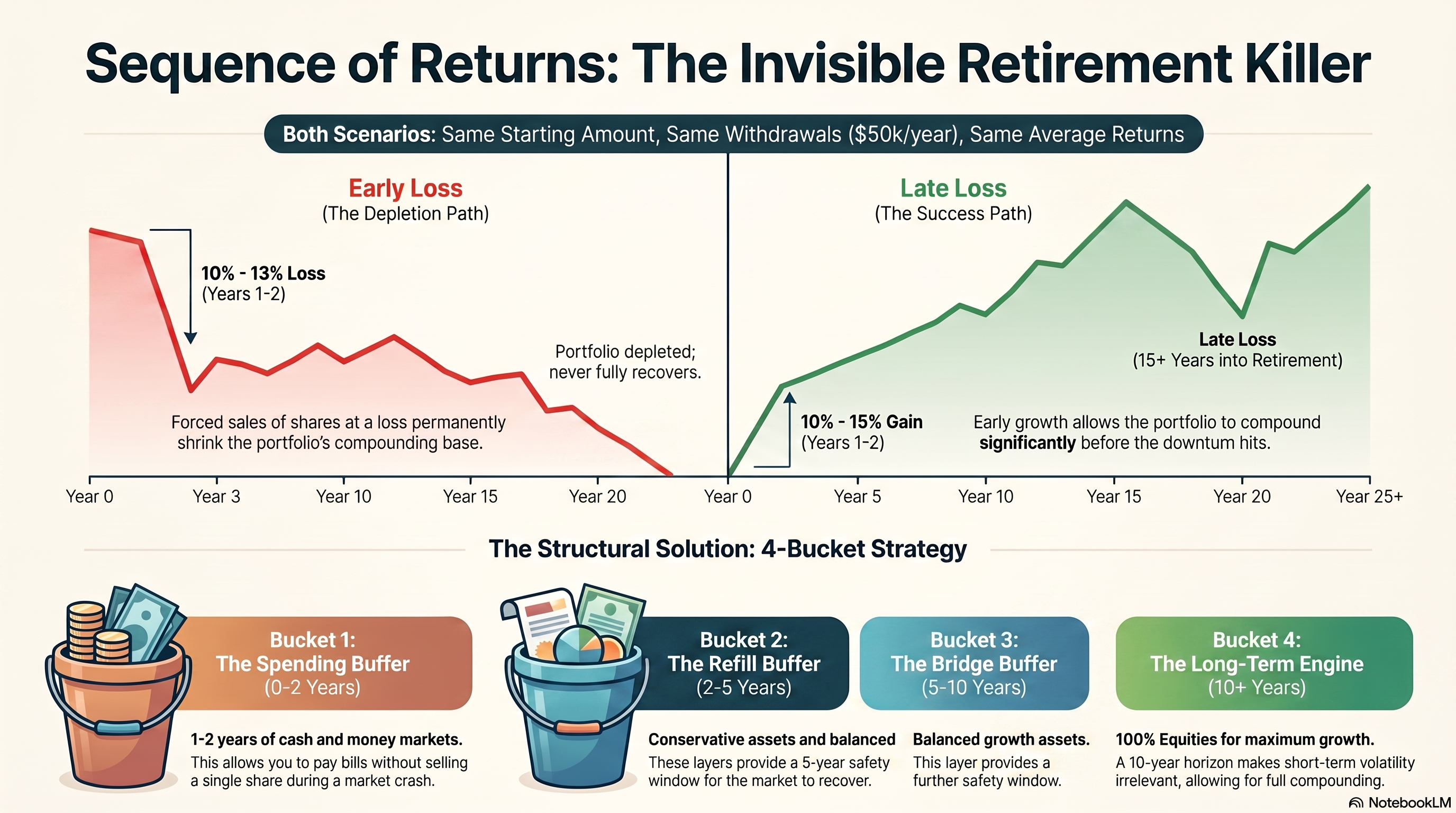
The moment you retire, this flips completely. Once withdrawals begin, early losses compound in a way that later gains cannot undo. The bad year that was irrelevant during accumulation becomes potentially devastating in retirement — because now you are selling shares to fund your life, not buying them.
Think about what that means in practice. A 30% market drop at 45 is uncomfortable but harmless in the long run. The same 30% drop at 63, in the first year of retirement, forces you to sell shares at their lowest price just to pay your mortgage. Those shares are gone. They will never participate in the recovery that follows. And the recovery happens on a smaller base — permanently.
This is called sequence of returns risk. It is the most dangerous threat to a retirement portfolio that almost nobody warns you about.
What Actually Happened to Real People
This is not theoretical. We have lived through it multiple times in the past 25 years.
Consider someone who retired in early 2000, having done everything right — $1 million saved, planning to withdraw $50,000 a year, invested in a broadly diversified stock portfolio. Textbook retirement.
The S&P 500 lost 10.1% in 2000, then 13% in 2001. After taking $50,000 for living expenses each year while the market fell, that retiree had $687,927 left at the beginning of 2002 — before the third year of losses arrived. The portfolio never fully recovered to where it would have been. The bull market of the mid-2000s helped, but it compounded on a depleted base.
The 2008 retiree faced the same trap. An 18-month financial crisis dropped portfolios by 27% or more. A retiree selling $50,000 in shares during that decline was not just riding out a bad market — they were permanently locking in losses on shares that would have recovered fully within three years, had they never been sold.
And in 2022, for the first time in decades, both stocks and bonds fell simultaneously — eliminating the protection that a traditional 60/40 portfolio had always provided. Retirees who depended on bonds as their safety buffer discovered that the safety buffer had its own problems.
The pattern across all three events is identical. The retirees who were forced to sell during the downturn suffered damage that no subsequent bull market could fully undo. The retirees who had a structure that let them avoid selling emerged largely intact.
The structure is the difference.
What the 4-Bucket Strategy Actually Is
The idea is almost embarrassingly simple once you hear it.
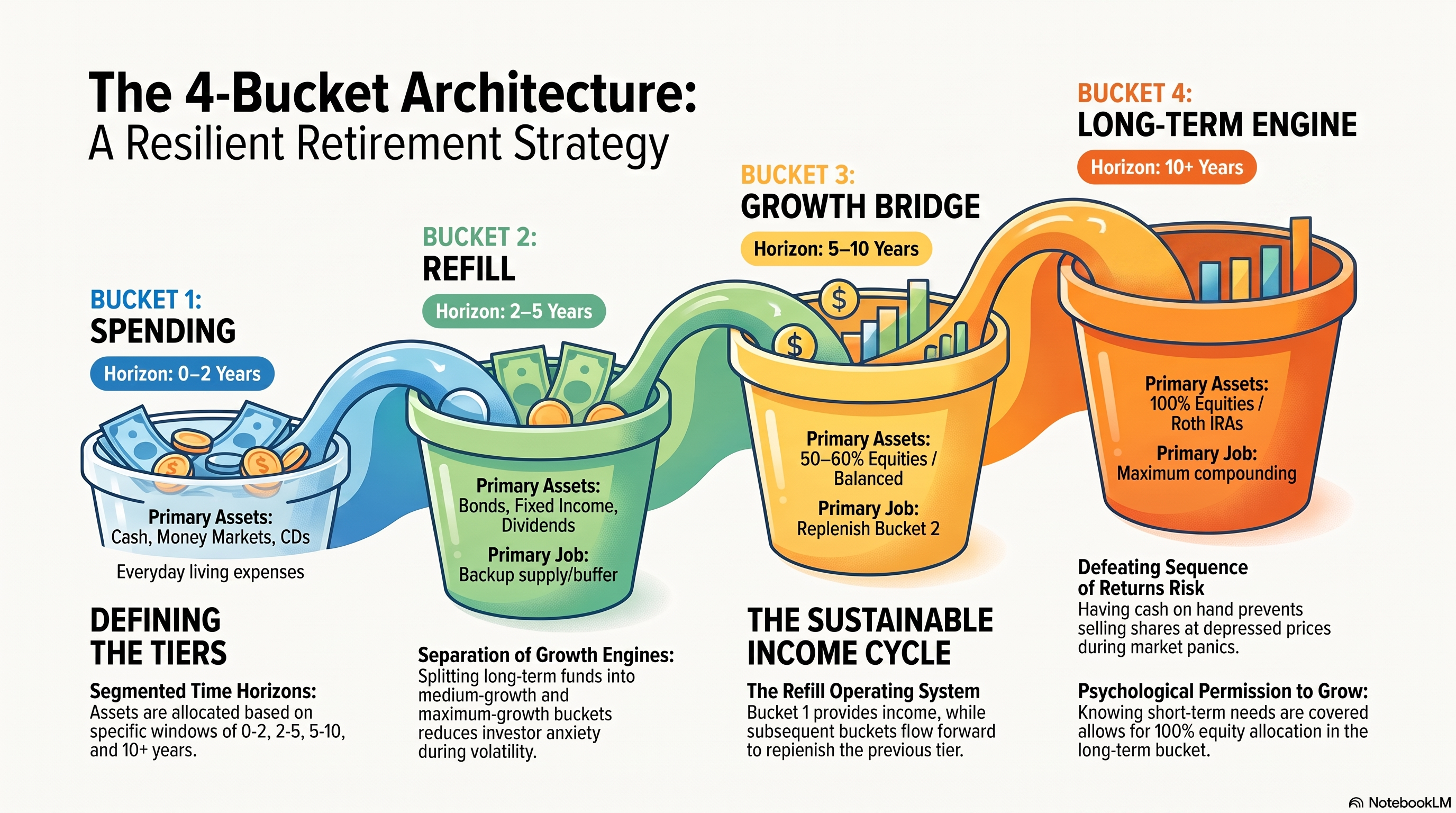
Instead of treating your retirement savings as one big pool of money — all subject to the same market risks, all available to be sold at any moment — you organize it into four separate buckets, each with a different job, based entirely on when you actually need the money.
Not based on asset class. Not based on risk tolerance ratings. Not based on what a Monte Carlo simulation says. Based on time horizon — the most honest possible way to think about money.
When you do this, something changes. The short-term volatility that causes panic — the thing that turns a temporary market drop into a permanent, life-altering decision — stops threatening most of your money. Because most of your money is not needed for years. Decades, even. Only a small portion needs to be stable right now.
Here is how each bucket works.
Bucket 1 — The Spending Bucket (0 to 2 Years)
This is your everyday money. One to two years of living expenses, sitting in cash, money market funds, and short-term CDs. It does not care what the stock market is doing. It does not need to grow. Its only job — its entire reason for existing — is to be there when you need it.
When the market drops 30%, you do not touch your investments. You draw from Bucket 1. The cash was already there, already set aside for exactly this moment. You pay your bills. You sleep. The market eventually recovers, and you never had to sell a single share at the wrong time.
In 2026, this bucket is actually more efficient than it was a decade ago. High-yield savings accounts and money market funds are earning real returns — your safety buffer is not just sitting idle, it is earning something while it waits. But the return is secondary. The real value of Bucket 1 is behavioral. It makes panic selling structurally unnecessary.
Bucket 2 — The Refill Bucket (2 to 5 Years)
Think of this as your backup supply. Three to five years of living expenses held in conservative assets — short and intermediate-term bonds, dividend-paying stocks, high-quality fixed income. More return than cash. Modest risk.
Bucket 2's job is to refill Bucket 1. In normal times, dividends and interest flow from Bucket 2 into Bucket 1, keeping your spending bucket stocked without selling anything. In a prolonged downturn, Bucket 2 gives you years of additional buffer while your growth assets have time to recover.
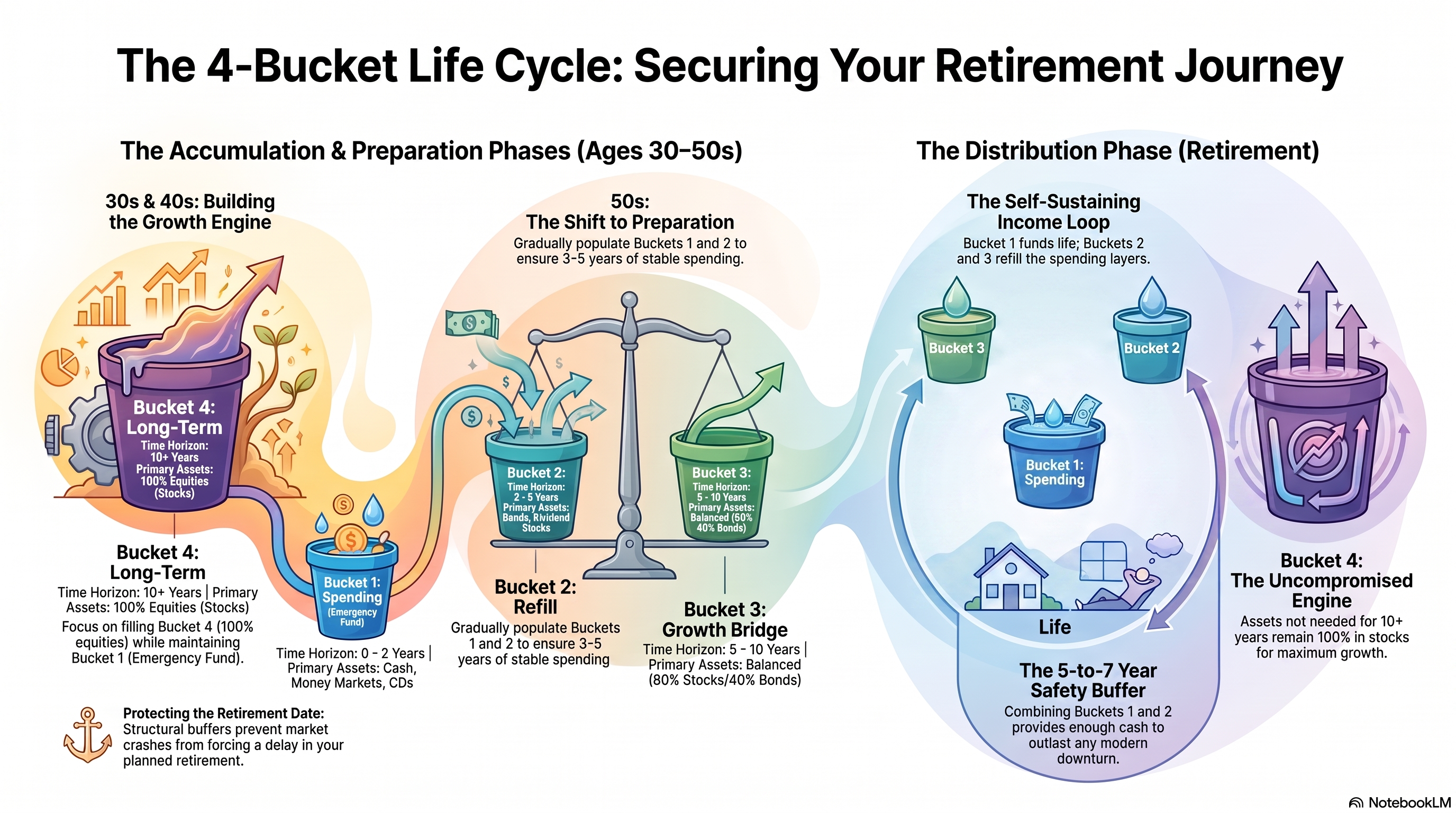
Together, Buckets 1 and 2 represent five to seven years of living expenses that never need to touch the market. Five to seven years of financial stability regardless of what happens to stock prices. In the history of modern financial markets, no downturn — not 2000, not 2008, not 2022 — lasted that long without a meaningful recovery.
Bucket 3 — The Growth Bridge (5 to 10 Years)
This bucket does not need to be touched for at least five years. That single fact changes everything about how it should be invested. A five-year minimum horizon is long enough to ride out most market cycles, long enough to give a severe downturn time to resolve, long enough to invest more aggressively than you could if you needed the money sooner.
Bucket 3 typically holds a balanced mix of stocks and bonds — something like 50-60% equities. Its job is to grow enough to refill Bucket 2 over time, keeping the whole system self-sustaining.
Bucket 4 — The Long-Term Engine (10+ Years)
This is where the real growth happens. Money you will not touch for at least a decade — invested entirely in equities, without compromise or hedging.
That 10-year horizon is the permission structure that makes this possible. You are not being reckless by putting this bucket in 100% stocks. You are being rational. Over any rolling 10-year period in modern financial history, a diversified equity portfolio has delivered strong positive returns. The volatility that is terrifying over 18 months is irrelevant over 10 years.
Bucket 4 is also where Roth IRA assets belong — growing tax-free, without required distributions, for as long as possible. Under SECURE 2.0, many people born in 1960 or later do not face mandatory withdrawals from traditional accounts until age 75, creating a long window where Roth assets in Bucket 4 can compound undisturbed.
The Real Case Study: Same $1 Million, Two Completely Different Retirements
Let me show you exactly what the difference looks like in human terms.
Margaret retires in January 2008 with $1 million, a careful investor her whole life. She uses the conventional approach — a single 60/40 portfolio, withdrawing $50,000 a year, adjusted for inflation. She has read the research. She is doing everything she was told to do.
Six months in, the financial crisis arrives. Her portfolio falls 27% over the next 18 months. She still needs $50,000 for her mortgage, her groceries, her life. So she sells shares — at 2008 prices. Those shares, had she held them, would have been worth significantly more by 2011. She does not get that recovery. She got the cash she needed at exactly the wrong moment, and those shares are gone.
The bull market of the 2010s helps. But it helps on a base that was permanently reduced. Margaret's retirement works out — but not as well as it should have, given everything she did right.
Now Robert. Same retirement date. Same $1 million. Same market. But a different structure.
- Bucket 1: $100,000 in cash and money market — two years of living expenses
- Bucket 2: $150,000 in bonds and dividend stocks — three more years of expenses
- Bucket 3: $300,000 in balanced allocation — not needed for five to ten years
- Bucket 4: $450,000 in equities — not needed for a decade or more
The 2008 crisis hits. Robert's Buckets 3 and 4 fall with the market — the same paper losses Margaret experienced. But Robert does not sell a single share of equities. He draws from Bucket 1. Dividends from Bucket 2 slowly refill Bucket 1. He watches the news with discomfort, but he does not make a single decision based on it. There is nothing to decide. The structure already decided for him.
By 2010, Bucket 1 needs replenishment. Bucket 2 has partially recovered and provides the refill. Bucket 3, untouched for two years, is recovering. Bucket 4, untouched and fully invested, participates in the full recovery that followed — not from a depleted base, but from the original $450,000.
Same market. Same retirement date. Same opening portfolio. Completely different outcomes — determined entirely by structure.
The Structure Works at Every Life Stage — Not Just Retirement
Most articles about the 4-bucket strategy write it as a retirement tool. It is more than that. The underlying logic — organize money by when you need it — applies at every stage of life. The earlier you build this habit, the more natural and powerful it becomes.
In Your 30s — You Already Have the Structure, You Just Haven't Named It
If you have an emergency fund and a 401(k), you have the bones of a bucket strategy. The emergency fund is Bucket 1. The 401(k) is Buckets 3 and 4. The gap most 30-somethings have is Bucket 2 — a medium-term savings layer for goals that are three to seven years away: a home down payment, a career transition, a child's education.
Making this intentional changes the way you make financial decisions. When you know which money is for what, you stop treating your investment account like a savings account. You stop pulling from long-term growth for short-term needs. The discipline is not about willpower — it is about structure that makes the right decision the easy decision.
In Your 40s — Build the Layers Deliberately
Your 40s are when the demands on your money multiply. Mortgage, retirement, college savings, aging parents, your own career uncertainty — every goal has a different time horizon, and the money that serves one goal cannot serve another without consequence.
The bucket framework makes this visible. Your retirement accounts are Buckets 3 and 4 — long-term, aggressive, untouched. Your emergency fund is Bucket 1 — stable, available, not invested in anything that can drop. Your medium-term savings for goals within the decade are Bucket 2. Naming them does not change the math. It changes the clarity. And clarity changes decisions.
In Your 50s — This Is the Decade That Determines Your Retirement Date
The single most important thing to understand about retirement planning in your 50s is this: a market event three to five years before you retire can delay your retirement by years if your portfolio has no structure.
A 55-year-old who plans to retire at 62 and keeps everything in a single growth portfolio is entirely at the mercy of whatever the market decides to do in 2029 or 2030. If it drops 30% the year before they planned to retire, they face a choice: retire anyway and sell shares at the bottom, or delay retirement until the market recovers.
A 55-year-old who starts building Bucket 1 and Bucket 2 gradually over the next five years arrives at 62 with three to five years of spending already in stable assets. A market crash the year before retirement is uncomfortable. It is not a crisis. The structure already handled it.
This is the decade when the structure determines whether you retire when you planned or when the market lets you.
In Retirement — The Structure Becomes Your Income Plan
Once withdrawals begin, the 4-bucket strategy stops being a framework and becomes an operating system. Bucket 1 funds spending. Bucket 2 refills Bucket 1. Bucket 3 refills Bucket 2. Bucket 4 grows until needed in the later decades of retirement.
RMDs from traditional IRAs — which begin at 73 for those born before 1960, and 75 for those born in 1960 or later — flow into Bucket 1 or Bucket 2, satisfying the required distribution while refilling the spending layers. Roth accounts, with no mandatory withdrawals, stay in Bucket 4 as long as possible.
The structure and the tax strategy become one system.
The Psychological Benefit Nobody Talks About Enough
Every financial argument for the 4-bucket strategy is real and well-documented. But the most important benefit is one that does not show up in any spreadsheet.
It removes the decision from the moment of maximum fear.
Think about what happens to a retiree who watches their portfolio drop 30% with no structure. They face a decision: sell some investments to cover living expenses, or not. That decision arrives during a market crisis, when every piece of financial news is catastrophic, when everyone around them seems to be panicking, when their gut is telling them the market might never recover. The decision has to be made with real money, under real stress, in real time.
That is the moment when human beings make their worst financial decisions.
Now think about what happens to a retiree with a bucket structure who watches their portfolio drop 30%. They face no decision. Their living expenses are already in Bucket 1, in cash that was set aside before the crisis began. The market can do whatever it wants. It does not affect their life this month, or next month, or the month after that. By the time Bucket 1 runs low and needs refilling, the worst of the crisis has usually passed.
The structure does not just protect your money. It protects you from yourself — from the fear response that turns temporary paper losses into permanent, irreversible decisions.
That psychological protection is worth more than any optimization of expected return.
Three Things That Make the 4-Bucket Strategy Even Better in 2026
The Planning Window Is Longer Than It Used to Be
SECURE 2.0 pushed mandatory RMD ages to 73 for those born before 1960 and 75 for those born in 1960 or later. For a 65-year-old born in 1962, that means a full decade before forced withdrawals begin — a decade where Bucket 4 grows tax-free in Roth accounts without any mandatory distributions touching it.
Ten uninterrupted years of compounding on a fully invested equity bucket is significant. The SECURE 2.0 change made the bucket strategy more powerful for everyone who has time to prepare for it.
Your Safety Buffer Actually Earns Now
For much of the 2010s, keeping money in Bucket 1 and Bucket 2 meant watching it earn almost nothing. The safety came at the cost of return. In 2026, high-yield savings accounts and money market funds are earning real rates. Short-term CDs are competitive. The buffer costs less in foregone return than it did when rates were near zero.
This does not change the structural logic. But it makes the strategy more efficient — the peace of mind is cheaper to maintain than it used to be.
The Safe Withdrawal Rate Has Been Recalibrated
Research from Morningstar and other major firms suggests that for someone retiring in 2026, a safe starting withdrawal rate is closer to 3.9% rather than the traditional 4%. The bucket strategy handles this naturally — because you are not rigidly withdrawing the same percentage every year regardless of market conditions. In strong years, you refill buckets from growth. In weak years, you draw exclusively from cash, effectively withdrawing zero from growth assets. That built-in flexibility is what makes the strategy work over 30 years.
The Five Mistakes People Make When Implementing This
Mistake 1: Keeping Too Much Cash in Bucket 1
The instinct is to keep more. More cash feels safer. But every dollar in excess of two years of living expenses in Bucket 1 is a dollar that is not growing in Bucket 4. If Social Security, a pension, or other guaranteed income already covers most of your fixed expenses, Bucket 1 can be much smaller — you only need to buffer the gap. Do not let the comfort of cash become a drag on your long-term returns.
Mistake 2: Forgetting to Refill
The buckets need to flow. Bucket 1 depletes as you spend. Bucket 2 needs to refill Bucket 1. Bucket 3 needs to periodically refill Bucket 2. If you build the structure and then ignore it, you have simply reorganized money without creating the self-sustaining system. A once-a-year review — the same week every year — to assess bucket levels and rebalance deliberately is all it takes.
Mistake 3: Being Too Conservative in Bucket 4
Once money is labeled "10+ years away," many people still soften the allocation. They add some bonds. They hedge. Over a 10-15 year horizon, that conservatism costs real money. Bucket 4's only job is to grow. Give it the full equity allocation its time horizon justifies — and then leave it alone.
Mistake 4: Getting the Tax Location Wrong
Where each bucket lives matters as much as what it holds. Traditional IRA assets generate taxable income every time they are withdrawn — they belong in Bucket 1 or Bucket 2, where withdrawals are planned and can be managed for tax efficiency. Roth IRA assets belong in Bucket 4, growing tax-free for as long as possible. Taxable brokerage assets belong in Bucket 3 or Bucket 4 for their long-term capital gains treatment. Getting this wrong costs money every year in a quiet, invisible way that only becomes visible at tax time.
Mistake 5: Planning the Buckets Without Planning Social Security
These are not separate decisions. If you retire at 62 but delay Social Security until 70, your first eight years of retirement have no Social Security income at all. Your Bucket 1 and Bucket 2 need to be large enough to cover that entire gap — which is a very different sizing calculation than for someone who claims immediately. The Social Security timing decision and the bucket sizing decision are part of the same plan. Make them together.
Your Specific Numbers Require More Than a Framework
The bucket strategy described here is a framework. It is the right framework — the structure that organizes retirement money in the way that most protects it from the most dangerous risks.
But the specific numbers — how large each bucket should be for your life, which accounts should hold which bucket, how the bucket sizes change with your Social Security timing decision, what happens to the system if markets fall 30% in your first year — those answers require modeling against your actual situation.
How much of your essential spending is already covered by guaranteed income? What does your tax picture look like across a 30-year retirement? What is the realistic probability that this structure sustains your withdrawals all the way through?
These are questions with specific answers for your specific numbers — not rules of thumb, not general guidance, not a single projection that assumes everything goes according to plan.
Running 25,000 different scenarios against your actual accounts, your actual income sources, your actual timing decisions, and your actual state tax situation is what turns the structural insight of the bucket strategy into a plan you can actually live.
The Real Reason This Works
Most people think about retirement as a destination — the day they stop working, the number they need to hit, the finish line.
The 4-bucket strategy reveals something different. Retirement is not a destination. It is a 25-30 year income management challenge that begins the day withdrawals start. And the structure you bring to that challenge determines whether the market's inevitable bad years are something that disrupts your retirement or something your retirement was designed to absorb.
The light bulb — the thing that changes the way you see your money — is this: during accumulation, time is the variable that works in your favor. Every bad year is followed eventually by recovery, and you are still adding money, not taking it out. During distribution, time no longer protects you the same way. Structure is what takes time's place.
Without structure, even a perfectly built retirement portfolio can be undone in one bad year — not because the investor was foolish, not because they chose the wrong funds, but because they were forced to sell at the wrong moment and the math of sequence risk made that damage permanent.
Two people. Same money. Same market. Same long-run returns. The one with structure barely notices the storm. The one without it is selling the shares that were supposed to fund their life, watching their future compound on a permanently smaller base.
Structure is not caution. It is not a concession to fear. It is how you stay invested in growth assets through the inevitable downturns — because you already removed the need to sell them.
The structure is the strategy. And the earlier you build it, the more powerfully it works.
Frequently Asked Questions
How much should I put in each bucket?
There is no one-size answer, but a starting framework helps. Bucket 1 should cover 1 to 2 years of living expenses not already covered by guaranteed income like Social Security or a pension. Bucket 2 covers the next 3 to 5 years. The remainder splits between Buckets 3 and 4 based on your time horizon and comfort with risk. The key insight: the more guaranteed income you have, the smaller Bucket 1 needs to be, and the more aggressively you can allocate to Buckets 3 and 4.
Is the 4-bucket strategy the same as the 3-bucket strategy?
The 3-bucket version is well-known and effective. The 4-bucket version simply separates the longer-term money into a medium-growth bridge (5-10 years) and a maximum-growth engine (10+ years). That separation allows Bucket 4 to be invested fully and aggressively — without compromise — while Bucket 3 handles the transition period where fully aggressive would feel uncomfortable. The result is more long-term growth potential without more near-term anxiety.
What happens if Bucket 1 runs out?
If the structure is maintained properly, it should not. Bucket 2 is designed to refill Bucket 1 before it runs empty. But in an extreme prolonged downturn, if both Bucket 1 and Bucket 2 are strained, the right response is to draw from Bucket 2 directly — not from Bucket 3 or Bucket 4. The entire design is built to give growth assets the most time possible to recover before being touched. In a truly severe scenario, temporarily reducing discretionary spending is preferable to permanent liquidation at depressed prices.
How do RMDs fit into this structure?
Required Minimum Distributions from traditional IRAs — beginning at 73 for those born before 1960, or 75 for those born in 1960 or later — are taxable income that arrives whether you need it or not. Direct those distributions into Bucket 1 or Bucket 2. This satisfies the legal requirement while refilling the spending layer from assets that were going to generate taxable income anyway. For those charitably inclined, Qualified Charitable Distributions of up to $108,000 per person in 2026 can satisfy RMD requirements without generating taxable income at all — a powerful combination with the bucket strategy.
Does this work if I have a pension?
Yes — and often better. A pension that covers most of your essential expenses dramatically shrinks the required size of Buckets 1 and 2. When your baseline income is already guaranteed regardless of market conditions, your portfolio can be weighted heavily toward Buckets 3 and 4, maximizing long-term growth. The protection the bucket strategy offers against sequence of returns risk is less critical when essential spending is already guaranteed — but the structure still matters for discretionary spending and legacy.
When should I start building this structure?
Earlier than you think. In your 30s, the structure is informal but the habits are already forming — emergency fund, medium-term savings, long-term investment account. In your 40s, naming and intentionalizing those buckets changes how you make decisions across all of them. In your 50s, the structure should become explicit and formal — three to five years before your target retirement date is when Buckets 1 and 2 should start being populated deliberately, so that a market event in the final years before retirement does not delay the day you planned to stop working.
Have a question this article didn't answer?
Every financial situation is different. If something here raised a question specific to your numbers — your IRA balance, your Social Security timing, your tax picture — we'd like to hear it. Send us a note at support@arthavita.co and we'll do our best to address it, either directly or in a future post.
Arthavita is an educational and planning platform. This article is for informational purposes only and does not constitute personalized financial, tax, or legal advice. All financial decisions remain with you. For personalized guidance, consult a qualified financial or tax professional.
Ketan Patel
Founder, Arthavita
Ketan Patel is the founder of Arthavita and a multi-industry entrepreneur with 30+ years of experience in technology and business operations. He built Arthavita to bring institutional-quality financial intelligence to individual investors.
LinkedIn ↗This article is for educational purposes only and does not constitute financial, tax, or legal advice. Arthavita is a recommendation-only platform. Always consult a qualified professional before making financial decisions.