
Saving for Retirement Takes 35 Years. Spending It Right Takes a Plan Nobody Gave You.
The financial industry spent 40 years teaching you to accumulate. Almost nobody taught you how to distribute. Turning a retirement portfolio into sustainable income is a completely different problem from building one — with different risks, different rules, and different decisions that need to be made years before you actually retire. The safe withdrawal rate in 2026 is 3.9%, not 4%. The retirement risk zone — the five years before and after retirement — is where most retirement failures actually happen. And the decisions you make about Social Security timing, account sequencing, and tax management in those years will determine whether your money outlasts you or you outlast your money.
Everyone told you to save for retirement. Nobody told you how to spend it.
For 35 years the financial system gave you a clear instruction: contribute to your 401(k), increase the percentage with every raise, diversify, stay the course through market downturns, and let compound interest do the rest. The instruction was clear. The feedback was measurable. The account balance went up. You were doing it right.
Then you arrived at retirement — or close enough to see it — and realized that nobody had ever explained what happens next.
How much can you actually withdraw each year without running out? Which accounts do you draw from first? When do you claim Social Security — and does it matter as much as people say? What happens to your tax rate when you start pulling from a traditional IRA? What is a Required Minimum Distribution and why does it complicate everything? What happens to your portfolio if the market drops 30% in year two of retirement?
These are not edge cases. They are the central questions of retirement. And most people arrive at them with no framework, no plan, and no understanding of why the rules that governed accumulation are almost completely reversed in distribution.
This article is the explanation nobody gave you.
Why Distribution Is a Completely Different Problem
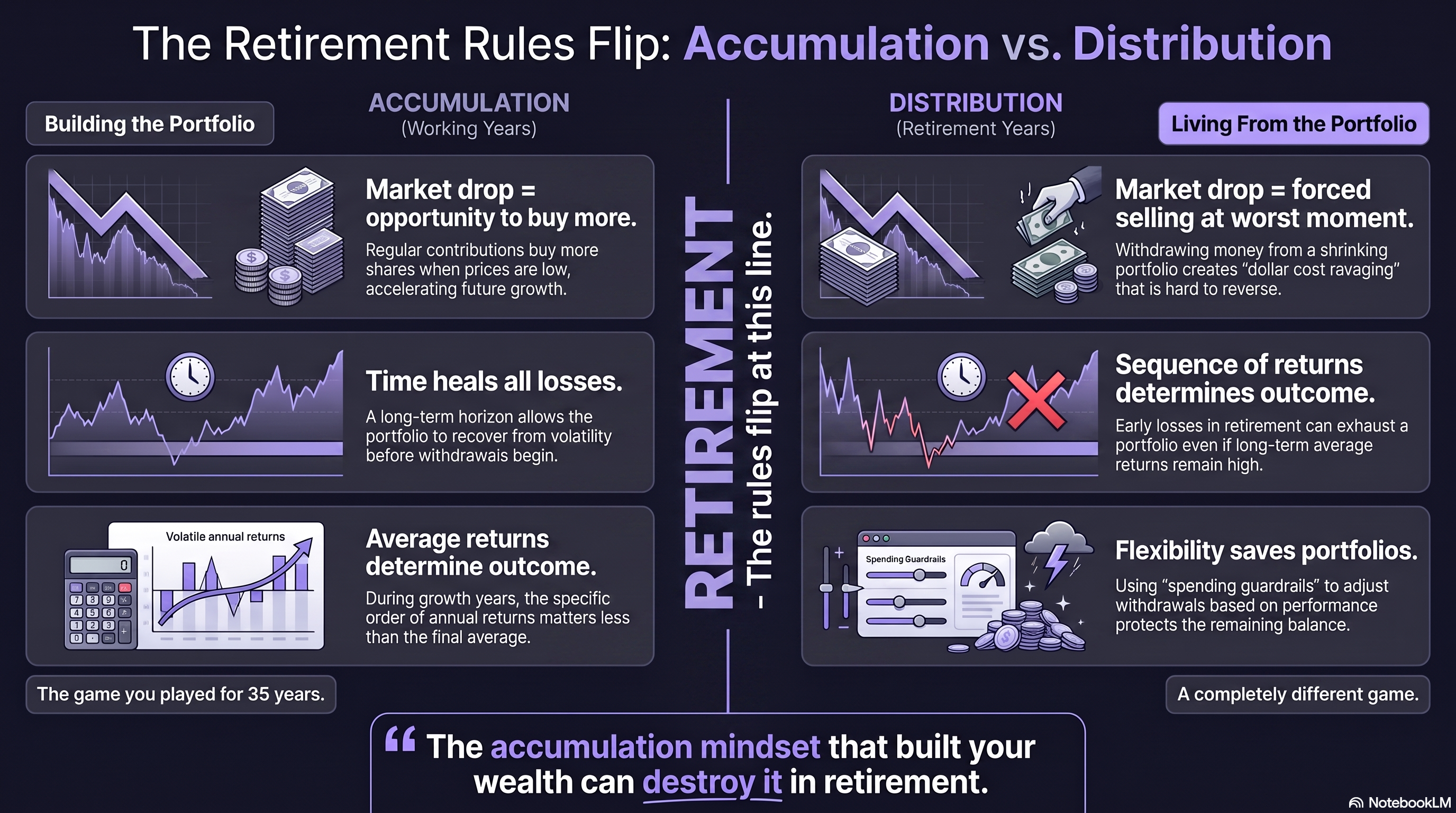
When you are saving for retirement, a market downturn is an opportunity. Your paycheck keeps buying shares. A 30% decline at 38 is noise by the time you are 58 — the portfolio recovered, the contributions continued, and time did its work.
When you are withdrawing from retirement, the same 30% decline can be permanently damaging. Here is why.
In accumulation, you are adding money to a portfolio while it grows. In distribution, you are removing money from a portfolio while it potentially shrinks. The combination of withdrawals and losses creates a mathematical dynamic that has nothing to do with long-term average returns — and everything to do with the sequence in which those returns arrive.
Researchers call it sequence of returns risk. J.P. Morgan's retirement research team calls it "dollar cost ravaging" — the mirror image of dollar cost averaging.
Here is the concrete example that makes it real.
Two retirees. Both retire with $1 million. Both average 7% annual returns over 20 years. Both withdraw $50,000 per year.
Retiree A gets good returns in the early years and bad returns later. At 20 years, the portfolio still has over $800,000.
Retiree B gets bad returns in the early years and good returns later. Same 7% average. Same $50,000 withdrawal. At 20 years, the portfolio is exhausted. Retiree B ran out of money despite identical average returns — because the losses arrived first, while withdrawals were depleting the portfolio before it had a chance to recover.
That is not a theoretical risk. That is the central structural challenge of retirement income — and it is why the accumulation playbook fails completely as a distribution strategy.
The Retirement Risk Zone — The Years Nobody Warns You About
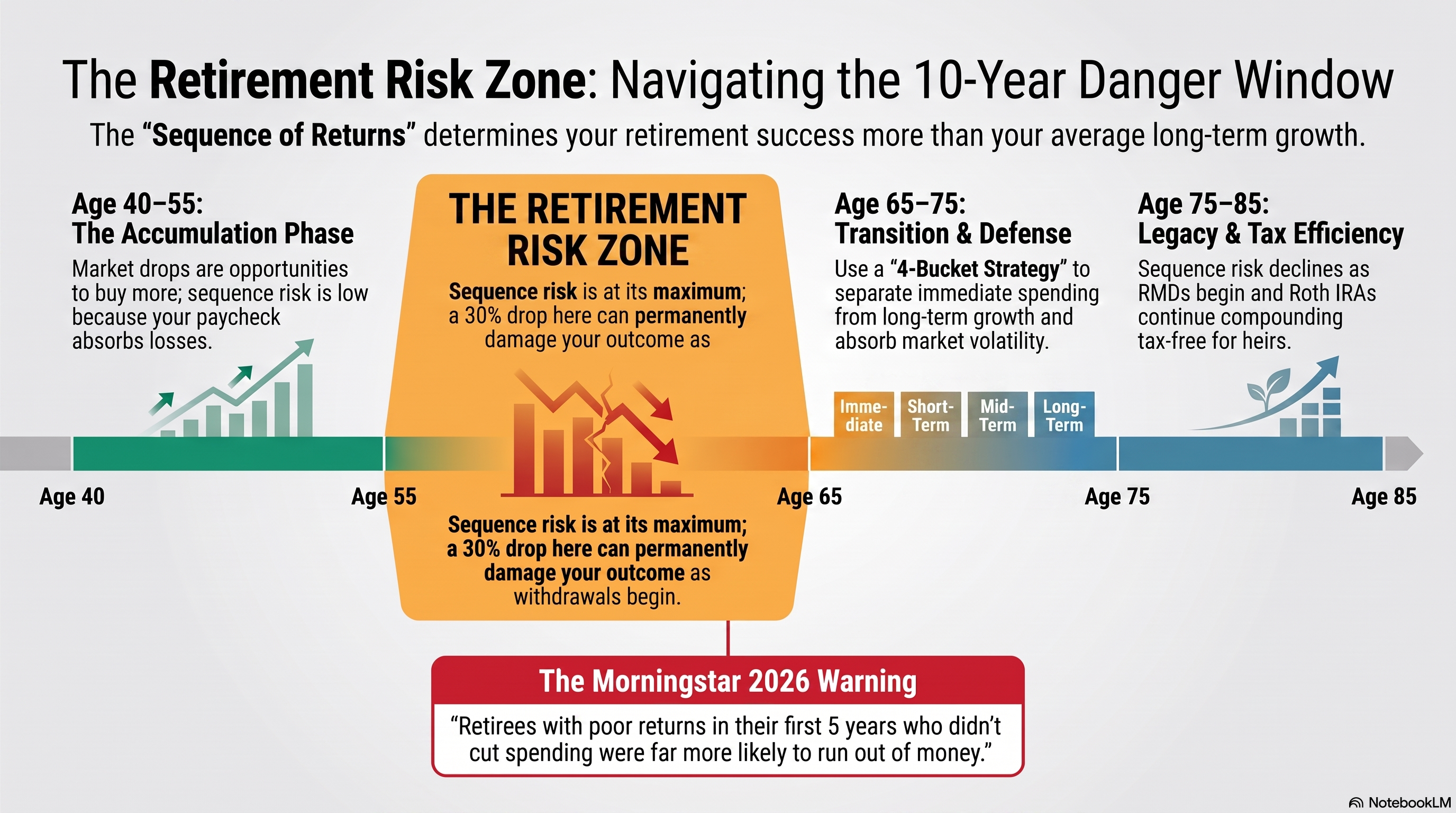
The five years before retirement and the five to ten years after retirement are the most financially dangerous period of your entire life.
Not because you are more likely to make bad investment decisions. Because the mathematical sensitivity of your retirement outcome to market performance is at its absolute highest during these years.
Before retirement, a bear market hurts but does not define the outcome — you still have working income, you can continue contributing, and time is still on your side. After ten years in retirement, a bear market hurts but the portfolio has had time to compound and the remaining withdrawal period is shorter.
In the retirement risk zone — those critical years around the transition — a bear market can permanently reset the trajectory of the entire retirement. The portfolio is at or near its maximum size. Withdrawals are beginning or about to begin. There is no paycheck to continue contributing. And the sequence of returns effect is operating at maximum force.
Morningstar's 2026 retirement income research is direct on this point: retirees who experienced poor returns in their first five years and did not cut spending were far more likely to run out of money than those who got positive early returns — regardless of what happened in the subsequent decades.
This is why distribution planning cannot begin at retirement. It must begin at 55 or 60, while the flexibility to adjust still exists.
The Safe Withdrawal Rate in 2026 — And Why the 4% Rule Needs an Update
The 4% rule — withdraw 4% of your portfolio in year one, then adjust for inflation each year — has been the default retirement income framework for three decades. It emerged from William Bengen's 1994 research showing that a 4% starting withdrawal had historically survived every 30-year retirement period tested.
In 2026, Morningstar's base-case safe starting withdrawal rate for a balanced portfolio over a 30-year horizon is 3.9%. Not dramatically different — but the direction matters. The research notes elevated equity valuations and the counterintuitive finding that higher equity allocations actually reduce the safe withdrawal rate rather than increase it, because of the volatility they add during the sequence risk window.
The 4% rule as a rule of thumb is still defensible. But treating it as a guarantee in 2026 is not.
More importantly, the 4% rule answers only one question — how much can I withdraw in year one — and leaves the five hardest questions of retirement income completely unanswered.
Which accounts do I draw from first? In what order do I claim income from different sources? How do I manage the tax rate on each withdrawal? What do I do when Required Minimum Distributions force taxable income I do not actually need? And what is my contingency if the market drops 30% in year three?
A withdrawal rate is not a distribution plan. A number is not a strategy.
When Distribution Planning Actually Needs to Start
The answer most people do not want to hear: ten years before retirement.
Not because the mechanics of distribution are complex — though they are. But because the most important distribution decisions are made during the accumulation phase, when there is still time to act on them.
The Roth conversion window. The years between 55 and 70 are typically the optimal period for converting traditional IRA balances to Roth. Income is often lower than peak working years but higher than early retirement. The conversions reduce future Required Minimum Distribution exposure and lower the taxable income that will affect Social Security taxation and IRMAA Medicare surcharges in retirement. Once RMDs begin at 73 or 75, the conversion window narrows dramatically.
Social Security timing. Claiming Social Security at 62 versus 70 produces a difference of approximately 76% in monthly benefit — for the same earnings record. Every year of delay between 62 and 70 increases the benefit by approximately 6-8%. For a retiree in good health, delaying to 70 almost always produces higher lifetime income — but the decision interacts with portfolio withdrawal sequencing, tax management, and survivor benefits in ways that cannot be optimized in isolation.
Portfolio restructuring. The portfolio that served you well at 45 — heavily weighted toward growth equities — is not the right portfolio for someone entering the retirement risk zone. The transition from accumulation to distribution requires restructuring toward income generation and sequence risk protection — not abandoning growth entirely, but organizing the portfolio around the time horizons of actual spending needs.
Account sequencing. The order in which you draw down different account types — taxable brokerage, traditional IRA, Roth IRA — has significant tax implications over a 25-30 year retirement. The conventional wisdom of drawing taxable first, then traditional, then Roth is not always optimal. The right sequence depends on your specific tax situation, RMD exposure, IRMAA thresholds, and estate planning goals.
None of these decisions can be made well at retirement. They require modeling, time, and the flexibility that only exists in the years before the transition.
The Five Distribution Decisions That Determine Everything
Decision 1: When to Claim Social Security
Social Security is the most valuable guaranteed income source most Americans will ever have — and the timing decision is one of the highest-stakes financial choices of retirement.
Claiming at 62 locks in a permanently reduced benefit — approximately 30% less than the full retirement age benefit. Claiming at 70 produces the maximum benefit — approximately 32% more than full retirement age. For a married couple, the decision is further complicated by survivor benefits: the higher earner delaying to 70 produces a larger survivor benefit if they die first, which can be the difference between a surviving spouse living comfortably or living precariously.
The breakeven analysis — the age at which delaying produces more lifetime income than claiming early — typically falls somewhere between 80 and 83 for most people. If you expect to live past that age, delay is almost always the mathematically superior choice.
But the Social Security decision does not live in isolation. It interacts with the portfolio withdrawal question — if you delay Social Security, you need to draw more from your portfolio in the early retirement years to cover living expenses. That increased early withdrawal amplifies sequence of returns risk. The optimal Social Security timing depends on your specific portfolio, your health history, your spouse's situation, and your other income sources — not on a generic breakeven calculation.
Decision 2: Which Accounts to Draw From and In What Order
Account sequencing — the order in which you withdraw from different account types — is one of the most underappreciated tools in retirement income management.
The conventional sequence: draw from taxable brokerage accounts first, then traditional IRA, then Roth IRA last.
But the conventional sequence is not always optimal. In years when taxable income is low — particularly in the early retirement years before Social Security begins — drawing from traditional IRA at low tax rates and simultaneously executing Roth conversions can reduce lifetime tax burden significantly. In years when RMDs force large traditional IRA withdrawals, drawing from Roth instead of adding to an already-high taxable income avoids pushing into higher brackets or crossing IRMAA thresholds.
The principle is income smoothing: keeping taxable income in a consistent range across retirement years, avoiding the spikes that push into higher brackets, trigger IRMAA surcharges, or increase Social Security taxation. The account sequence is the tool that makes income smoothing possible.
Decision 3: How Much to Withdraw — And How Flexible to Be
The 3.9% starting safe withdrawal rate from Morningstar's 2026 research assumes a fixed real withdrawal — the same inflation-adjusted amount every year regardless of market conditions. That assumption produces the most conservative estimate.
Flexible withdrawal strategies — adjusting spending based on portfolio performance — allow significantly higher starting withdrawal rates. Morningstar's research shows that combining a flexible guardrails strategy with delayed Social Security claiming can push the sustainable starting withdrawal rate as high as 5.7%.
The guardrails approach works like this: establish an upper and lower percentage of the portfolio as spending guardrails. If a good market sequence pushes the portfolio above the upper guardrail, you can increase spending. If a bad sequence pushes the portfolio below the lower guardrail, you reduce spending — typically by 10% — until the portfolio recovers. The flexibility to cut spending in bad years is what allows the higher starting withdrawal rate in good years.
For most retirees, a hybrid approach makes the most sense: fixed spending for essential expenses, flexible spending for discretionary expenses. The essentials are covered by Social Security plus a conservative fixed withdrawal. The discretionary layer expands or contracts with portfolio performance.
Decision 4: How to Manage Taxes on Every Withdrawal
Every dollar you withdraw from a traditional IRA or 401(k) is ordinary income — taxed at the same rates as your salary once was. And that ordinary income interacts with Social Security taxation, IRMAA surcharges on Medicare premiums, and Required Minimum Distributions in ways that can significantly increase the effective tax rate on retirement income.
The Social Security taxation cascade alone can create effective marginal tax rates of 40% or higher on IRA withdrawals for retirees in the 22% bracket. For every additional dollar of IRA withdrawal, up to $0.85 of Social Security becomes taxable. If the Social Security income is taxed at 22%, the effective marginal rate on the IRA withdrawal is 22% plus 22% times 85% — approximately 41%. That is not a marginal rate the printed tax brackets show anywhere. It emerges from the interaction between income sources.
Tax-aware withdrawal sequencing — drawing from Roth in years when taxable income is high, drawing from traditional in years when income is low, using taxable accounts to harvest capital losses that offset gains — is the practical response to this complexity.
Decision 5: How to Handle Required Minimum Distributions
Required Minimum Distributions beginning at age 73 — or 75 for those born after 1960 under SECURE 2.0 — are forced taxable withdrawals from traditional IRA and 401(k) accounts, calculated based on account balance and IRS life expectancy tables.
For retirees with large traditional balances, RMDs can force more taxable income than they actually need — pushing them into higher brackets, triggering IRMAA surcharges, and increasing Social Security taxation. A retiree with $1.5 million in traditional IRA at 73 faces a first-year RMD of approximately $56,000 — whether they need that income or not.
The RMD problem is best addressed before it arrives. Systematic Roth conversions in the years before 73 reduce the traditional balance that will be subject to RMDs and shift that money into an account with no distribution requirements.
For retirees who do not need their RMD income, a Qualified Charitable Distribution — directing up to $108,000 per year of RMD directly to a charity — satisfies the RMD requirement without the amount being counted as taxable income.
The Accumulation Mindset That Fails in Distribution
Most people enter retirement with a portfolio built for growth and a mindset built for accumulation. Both need to change.
The accumulation mindset treats market downturns as opportunities — buy more at lower prices, stay the course, time in the market beats timing the market. This is correct during the working years. It is dangerous during the retirement risk zone.
A retiree who sees a 30% market decline and stays the course while continuing to withdraw $60,000 per year from a depleted portfolio is locking in losses at the worst possible time. The mathematical reality of sequence risk does not care about long-term optimism — it cares about the order in which returns and withdrawals interact.
The distribution mindset requires something the accumulation mindset resists: acknowledging that the portfolio now has a specific job to do — fund your life for 25-30 years — and that job requires a structure, not just a balance.
That structure is the four-bucket strategy — not as a static allocation, but as a dynamic system where:
Bucket 1 holds two years of living expenses in cash or money market — never invested, always available, immune to sequence risk.
Bucket 2 holds three to five years of income in conservative bonds and dividend-paying assets — refills Bucket 1 as it depletes, absorbs market volatility without requiring equity sales.
Bucket 3 holds balanced growth assets for the five to ten year horizon — generates the returns that refill Bucket 2 over time.
Bucket 4 holds long-term growth assets — equities, Roth IRA balances — for the decade-plus horizon where market volatility is irrelevant to near-term spending.
The system works because it separates the spending decision from the market. When equities drop 30%, you draw from Bucket 1. You do not sell equities at the worst moment. You wait for Bucket 3 to recover and then refill the shorter-term buckets from strength rather than necessity.
What the Distribution Plan Actually Looks Like — A Real Example
A 63-year-old retiring at 65 with $900,000 in traditional 401(k), $180,000 in Roth IRA, $75,000 in taxable brokerage, and an expected Social Security benefit of $2,400 per month at full retirement age — $3,168 at 70.
Without a distribution plan: retire at 65, claim Social Security immediately, start withdrawing from the 401(k) for everything else.
With a distribution plan:
Ages 63-65 — Pre-retirement Roth conversion window: Convert $40,000-$50,000 per year from traditional 401(k) to Roth IRA, staying within the 22% bracket. Pay the conversion tax from the taxable brokerage account.
Ages 65-70 — Bridge period before Social Security: Draw from taxable brokerage first, supplement with moderate traditional 401(k) withdrawals managed to stay within favorable brackets. Continue Roth conversions where bracket space allows. Do not claim Social Security.
Age 70 — Claim Social Security at maximum benefit: Monthly benefit of $3,168 versus $2,400 at 65 — a $768 per month permanent increase. Over a 20-year retirement, that difference produces approximately $184,000 in additional lifetime income.
Ages 70-73 — Pre-RMD optimization: Portfolio has had five years to potentially recover and grow. Taxable brokerage substantially depleted. Traditional balance reduced by conversions. The RMD that arrives at 73 is smaller and more manageable because of the conversion work done in earlier years.
Ages 73 and beyond — Managed RMDs and Roth preservation: Draw traditional first to satisfy RMDs. Use Roth for years when taxable income is already high. Direct any unneeded RMD to Qualified Charitable Distributions if charitably inclined. Roth IRA continues compounding as legacy for heirs.
The difference between this plan and the no-plan alternative is not marginal. Over a 25-year retirement, the tax management alone often produces six-figure lifetime savings. The Social Security delay alone produces over $180,000 in additional income. The sequence risk management preserves the portfolio through the years when it is most vulnerable.
That is what a distribution plan actually does. It does not change the market. It changes the decisions that interact with the market — and those decisions are entirely within your control.
What Arthavita's Platform Does for Distribution Planning
For users in the Pre-Retirement and Retirement life stages, Arthavita's Wealth Journey Dashboard surfaces an entirely different set of priorities than it shows for accumulation-stage users.
The 25,000-scenario Monte Carlo simulation models your actual distribution — your specific balances, your Social Security timing options, your planned withdrawal rate, your RMD schedule, and your tax situation — against 25,000 possible market sequences. It does not tell you what the average outcome is. It tells you the probability your money lasts across the full range of possible futures, including the bad sequences that generic planning tools ignore.
The Social Security Optimizer models the lifetime income impact of every claiming age from 62 to 70, including survivor benefit scenarios and the interaction with portfolio withdrawal sequencing.
The Roth Conversion Optimizer sizes the optimal annual conversion amount — staying within bracket limits, avoiding IRMAA crossings, and coordinating with Social Security timing — to minimize lifetime tax burden across the entire retirement horizon.
The RMD Planner projects Required Minimum Distributions from age 73 forward, shows the tax impact of those forced withdrawals, and integrates the Roth conversion strategy that reduces the problem before it arrives.
And the four-bucket framework is embedded in the portfolio management feature — not as a static asset allocation but as a dynamic structure that separates near-term spending from long-term growth and eliminates the forced selling at bad moments that sequence risk creates.
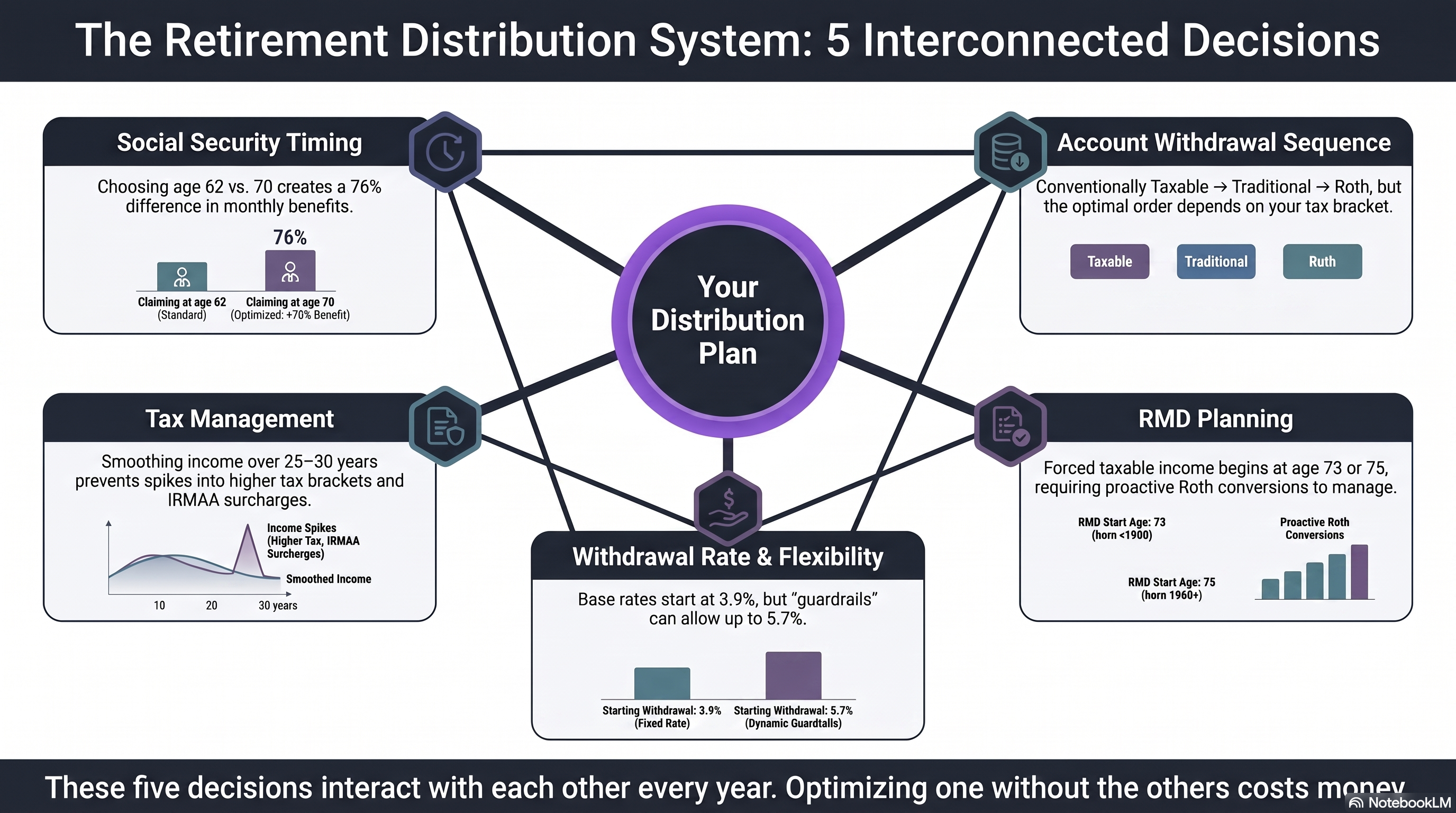
Distribution planning is not one decision. It is a coordinated system of five decisions that interact with each other across 25-30 years. The platform models all five simultaneously against your actual numbers.
The Question Nobody Asks Until It Is Almost Too Late
Most pre-retirees spend more time planning a two-week vacation than they spend planning how they will convert 35 years of savings into 30 years of income.
That is not a character flaw. The financial system never gave them the framework. The 401(k) enrollment form asked how much to contribute. Nobody asked how much to withdraw, from which account, in which year, at what tax rate, coordinated with which Social Security timing, structured to survive which sequence of returns.
The accumulation machine was designed for simplicity. The distribution problem is genuinely complex — and the consequences of getting it wrong are permanent and compounding in ways that accumulation mistakes rarely are.
A bad investment decision during accumulation can be recovered from. You can contribute more, stay invested, let time do its work. A bad distribution decision — claiming Social Security too early, drawing from the wrong account in the wrong year, failing to manage the sequence risk window — cannot be undone. The years pass. The decisions compound. And the portfolio that was supposed to last 30 years runs shorter than it needed to.
The good news: the decisions that determine distribution outcomes are almost entirely within your control. They do not require predicting the market. They require understanding the system — and making the right structural choices in the years before retirement when the flexibility to act still exists.
That is the plan nobody gave you. Now you have it.
Frequently Asked Questions
Is the 4% rule still safe in 2026?
The 4% rule remains a useful starting reference point but Morningstar's 2026 retirement income research puts the base-case safe withdrawal rate at 3.9% for a balanced portfolio over a 30-year horizon. If you are willing to use a flexible withdrawal strategy — adjusting spending based on portfolio performance — sustainable starting rates as high as 5.7% are possible when combined with delayed Social Security claiming.
When should I start Social Security?
For most people in good health, delaying to age 70 produces the highest lifetime income — approximately 76% more per month than claiming at 62. The breakeven age — when the higher monthly benefit from delaying exceeds the income foregone by waiting — typically falls between 80 and 83. The decision is further complicated by survivor benefits, portfolio withdrawal sequencing, and tax management — which is why it cannot be optimized in isolation from the rest of your distribution plan.
What is the retirement risk zone and how do I protect against it?
The retirement risk zone is the five years before and five to ten years after retirement — the period when sequence of returns risk is at its maximum. Protection comes from structural decisions: building a cash or short-term bucket covering two years of living expenses before retirement begins, reducing equity concentration in the years approaching retirement, and having a clear plan for reducing discretionary spending if early retirement returns are poor.
What order should I withdraw from my accounts?
The conventional sequence — taxable brokerage first, then traditional IRA, then Roth last — is a reasonable default but not always optimal. The better framework is income smoothing: drawing from whichever account keeps taxable income in the most favorable range in each specific year. Tax-aware sequencing across a 25-year retirement typically produces six-figure lifetime tax savings compared to a fixed sequence.
How do Required Minimum Distributions affect my distribution plan?
RMDs beginning at 73 or 75 force taxable income from traditional IRA and 401(k) accounts regardless of whether you need that income. For retirees with large traditional balances, RMDs can push taxable income into higher brackets and trigger IRMAA Medicare premium surcharges. The best response is proactive Roth conversion in the years before RMDs begin. For charitably inclined retirees, Qualified Charitable Distributions of up to $108,000 per year satisfy RMD requirements without the amount counting as taxable income.
What if I do not have $1 million saved — does distribution planning still matter?
Absolutely — and arguably more so. Sequence of returns risk does not scale with portfolio size. A $400,000 portfolio at a 4% withdrawal rate faces identical structural vulnerability to a $1 million portfolio at the same rate. The distribution decisions — Social Security timing, account sequencing, withdrawal flexibility, tax management — are equally important regardless of portfolio size.
When should I start distribution planning?
Ten years before your target retirement date is the honest answer — because the most valuable distribution decisions happen during the accumulation phase. Roth conversion opportunities, Social Security timing analysis, portfolio restructuring, and RMD projection all require time and flexibility that only exist before retirement. If you are within five years of retirement and have not started, start immediately.
Have a question this article didn't answer?
Distribution planning is genuinely specific to your situation — your account balances, your Social Security earnings history, your tax picture, your health, your spouse's situation. If something here raised a question about your specific numbers, send us a note at support@arthavita.co and we'll do our best to address it directly or in a future post.
Arthavita is an educational and planning platform. This article is for informational purposes only and does not constitute personalized financial, tax, or legal advice. All financial decisions remain with you. For personalized guidance, consult a qualified financial or tax professional.
Ketan Patel
Founder, Arthavita
Ketan Patel is the founder of Arthavita and a multi-industry entrepreneur with 30+ years of experience in technology and business operations. He built Arthavita to bring institutional-quality financial intelligence to individual investors.
LinkedIn ↗This article is for educational purposes only and does not constitute financial, tax, or legal advice. Arthavita is a recommendation-only platform. Always consult a qualified professional before making financial decisions.