
Roth vs. Traditional: The Decision That Shapes Your Entire Retirement Tax Bill
The Roth vs. Traditional decision is not about which account grows more — the math is identical when tax rates are equal. It is about when you pay taxes and at what rate. Roth wins when your current tax rate is lower than your future effective retirement rate. Traditional wins when the reverse is true. For most people, the right answer is neither exclusively — it is tax diversification across both account types, with the specific allocation shifting by life stage, income, and how Social Security, RMDs, and IRMAA interact with your withdrawals. The 2026 numbers have changed. This guide has been updated to reflect them.
Here is a question most people get wrong the first time they answer it.
"Should I put my retirement savings in a Roth or a Traditional account?"
The answer most people give: "Roth, because the money grows tax-free."
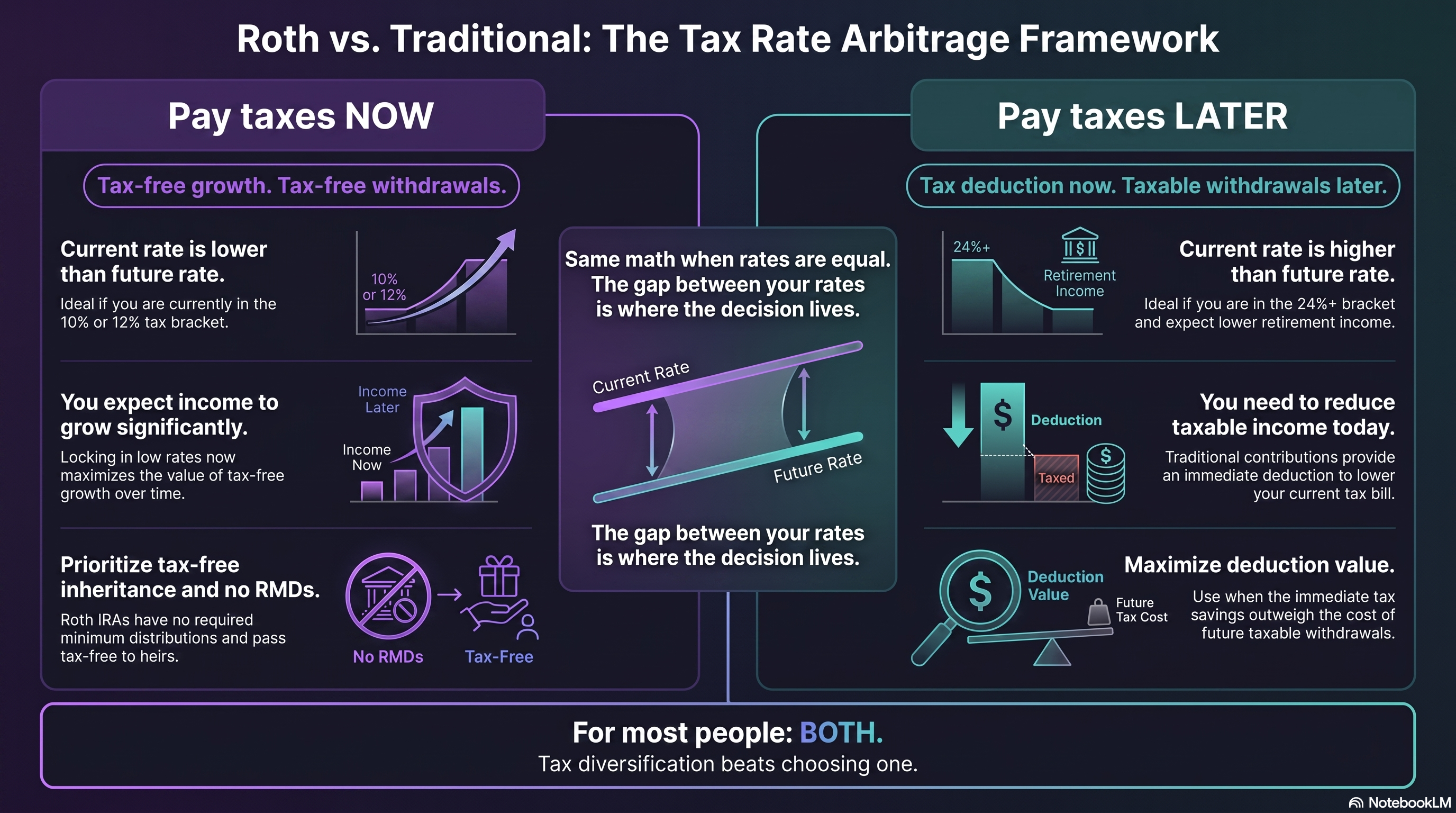
That answer sounds right. It is incomplete. Roth money grows tax-free — but you already paid taxes on it before it went in. Traditional money grows tax-deferred — but you get a deduction now and pay taxes when it comes out. Over identical time horizons with identical tax rates, the two approaches produce identical after-tax outcomes. The math is equivalent.
What makes them genuinely different is not the growth. It is the tax rate at which you pay. Pay now at a lower rate — Roth wins. Pay later at a lower rate — Traditional wins. The decision lives entirely in the gap between those two rates.
And that gap is harder to estimate than most people realize — because it depends not just on your income today, but on Social Security taxation, Required Minimum Distributions, IRMAA surcharges, and a tax rate environment that may look different in 2041 than it does in 2026.
This article gives you the framework to make the right decision at whatever point you are in right now — and to understand why that answer may need to change as circumstances change.
The Core Principle: Tax Rate Arbitrage
Strip away everything else and the Roth vs. Traditional decision reduces to one question: will your effective tax rate be higher now or in retirement?
If your current marginal tax rate is higher than your expected retirement effective tax rate — contribute to Traditional. You get the deduction now at the higher rate and pay taxes in retirement at the lower rate. The difference is permanent savings.
If your current marginal tax rate is lower than your expected retirement effective rate — contribute to Roth. You pay taxes now at the lower rate and withdraw tax-free in retirement, avoiding the higher future rate.
If the rates are approximately equal — the accounts produce similar after-tax outcomes, and other factors — flexibility, RMDs, estate planning, behavioral discipline — tip the decision.
Four factors complicate this framework that most discussions ignore entirely.
Factor 1: You are comparing a known current rate to an unknown future rate. Your 2026 marginal rate is certain. Your 2041 effective retirement tax rate depends on tax law changes, your Social Security income, your RMD amount, your investment returns, and your spending. Any comparison involves estimating an unknown.
Factor 2: The effective tax rate in retirement is not the same as the marginal bracket. The Social Security taxation cascade — where each additional dollar of retirement income causes up to $0.85 of Social Security to become taxable — can push effective marginal rates significantly above the printed bracket rate. A retiree nominally in the 12% bracket can face effective marginal rates of 22% or higher on IRA withdrawals because of this interaction.
Factor 3: Traditional deductions are not available to everyone. If you have access to a workplace 401(k) and your income exceeds certain thresholds, traditional IRA contributions are not deductible — eliminating the core advantage of the traditional account. Single filers with incomes above $91,000 who have a workplace plan cannot deduct traditional IRA contributions in 2026.
Factor 4: The OBBBA changed the urgency calculus. The One Big Beautiful Bill Act, signed in 2025, permanently extended the TCJA tax rate structure. The 10/12/22/24/32/35/37% brackets are no longer scheduled to sunset. The urgency narrative of "convert before rates go up" has shifted — but the fundamental case for diversification remains unchanged. Lower rates today versus uncertain rates tomorrow is still a meaningful planning consideration.
The 2026 Numbers You Need to Know
IRA contribution limits:
- Under 50: $7,500 (up from $7,000 in 2025)
- Age 50 and older: $8,600 ($7,500 + $1,100 catch-up — first catch-up increase under SECURE 2.0 inflation indexing)
- The $7,500 limit is shared across all traditional and Roth IRAs combined
401(k) limits:
- Employee deferral: $23,500
- Standard catch-up (ages 50-59 and 64+): $8,000 → total $31,500
- Super catch-up (ages 60-63): $11,250 → total $34,750 — the most powerful contribution window available to pre-retirees
Roth IRA income phase-outs:
- Single filers: phase-out $153,000-$168,000 MAGI
- Married filing jointly: phase-out $242,000-$252,000 MAGI
- Above the upper limit: direct Roth IRA contributions not available — Backdoor Roth still open
Traditional IRA deductibility phase-outs (if covered by workplace plan):
- Single filers: $81,000-$91,000 MAGI
- Married filing jointly (contributor covered): $129,000-$149,000 MAGI
Mandatory Roth catch-up for high earners: If your FICA wages exceeded $150,000 in 2025, your 2026 catch-up contributions to a 401(k) must go into a Roth 401(k). This is now fully in effect. For high earners who previously directed all contributions to traditional pre-tax accounts, this changes the calculation — paying taxes now on those catch-up dollars may be favorable or unfavorable depending on your expected retirement rate.
The Right Answer by Life Stage
In Your 20s and Early 30s: Roth Is Almost Always Right
Three reasons the case for Roth is strongest at the beginning of a career.
First, your current tax rate is almost certainly the lowest it will be in your entire working life. If you are in the 10% or 12% federal bracket, paying taxes now at that rate and growing money tax-free for 35-40 years is an exceptional trade.
Second, the compounding advantage of Roth is most powerful over long time horizons. A dollar in a Roth IRA at 25 that grows to $15 at 65 produces $14 of tax-free growth. The same dollar in a Traditional IRA produces $15 before taxes — the taxes owed on withdrawal reduce the benefit of every dollar of growth.
Third, Roth IRA contributions — not growth, but the amount actually contributed — can be withdrawn at any time without penalty. For someone in their late 20s who is not yet certain they will not need the money for a home purchase or emergency, this flexibility has real value.
The exception: someone in their early 30s already in the 24% or higher bracket who expects to retire on significantly less income. In that case traditional contributions deserve consideration.
In Your 40s: Tax Diversification Becomes the Priority
By the 40s the calculation has become genuinely uncertain. Income is likely at or near its peak — highest current tax rate. The simple case for Roth weakens when you are in the 24% or 32% bracket and genuinely expect to live on less in retirement.
But the uncertainty works in both directions. Retirement income is not just portfolio withdrawals — it includes Social Security, possibly a pension, potentially part-time work or rental income. The effective tax rate in retirement is rarely what it appears from a simple bracket comparison.
The right answer for most 40-somethings is not to choose between Roth and Traditional — it is to build tax diversification across both. Target a mix that gives flexibility in retirement to draw from whichever source is most tax-efficient in any given year.
Practical implementation: contribute to traditional pre-tax up to the point where it provides meaningful deduction value, then contribute to Roth for the remainder. For most 40-somethings in the 22% bracket, the split might be 60% traditional / 40% Roth. In the 24% bracket, the split narrows. In the 32% bracket, traditional contributions may dominate.
If income exceeds the Roth IRA contribution phase-out, the Backdoor Roth remains available regardless of income. Contribute a non-deductible amount to a traditional IRA and immediately convert it to Roth. Available to anyone — eliminates the income ceiling entirely.
In Your 50s — The Roth Conversion Window Opens
The 50s are when the Roth vs. Traditional decision becomes genuinely sophisticated — and when the stakes are highest.
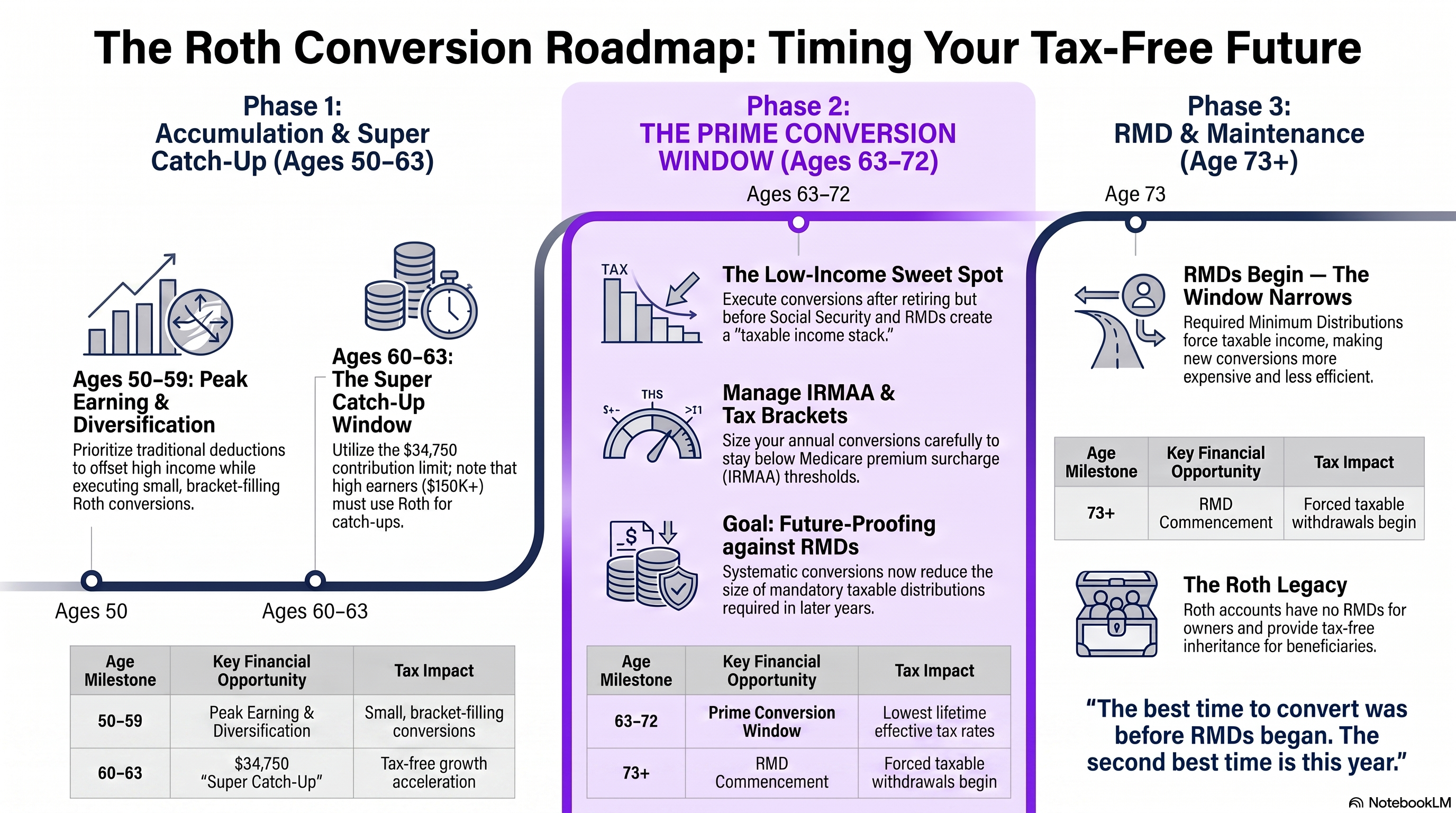
For most people who accumulated primarily in traditional 401(k)s throughout their career, the 50s are the decade when a strategic pivot begins. The existing traditional balance — which will eventually become subject to Required Minimum Distributions starting at 73 or 75 — is growing into a future tax problem.
Converting traditional IRA dollars to Roth IRA in the 50s, deliberately and at a controlled pace, reduces future RMD exposure while controlling the tax rate at which the conversion is taxed.
The conversion amount needs careful sizing. Converting too much in one year can push income into a higher bracket or over an IRMAA threshold. The optimal conversion fills the current tax bracket without crossing into the next — or fills the space between current income and the next IRMAA threshold, whichever is lower.
One critical point: if you pay the taxes on the Roth conversion from outside funds — from a taxable brokerage account rather than from the IRA itself — the conversion is significantly more efficient. Paying the taxes from inside the IRA means the converted amount arriving in the Roth is reduced by the tax cost. Paying from outside funds preserves the full converted amount in the Roth, compounding tax-free.
In Retirement: The Roth Withdrawal Strategy
For retirees who have both traditional and Roth accounts, the sequencing question replaces the contribution question.
The conventional advice — draw down taxable accounts first, then traditional, then Roth — is not always optimal. The right approach is to manage taxable income deliberately across multiple years to minimize lifetime tax burden.
In years when income is lower — perhaps before Social Security begins, or in a year with significant deductible expenses — drawing from traditional accounts makes sense, generating income at a lower effective rate. In years when income is already high — an RMD year, a year you sold a property — drawing from Roth preserves the traditional balance and avoids stacking taxable income.
The goal is income smoothing: keeping taxable income in a consistent range across retirement years, avoiding spikes that push into higher brackets or trigger IRMAA surcharges on Medicare premiums.
The Five Variables That Determine Your Answer
Rather than a blanket recommendation, these five questions in sequence produce the right answer for your specific situation.
Question 1: Are you eligible for a deductible traditional IRA contribution?
If you have a workplace retirement plan and your income exceeds $91,000 (single) or $149,000 (married, contributor covered), your traditional IRA contribution is not deductible. A non-deductible traditional IRA removes the core advantage of the traditional account — you pay taxes now and again on the growth in retirement. For most people in this situation, Roth or Backdoor Roth is preferable.
Question 2: What is your current marginal tax rate?
10% or 12% bracket — prioritize Roth. The rate is low enough that paying taxes now is almost always the right trade.
22% bracket — likely Roth or a mix. The rate is moderate and the future is genuinely uncertain.
24% bracket — careful analysis required. The difference between 24% now and an estimated 20-22% retirement effective rate is small enough that flexibility and other factors may matter more.
32% bracket or above — traditional contributions often make more sense, unless specific reasons to expect a higher future rate exist.
Question 3: What does your retirement income picture actually look like?
This is the variable most people underestimate. Retirement income is not just portfolio withdrawals — it is Social Security, possibly a pension, potentially rental income or part-time work, and portfolio withdrawals combined. The interaction between these sources determines the actual effective tax rate on each withdrawal.
For a retiree with $40,000 in Social Security and $60,000 in annual IRA withdrawals, the provisional income calculation makes 85% of Social Security taxable — meaning $34,000 of Social Security is added to the $60,000 IRA withdrawal for tax purposes. The effective marginal rate on those IRA withdrawals is significantly higher than the bracket alone suggests.
Question 4: Do you have significant traditional balances that will generate large RMDs?
Required Minimum Distributions beginning at 73 or 75 are forced taxable income regardless of spending needs. A $1.5 million traditional IRA generates approximately $56,000 in forced withdrawals in the first year — whether you need that income or not. Those withdrawals are taxable, push other income into higher taxation, and can trigger IRMAA surcharges on Medicare premiums.
If your traditional balance is large enough to generate RMDs that will push you into higher tax territory, systematic Roth conversion before RMDs begin is almost certainly worth considering.
Question 5: Do you have estate planning goals that involve passing wealth to heirs?
Roth IRAs have no required minimum distributions during the owner's lifetime. When inherited, beneficiaries must distribute the inherited Roth over 10 years under current rules — but those distributions are tax-free. Traditional IRA beneficiaries face the same 10-year distribution requirement — but every distribution is taxable income for the beneficiary at whatever rate they are in at the time.
For families with estate planning goals, the Roth account's combination of no RMDs and tax-free inheritance makes it the preferred vehicle for generational wealth transfer.
The Conversation Nobody Has: Tax Diversification as the Real Goal
Most discussions of Roth vs. Traditional frame it as a binary choice. Pick one. Build it. Repeat.
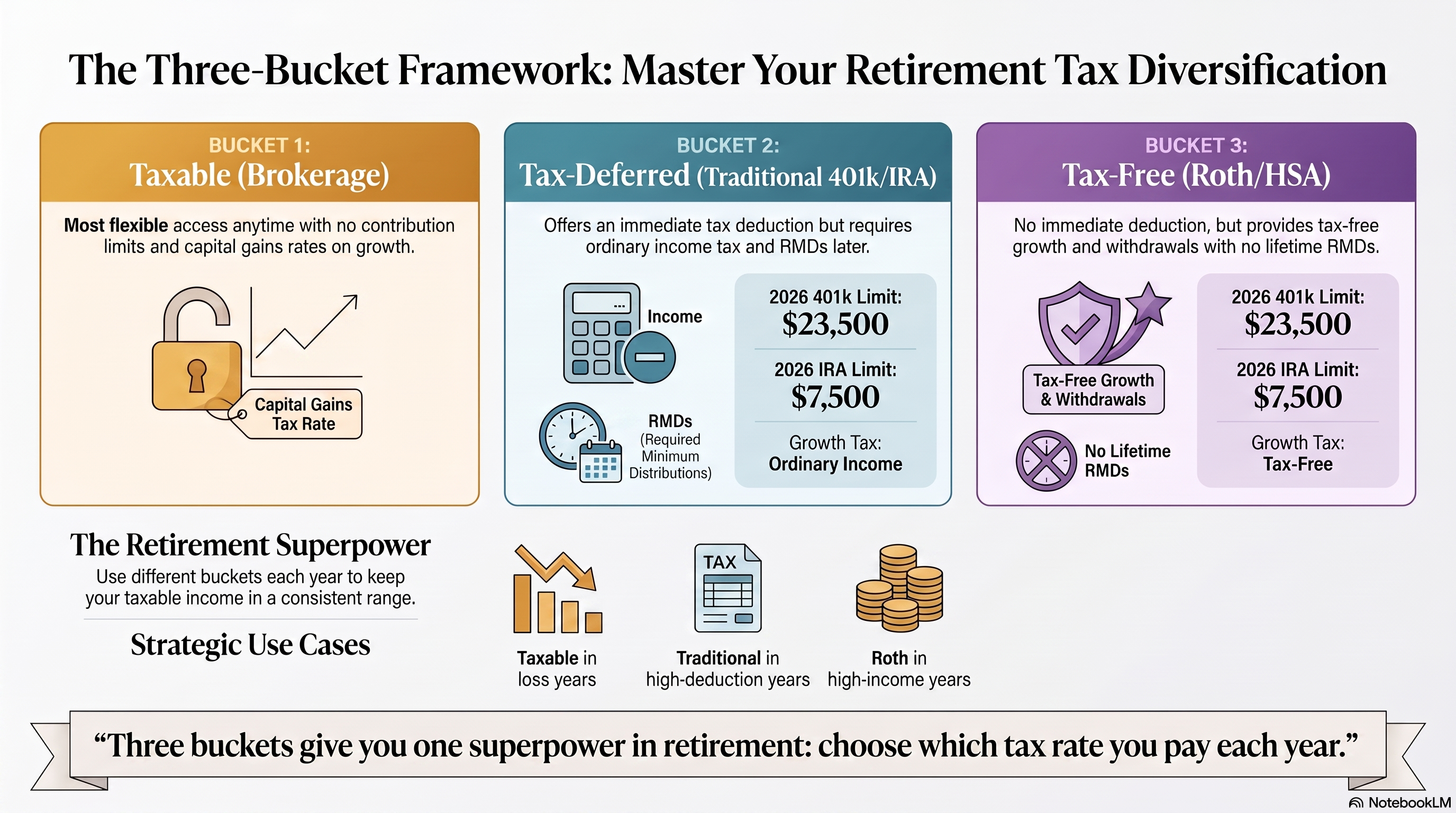
The more sophisticated framework is deliberate tax diversification across three buckets: taxable accounts (brokerage), tax-deferred accounts (traditional 401k, traditional IRA), and tax-free accounts (Roth 401k, Roth IRA, HSA).
The value of having all three types in retirement is not primarily about which one grows more. It is about flexibility — the ability to draw from whichever source is most tax-efficient in any given year based on actual income circumstances.
In a year when you have significant medical expenses that push deductions high, draw from traditional — the income is offset by deductions. In a year when you want to stay below an IRMAA threshold, draw from Roth — the withdrawals do not count as income. In a year when you realize a capital loss, draw from a taxable account — the loss offsets the gain.
This flexibility is worth real money over a 25-30 year retirement. A retiree with $1 million in traditional accounts only has one option for every withdrawal. A retiree with $400,000 in traditional, $400,000 in Roth, and $200,000 in taxable has the ability to optimize every year based on actual circumstances.
Building tax diversification is the argument for contributing to both types throughout your career — even when the pure tax rate calculation slightly favors one over the other.
The Arthavita Roth Conversion Optimizer
The decision described in this article — how much to convert each year, at what rate, without triggering IRMAA, while managing brackets — is exactly the kind of multi-variable optimization problem that requires modeling rather than rules of thumb.
Arthavita's Roth Conversion Optimizer runs your actual numbers — your traditional IRA balance, your expected Social Security income and timing, your current and projected tax rates, your state's tax treatment, your IRMAA exposure — against 25,000 scenarios and produces a year-by-year conversion plan that minimizes your lifetime tax burden.
The difference between an optimal Roth conversion strategy and a generic "convert some each year" approach can be $50,000-$150,000 in lifetime tax savings for households with significant traditional balances. The model shows you not just whether to convert, but how much to convert each year, from which accounts, in which order, and at what pace — all coordinated with your Social Security timing decision and your projected RMD schedule.
This is not a one-time calculation. The right conversion amount changes every year as income, tax law, account balances, and circumstances change. Arthavita's Quarterly Review system prompts you to revisit the conversion strategy annually and update the model with actual numbers — so the plan stays current rather than becoming a document that was right once and slowly drifts out of alignment.
The Five Most Common Mistakes in the Roth vs. Traditional Decision
Mistake 1: Assuming Roth is always better because the growth is tax-free. The growth in a Roth is tax-free. But you paid taxes on the contribution. The after-tax outcome is identical to traditional when the tax rate at contribution equals the tax rate at withdrawal. Roth is only better when the current rate is lower than the future rate — which is not true for everyone.
Mistake 2: Ignoring the Social Security taxation interaction. Most people estimate their retirement tax rate based on spending alone. They forget that Social Security — which they will also receive — interacts with every other income source to determine effective tax rates. A retiree who expects to be in the 12% bracket may face effective marginal rates of 22% or higher on IRA withdrawals because of the Social Security taxation cascade. This changes the Roth vs. Traditional calculus significantly.
Mistake 3: Paying Roth conversion taxes from inside the IRA. When converting traditional to Roth, the instinct is to withhold taxes from the conversion amount. This is almost always wrong. Paying the taxes from inside the IRA reduces the amount arriving in the Roth — permanently. Pay conversion taxes from taxable accounts, not from the conversion amount itself.
Mistake 4: Ignoring the IRMAA two-year lookback when sizing conversions. A Roth conversion that crosses an IRMAA threshold — $106,000 for single filers, $212,000 for married filers in 2026 — adds more than $1,000 per year in Medicare premium surcharges, two years later. A $95,000 conversion that stays below the threshold is often worth more in net terms than a $110,000 conversion that crosses it. Always model the IRMAA impact before finalizing the conversion amount.
Mistake 5: Making the decision once and never revisiting it. The right Roth vs. Traditional allocation changes as income changes, as tax law changes, as account balances change, and as retirement approaches. A strategy that was optimal at 32 may be suboptimal at 45. This is a decision to revisit annually — not once and then forget.
The Decision in Plain English
For most people, the answer lands here.
Under 40 in the 10% or 12% bracket — prioritize Roth. The rate is low, the time horizon is long, the flexibility value is high.
Under 40 in the 22% or higher bracket — split. Contribute enough to traditional to capture meaningful deductions, route the remainder to Roth. Build tax diversification from the beginning.
Between 40 and 55 in the 22% to 32% bracket — tax diversification is the priority. If primarily traditional balances from prior decades, consider moderate Roth conversion. If primarily Roth balances, consider traditional contributions for their deduction value.
Over 55 approaching retirement — the conversion window is open. Model expected RMDs against current tax rate. If RMDs will push into higher brackets or IRMAA territory, systematic conversion before retirement likely justifies the current tax cost.
Already retired — manage withdrawal sequencing annually to optimize across all three tax buckets. Revisit every year before making large distributions.
Frequently Asked Questions
Can I contribute to both a Roth IRA and a traditional IRA in the same year?
Yes — the $7,500 limit ($8,600 if 50+) is a combined limit across all IRA accounts. You can split the contribution between traditional and Roth in any proportion, as long as the total does not exceed the annual limit.
What is the Backdoor Roth and who should use it?
The Backdoor Roth is a strategy for high earners above the Roth IRA income phase-out. You contribute a non-deductible amount to a traditional IRA — no income limit for contributions, only for deductibility — then immediately convert it to Roth. The conversion is tax-free if you have no other traditional IRA balances, or requires a pro-rata calculation if you do. Anyone above the $168,000 single or $252,000 married Roth income ceiling should consider this strategy.
What is the pro-rata rule and why does it matter for Backdoor Roth?
The pro-rata rule determines what percentage of a Roth conversion is taxable based on the ratio of non-deductible to total traditional IRA balances. If you have $90,000 in traditional IRA pre-tax and contribute $7,500 non-deductibly, then convert $7,500 to Roth, only about 7.7% of the conversion is tax-free — the rest is taxable. The workaround is a reverse rollover: rolling traditional IRA balances into your current employer's 401(k) before executing the Backdoor Roth, if the plan allows it.
Should I convert traditional IRA to Roth before Social Security begins?
For most people, yes — if the current tax cost of conversion is lower than the expected future tax cost. The years between retirement and Social Security claiming are often the lowest-income years of your retirement, making them optimal for conversion. Every dollar converted in this window eliminates a dollar of future RMD exposure and reduces the provisional income that determines how much of your Social Security will be taxable.
How does the SECURE 2.0 super catch-up affect the Roth vs. Traditional decision?
Workers ages 60-63 can contribute $34,750 to a 401(k) in 2026 — the base $23,500 plus the $11,250 super catch-up. High earners whose FICA wages exceeded $150,000 in 2025 must direct catch-up contributions to Roth — the mandatory Roth catch-up rule. For others, the super catch-up creates a powerful opportunity to build Roth balances in the years just before retirement, when the conversion window is most valuable.
What happens to a Roth IRA when I die?
Your spouse can inherit your Roth IRA and treat it as their own — no required distributions during their lifetime. Non-spouse beneficiaries must distribute the inherited Roth within 10 years under current rules — but all distributions are tax-free. For estate planning purposes, the Roth IRA is often the most valuable asset to leave to heirs, because the tax-free inheritance combined with the 10-year growth window during distribution produces substantially better after-tax outcomes for beneficiaries than an inherited traditional IRA.
What is the single most important action I can take this year on the Roth vs. Traditional question?
Run the numbers on your specific situation — not someone else's rule of thumb. If you are in the 22% bracket with a large traditional balance growing toward significant RMDs, model what those RMDs will actually cost in effective tax rates in retirement. If you are in the 12% bracket and your employer offers a Roth 401(k), consider directing all contributions there. If you are above the Roth income limit, execute the Backdoor Roth before year-end. The answer is always specific to your numbers — and it almost always differs from the generic guidance.
Have a question this article didn't answer?
The Roth vs. Traditional decision is genuinely specific to your situation — your income, your existing balances, your Social Security timing, your state tax picture. If something here raised a question about your specific numbers, send us a note at support@arthavita.co and we'll do our best to address it directly or in a future post.
Arthavita is an educational and planning platform. This article is for informational purposes only and does not constitute personalized financial, tax, or legal advice. All financial decisions remain with you. For personalized guidance, consult a qualified financial or tax professional.
Ketan Patel
Founder, Arthavita
Ketan Patel is the founder of Arthavita and a multi-industry entrepreneur with 30+ years of experience in technology and business operations. He built Arthavita to bring institutional-quality financial intelligence to individual investors.
LinkedIn ↗This article is for educational purposes only and does not constitute financial, tax, or legal advice. Arthavita is a recommendation-only platform. Always consult a qualified professional before making financial decisions.