
Retirement Protection: The Risks Nobody Plans For
Most retirement plans are built to answer one question — will the money last? But surviving retirement financially takes more than a big enough number. A healthy 65-year-old retiring today can expect to spend roughly $185,500 on healthcare alone, before a dollar of long-term care is counted. Nearly seven in ten retirees will need long-term care at some point, at a cost that can run $75,000 to over $130,000 a year. Fraud losses among people 60 and older have quadrupled since 2020. A surviving spouse can lose a third or more of household income overnight. Divorce among people 50+ now makes up 36% of all U.S. divorces. An outdated beneficiary form can override a will entirely. And claiming Social Security at 62 — still the most common age — locks in a permanent 30% cut. None of these risks show up in a standard retirement projection — and none of them are optional to plan for. This post walks through nine protection risks a distribution-phase plan has to account for, and what actually protects against each one.
The Plan That Works Until It Doesn't
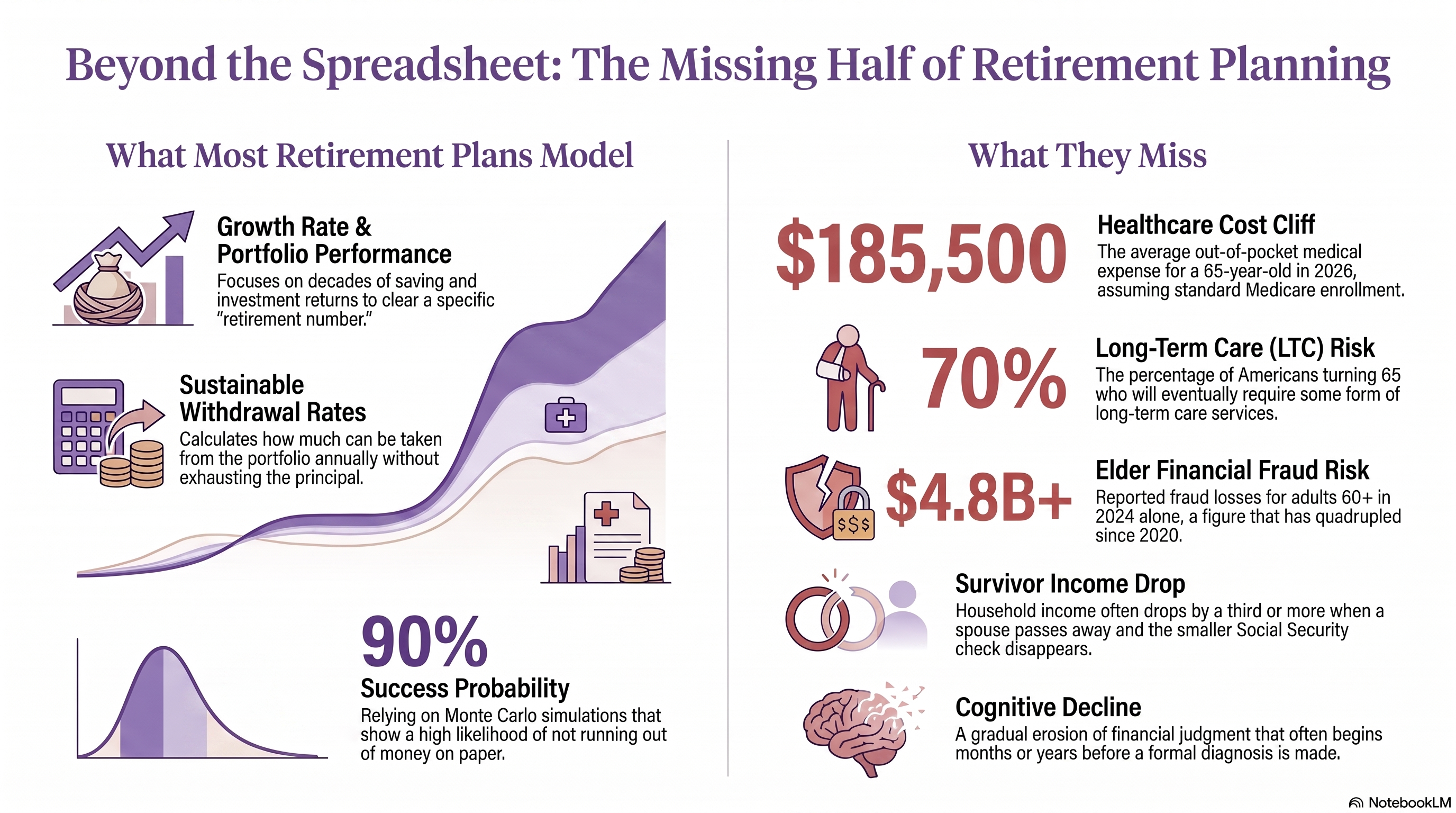
Most people who reach retirement have done the hard part. Decades of saving, a portfolio that's grown, a number that clears the retirement calculator's bar. The Monte Carlo simulation says 90% success. The withdrawal rate looks sustainable. On paper, the plan works.
Then something happens that the plan never modeled.
A spouse is diagnosed with a condition that requires care no one budgeted for. A widow discovers her Social Security check dropped by a third the month after her husband passed away. A market downturn hits in year two of retirement instead of year twenty, and the math that looked fine on a spreadsheet suddenly doesn't. A scammer poses as a grandchild in trouble, and $40,000 is gone before anyone realizes what happened.
These are not edge cases. They are the ordinary risks of a 30-year retirement, and they belong to a different category than "will I run out of money." That question is about longevity. This is about protection — the risks that can derail a technically sound plan regardless of how much money is behind it.
A retirement plan that only models growth and withdrawal rates is answering half the question. The other half is: what happens when something goes wrong, and does the plan survive it?
Risk 1: Sequence of Returns — Why the First Five Years Decide Everything
Two retirees can have the identical average annual return over 30 years and end up in completely different financial positions, purely because of when the bad years happened.
If a retiree experiences strong markets in the first five years of retirement, the portfolio grows even while withdrawals are being taken, and the plan has enormous cushion for whatever comes later. If the same retiree experiences a market decline in year one or two — while still taking the same dollar withdrawals — the portfolio is forced to sell more shares at depressed prices to generate the same income. Those shares are gone. They don't get to participate in the recovery. The math never fully catches up, even if the market averages out to the exact same long-term return.
This is sequence of returns risk, and it is arguably the single most underappreciated risk in retirement planning. It doesn't show up in a simple average-return projection, because average-return projections assume the same return every year — which is never how markets actually behave.
Consider two hypothetical retirees, each starting with the same portfolio balance and taking the same annual withdrawal, over the same 30-year period, earning the exact same average annual return. The only difference: Retiree A experiences a market decline in years one and two of retirement, then strong returns for the rest of the period. Retiree B experiences the identical returns in reverse order — strong years first, the decline arriving late, closer to year twenty-eight. By year thirty, despite averaging out to the same long-term return, Retiree A's portfolio can be meaningfully depleted or even exhausted, while Retiree B's portfolio may have grown substantially. Same average. Same withdrawals. Wildly different outcomes — purely because of when the bad years happened to land.
This is why the first five years of retirement carry a disproportionate amount of risk. A downturn that would have been a minor, recoverable dip during the accumulation years — when new contributions were still flowing in and there was no need to sell anything — becomes a permanent, compounding loss during the withdrawal years, because shares sold at depressed prices to fund living expenses can never participate in the eventual recovery.
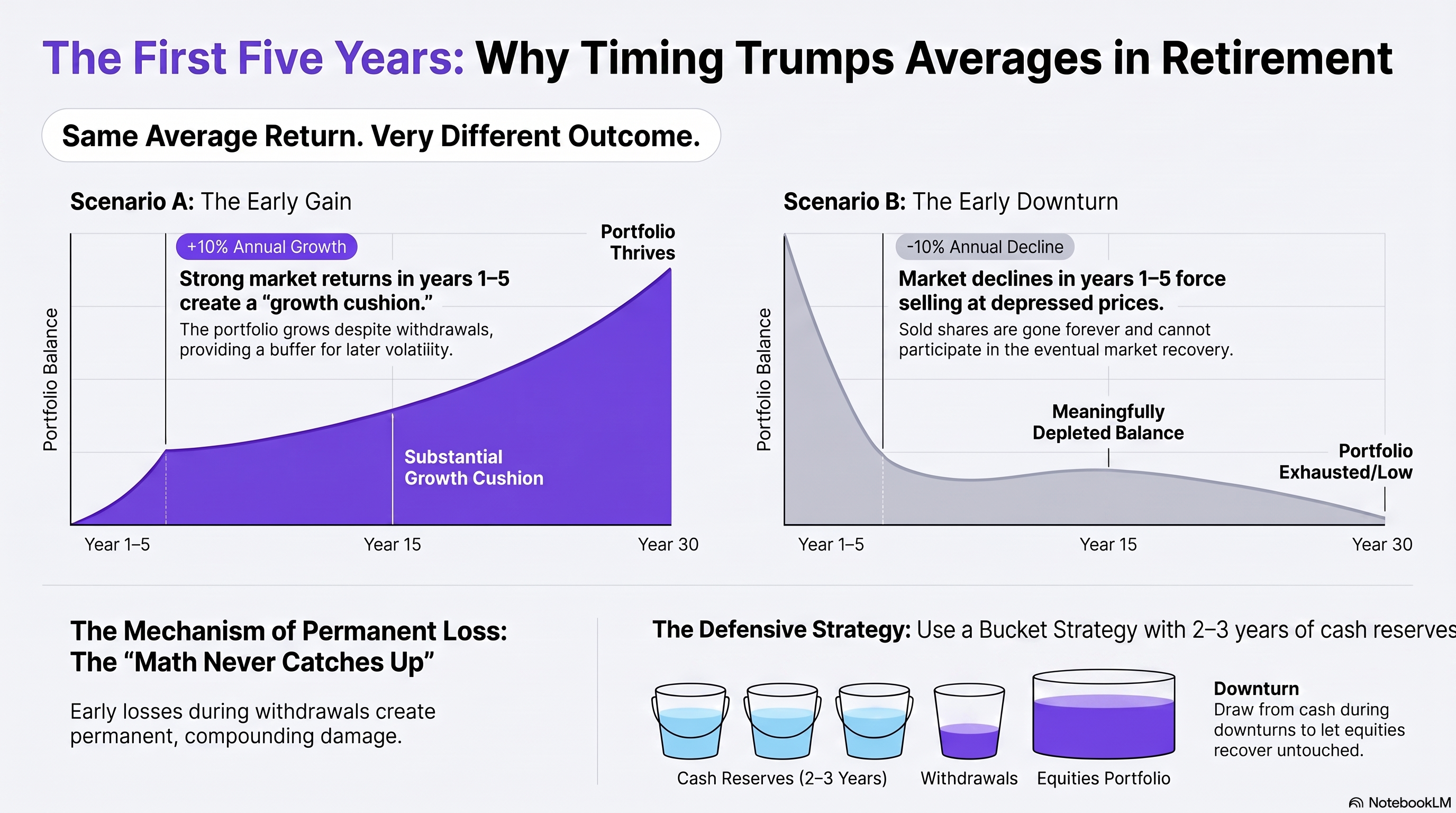
The traditional defense is a bucket strategy: keeping two to three years of living expenses in cash and short-term instruments so that a market downturn never forces a retiree to sell equities at the bottom. When the portfolio is up, the retiree refills the bucket by selling some gains. When the portfolio is down, the retiree draws from cash instead and lets the equity side recover untouched. A guardrails approach — pre-committing to specific rules for when to trim spending after a bad year and when to allow more spending after a strong one — adds a second layer of defense, turning a stressful, emotional decision into one that was already decided calmly, in advance.
Both ideas are simple. Both are also very easy to abandon under pressure, in the middle of an actual downturn, when the instinct is either to panic-sell everything or to freeze and do nothing. That is exactly why the structure needs to exist in the plan before the downturn happens, not get improvised during one.
Risk 2: The Healthcare Cost Cliff
Most people think Medicare means healthcare is handled. It isn't.
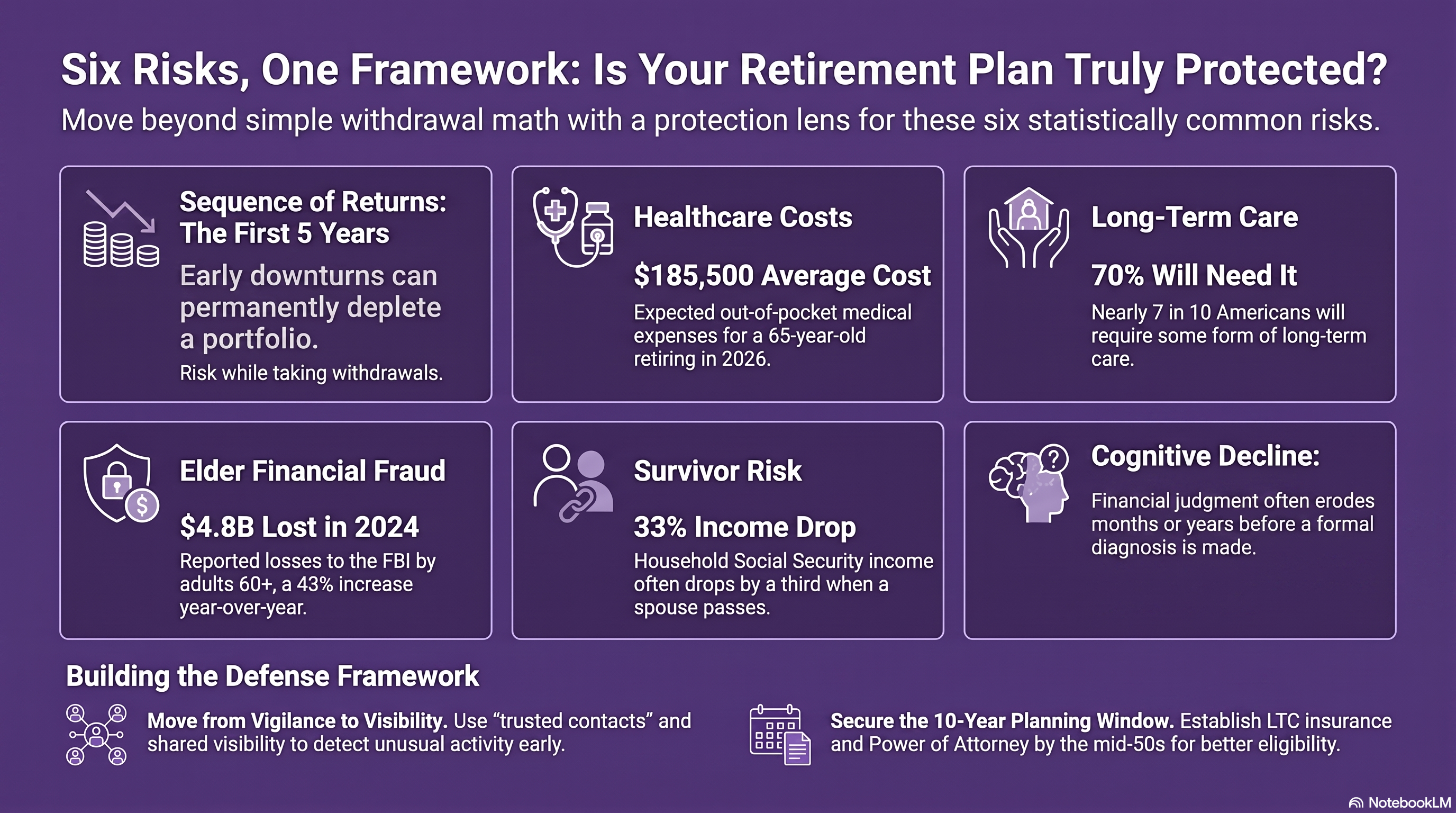
A 65-year-old retiring in 2026 can expect to spend an average of $185,500 on healthcare and medical expenses throughout retirement — a figure that's climbed 7.5% in a single year, according to Fidelity's most recent Retiree Health Care Cost Estimate. That number assumes standard enrollment in Medicare Parts A, B, and D. It covers premiums, copayments, deductibles, and the out-of-pocket costs Medicare simply doesn't touch — a category that includes most vision, dental, and hearing care. And that figure does not include long-term care at all.
Two mechanics make this worse than most retirees expect:
IRMAA. Medicare premiums aren't flat — they're means-tested. Cross certain income thresholds and Medicare Part B and Part D premiums jump, sometimes substantially, based on income from two years prior. A large Roth conversion, a big capital gain, or an RMD that pushes income over a bracket line can trigger a premium surcharge that lasts an entire year, often catching retirees by surprise because the income that triggered it happened two years earlier and is easy to forget about.
Medicare Advantage vs. Medigap. The choice between these two paths, usually made once at 65, has consequences that can last decades — and switching later is often difficult or medically underwritten, meaning a health event that happens after the initial enrollment window can permanently close the door on switching to the other option. Advantage plans typically carry lower or even zero monthly premiums but narrower provider networks, referral requirements, and less predictable out-of-pocket exposure in a bad health year. Medigap offers more predictable costs, broader provider access, and no network restrictions, but at a meaningfully higher monthly premium paid every single month, healthy or not. Getting this decision wrong isn't a small inconvenience; for someone who develops a serious condition years into an Advantage plan and finds the network doesn't include the specialist they need, it can mean thousands of dollars a year in unplanned costs, or worse, delayed care, for the rest of retirement.
Retirees also frequently underestimate dental, vision, and hearing costs, which traditional Medicare barely touches. Hearing aids alone can run several thousand dollars and are rarely covered — a reason to build these categories into the plan as their own line items rather than assuming "Medicare" means "handled."
The protection move here isn't complicated, but it does require deliberate planning rather than reaction: model healthcare costs as their own line item, separate from general living expenses, and manage taxable income in the years leading up to and during Medicare enrollment with IRMAA thresholds specifically in mind — not just for the tax bracket, but for the Medicare premium bracket sitting on top of it.
Risk 3: The Long-Term Care Blind Spot
This is the risk most retirement plans skip entirely, and it's the one with the widest range of financial outcomes.
Close to 70% of Americans turning 65 will need some form of long-term care at some point, according to Department of Health and Human Services data. The median cost isn't small: $5,900 a month for assisted living and nearly $11,000 a month for a private room in a nursing home, per 2026 Genworth data — and annual costs across care types range from roughly $23,000 to over $128,000, depending on the type and level of care needed. The average person who needs long-term care needs it for about three years. Do the math on three years of nursing home care at current rates, and the number rivals what many people have saved for their entire retirement.
Medicare does not cover long-term care. Medicaid does, but only after a person has spent down most of their assets — which is a legacy-destroying outcome, not a protection strategy. That leaves three real paths: long-term care insurance, self-funding through a dedicated reserve, or hybrid life insurance/LTC policies that pay a death benefit if care is never needed.
The timing here matters more than almost any other decision in this article. Long-term care insurance gets dramatically more expensive with age, and coverage gets harder to qualify for — more than 47% of applicants aged 70 and older are denied coverage due to health concerns, and waiting even ten years from age 55 can increase the cost of the same coverage by roughly 50%. The window to make this decision well is typically the mid-50s, which is exactly why this decision belongs in an accumulation-phase plan, not a distribution-phase scramble. If that window has already closed, self-funding through a specifically earmarked reserve — separate from the general retirement portfolio — becomes the realistic fallback.
Whichever path a family chooses, the mistake to avoid is having no explicit answer at all. "We'll figure it out if it happens" is not a plan; it's a bet that the worst-case scenario — the one nearly seven in ten people actually face — won't happen to you.
Risk 4: Elder Financial Fraud
This risk has grown faster than almost any other in the last five years, and it's rarely discussed as part of retirement planning at all.
Americans aged 60 and older reported $4.8 billion in fraud losses to the FBI's Internet Crime Complaint Center in 2024 alone — up 43% from the year before. The FTC's separate tally shows fraud losses among older adults have roughly quadrupled since 2020, and adults 60+ are more likely than any other age group to report losses of $100,000 or more in a single incident. These aren't small nuisance scams; they are often life-savings events, and they are increasingly sophisticated — organized, often AI-assisted operations impersonating family members, government agencies, or trusted institutions.
Underreporting makes the real numbers almost certainly higher. Shame, and a fear that reporting a scam will be read by family as a sign of declining capacity, keeps many victims silent — one estimate suggests only a fraction of actual elder financial abuse cases are ever reported.
Protection against this risk isn't primarily a product — it's structure. A trusted contact designated on financial accounts who can be notified of unusual activity. A second set of eyes on large or unusual transactions, ideally an adult child or a designated legacy contact with visibility into the financial picture — not control, but visibility. Delay mechanisms on large wire transfers. And, candidly, an ongoing family conversation about scams that doesn't happen once and get forgotten, because tactics evolve constantly and yesterday's warning signs aren't tomorrow's.
This is precisely the protection gap that a Legacy Vault or shared household financial view is designed to close — not by taking control away from a retiree, but by ensuring at least one other trusted person can see when something looks wrong before it becomes catastrophic.
Risk 5: Survivor Risk — What Happens to the Spouse Left Behind
Retirement plans are almost always modeled for a couple. Retirement almost always ends with one person alone.
When one spouse passes away, Social Security doesn't simply continue at the household level — the survivor generally keeps only the higher of the two individual benefits, not both. For many couples, that means household income drops by a third or more overnight, even as many expenses — the mortgage, property taxes, insurance, home maintenance — barely change at all. Filing status also shifts from Married Filing Jointly to Single, often within the same tax year or the year after, which can push the surviving spouse into materially higher marginal tax brackets on a lower income.
The households most exposed to this risk are the ones where one spouse has handled all the financial decisions for decades and the other has limited visibility into accounts, passwords, advisors, or the reasoning behind the plan. The financial shock of losing a spouse is compounded by an informational shock — not knowing where anything is or how any of it works, at the worst possible moment to be learning.
The protection response has two parts. First, model survivor scenarios explicitly — what does the surviving spouse's income, tax bracket, and expense picture actually look like under each possible order of death, not just the joint household picture. Second, and just as important: both spouses need visibility into the full financial picture before it's needed, not after. This is the entire premise behind planning together as a couple rather than one spouse managing everything unilaterally — the protection isn't just financial, it's structural.
6: Cognitive Decline and the Financial Architecture Nobody Wants to Discuss
This is the hardest risk to plan for, because planning for it requires acknowledging a possibility no one wants to imagine about themselves.
Cognitive decline doesn't arrive with a clear starting date. It's gradual, and by the time it's obvious to others, financial decision-making has often already been compromised for months or years — which is precisely the window where fraud, poor investment decisions, and missed bill payments tend to cluster. The financial risk of cognitive decline isn't a single event; it's a slow erosion of the very judgment the rest of the plan depends on.
The protection architecture has to be built while capacity is intact, because it cannot be built after the fact. That means a durable power of attorney established well before it's needed, not scrambled together during a crisis. It means a designated trusted contact on file with financial institutions. It means, ideally, a period of overlapping financial visibility — a spouse, adult child, or trusted contact who already understands the accounts, the strategy, and the passwords, so that a transition of financial responsibility doesn't have to happen from zero at the worst possible moment.
This is uncomfortable to plan for precisely because it requires imagining a version of yourself with diminished capacity. But the alternative — leaving it undecided — doesn't avoid the risk. It just guarantees that whoever has to step in will be doing so without a plan, under pressure, possibly while family members disagree about what should happen, and possibly after damage has already been done.
There is also a subtler, more common version of this risk that doesn't require a formal diagnosis at all: a gradual decline in financial decision quality that is easy to rationalize as one-off mistakes — a missed payment here, a confused call to the bank there, an unusually large and out-of-character gift or purchase. Family members are often reluctant to raise these observations, worried about seeming intrusive or accusatory. Building in a designated, agreed-upon trusted contact ahead of time — someone whose job is specifically to ask questions when something looks off — removes the awkwardness from that first conversation, because the arrangement was agreed to in advance, while everyone had full capacity and no immediate concern to react to.
Three More Risks That Don't Get Talked About — And Aren't Edge Cases
The six risks above are the ones that show up most often in retirement planning conversations, even if they're underweighted. The three below rarely come up at all, despite affecting a large and growing share of retirees. None of these are hypothetical or rare — each is a documented, statistically common pattern.
Gray Divorce
Divorce among people 50 and older — commonly called "gray divorce" — has roughly doubled since 1990 and now accounts for 36% of all U.S. divorces, up from under 9% in 1990. Adults 65 and older are currently the only age group where divorce rates are still rising while every younger cohort's rate falls. Nearly half of gray divorces end a second or later marriage, and remarried adults over 50 divorce at roughly 2.5 times the rate of those in first marriages.
The financial impact is asymmetric and severe: one 2026 state-level analysis found women over 50 face a 45% decline in standard of living after a gray divorce, compared to 21% for men — largely because retirement assets, pensions, and Social Security strategies built around a joint household get split at exactly the point in life when there's the least runway left to rebuild them. In a separate industry study, 56% of married Americans said a divorce would derail their retirement strategy entirely, and over a third of those who actually went through a late-life divorce said it set their retirement plans back.
This isn't a risk that belongs only in a divorce attorney's office. A retirement plan that assumes a permanent joint household — joint tax filing, combined Social Security claiming strategy, shared beneficiary designations — has an unstated assumption baked into it that, for more than a third of people who divorce, turns out to be wrong later in life.
The Beneficiary Designation Trap
This is arguably the single most common, most avoidable, and least understood mistake in estate planning — and it has nothing to do with whether someone has a will or trust.
Retirement accounts, life insurance policies, annuities, and payable-on-death or transfer-on-death accounts don't pass through a will at all. They pass directly to whoever is named on the beneficiary form filed with the account custodian or insurer, regardless of what the will says. If a will leaves everything to a current spouse but a 401(k) still lists an ex-spouse from a marriage that ended fifteen years ago — because the form was filled out once, at account opening, and never revisited — the ex-spouse receives that account. Not the current spouse. Not the children. The custodian has no authority to override the form, and the will has no legal effect on that specific asset.
This isn't a rare technicality; it is, according to multiple estate planning attorneys, the most frequent mistake they see, precisely because a beneficiary form feels like paperwork completed once and forgotten, while a will feels like the document that governs everything. It doesn't. The fix costs nothing and takes minutes: log into every retirement account, life insurance policy, and annuity, confirm the named primary and contingent beneficiary, and update anything that predates a divorce, remarriage, death in the family, or birth of a child. This should happen every couple of years as routine maintenance, not just once during the original estate plan.
The Social Security Early-Claiming Trap
Nearly 90% of Americans claim Social Security at or before their full retirement age, and claiming at 62 — the earliest possible age, and still the single most common claiming age — locks in a benefit that's permanently reduced by roughly 30% for life compared to waiting until full retirement age, and by as much as 56% less than waiting until 70. These aren't temporary reductions that catch up later. They are locked in for as long as that person collects benefits, which for someone who lives into their 90s can mean leaving well over a hundred thousand dollars in cumulative benefits unclaimed.
The reasons people claim early are often legitimate — a health concern, a job loss, a genuine need for income now. But a meaningful share of early claiming happens simply because it's the default, not because it's the right call after an actual analysis of health, other income sources, and household longevity. This is a decision made once, that cannot be meaningfully undone, that most people make without ever running the numbers on what waiting would actually be worth to their specific household — and it's a decision retirement plans should model explicitly rather than assume.
What This Looks Like in Practice
These risks rarely arrive one at a time, cleanly labeled. Consider a composite, hypothetical picture built from the patterns above: a couple retires at 65 with a portfolio that clears their Monte Carlo projection comfortably. Two years in, a market downturn hits — sequence of returns risk, right on schedule for the highest-risk window. They weather it, because they'd built a cash reserve years earlier without fully understanding why their advisor had insisted on it.
At 78, one spouse is diagnosed with a condition requiring in-home care, then eventually a nursing facility — the long-term care risk that "probably won't happen" for the 70% of people it eventually does happen to. There was no LTC insurance, purchased too late to qualify affordably, and no dedicated reserve, because the plan had treated healthcare and long-term care as the same line item, when they are not.
The following year, the spouse who required care passes away. The survivor's Social Security income drops by roughly a third the very next month, while the mortgage, insurance, and home maintenance costs stay exactly the same. The surviving spouse, who had never handled the household finances, doesn't know which advisor to call, doesn't have the passwords, and isn't sure what accounts even exist.
Eighteen months later, a phone call from someone claiming to be a grandchild in urgent trouble results in a wire transfer that can't be recovered — a scenario that plays out for thousands of families every year, disproportionately targeting exactly this demographic, at exactly this moment of grief and disorientation.
None of these events, on their own, was unforeseeable. Each one is a documented, statistically common risk with a name, a probability, and a known set of defenses. What made this hypothetical family's outcome worse than it needed to be wasn't bad luck — it was that the plan had never explicitly modeled any of these risks in the first place, so each one arrived as a surprise instead of a contingency the family had already thought through together.
The Common Thread
Every risk in this article shares the same structural weakness: none of them show up in a standard withdrawal-rate or Monte Carlo projection. A plan can show a 95% probability of not running out of money and still leave a family financially exposed to a long-term care event, a fraud loss, a survivor income cliff, or a cognitive decline crisis with no architecture in place.
Protection isn't a subtraction from the growth-and-longevity conversation — it's the third leg of the stool. A plan that only optimizes for growing the portfolio and making it last long enough is only two-thirds complete. The protection lens asks a different question at every stage of retirement: if something goes wrong — a market downturn, a health event, a fraud attempt, a death, a decline in capacity — does the plan survive it, or does it depend on nothing bad happening?
That's the standard a retirement plan should be held to. Not just "will the money last," but "will the plan hold up when something doesn't go according to plan."
Frequently Asked Questions
Does Medicare cover long-term care?
No. Medicare covers short-term skilled nursing and rehabilitation after a qualifying hospital stay, but not extended custodial long-term care — the kind of ongoing help with daily living that most long-term care actually involves. Medicaid can cover long-term care, but only after a person has spent down most of their assets to qualify, which is why it's a last resort rather than a plan.
When is the right time to buy long-term care insurance?
Generally the mid-50s. Premiums rise steeply with age, and health-based denials become far more common after age 70 — more than 47% of applicants 70 and older are denied coverage. Waiting is the single most expensive mistake in long-term care planning.
What actually protects against sequence of returns risk?
A structured cash and short-term reserve — typically covering two to three years of living expenses — that lets a retiree draw down cash instead of selling equities during a market downturn, giving the equity portion of the portfolio time to recover before it's touched again.
How much does household income typically drop when a spouse passes away?
It varies by household, but a drop of a third or more in Social Security income alone is common, since the survivor generally retains only the higher of the two individual benefits rather than both. Pension survivor benefits, if any, are usually a reduced percentage of the original amount. Meanwhile, many fixed household expenses don't decrease at all.
What's the single best defense against elder financial fraud?
Structural visibility, not vigilance alone. A trusted contact on file with financial institutions, a second set of eyes on unusual or large transactions, and an ongoing — not one-time — family conversation about current scam tactics.
Building Protection Into the Plan
A distribution-phase plan that only models growth and withdrawal sustainability is solving half the problem. Arthavita's retirement planning tools model these protection risks explicitly and side by side with the growth-and-longevity picture — survivor scenario planning that shows exactly what changes for a surviving spouse under each order of death, healthcare and long-term care cost modeling built into the same 25,000-scenario Monte Carlo simulation used for retirement probability, and a Legacy Vault that gives a named trusted contact time-limited visibility into the financial picture without requiring a full account or giving up control.
Protection isn't a separate conversation from retirement planning. It's the part of the plan that determines whether the rest of it survives contact with real life.
Have a question about how protection risks apply to your specific retirement plan? Send us a note at support@arthavita.co — we read every message.
This article is for educational purposes only and does not constitute financial, insurance, tax, or legal advice. Arthavita does not sell insurance products, execute trades, or receive referral fees for any recommendation. Consult a qualified financial advisor, insurance professional, or estate attorney regarding your specific situation.
Sources
Fidelity Investments, 25th Annual Retiree Health Care Cost Estimate (2026) — via CNBC, "Fidelity says 2026 retirees may spend $185,500 on healthcare," July 22, 2026.
U.S. Department of Health and Human Services (2020 data), cited in CNBC, July 22, 2026 — ~70% lifetime likelihood of needing long-term care at age 65.
Genworth / SeniorLiving.org, 2026 Long-Term Care Cost Calculator — median monthly costs for assisted living and nursing home care.
LTC News, "How Much Does Long-Term Care Cost in 2026?" — annual cost range across care types.
AALTCI (American Association for Long-Term Care Insurance), cited in GetAmplifyLife, "50 Long-Term Care Statistics" (2026) — LTC insurance qualification and cost-of-waiting data.
FBI Internet Crime Complaint Center (IC3), 2024 Annual Report — elder fraud losses reported by adults 60+. Federal Trade Commission, Protecting Older Consumers report (2024–2025) — elder fraud loss trends since 2020, and share of losses over $100,000.
Social Security Administration, Benefits Planner: Retirement Age and Benefit Reduction — official early-claiming reduction schedule.
CNBC / Center for Retirement Research at Boston College, "This is the age most people start claiming Social Security" (2026) — claiming-age distribution statistics.
Bowling Green State University (Susan Brown & I-Fen Lin) / Pew Research Center — "gray divorce" rate trends since 1990. Divorce.law, "Gray Divorce Hits 36% of All U.S. Divorces" (April 2026) — state-level analysis of post-divorce standard-of-living decline by gender.
Allianz Life, 2025 Annual Retirement Study — survey data on divorce's impact on retirement strategy.
Estate planning legal commentary (multiple licensed estate attorneys, 2025–2026) — beneficiary designation precedence over wills under state law.
All statistics current as of publication date. Figures such as healthcare and long-term care costs are updated annually by their respective sources and should be re-verified for planning purposes beyond the current year.
Ketan Patel
Founder, Arthavita
Ketan Patel is the founder of Arthavita and a multi-industry entrepreneur with 30+ years of experience in technology and business operations. He built Arthavita to bring institutional-quality financial intelligence to individual investors.
LinkedIn ↗This article is for educational purposes only and does not constitute financial, tax, or legal advice. Arthavita is a recommendation-only platform. Always consult a qualified professional before making financial decisions.