
Planning for a Dependent Child: What Happens After You Are Gone
Every parent of a child who will never be fully financially independent carries a question that has no easy answer: what happens to my child the morning after I am gone? The financial and legal tools that exist — Special Needs Trusts, ABLE accounts, Letter of Intent, guardian succession planning — are genuinely powerful but almost completely unknown outside estate attorney and special needs planning circles. Two major rule changes took effect in January 2026 that expand access to these tools significantly. This post is written for the parent who has been carrying this question alone. The answers exist. They require planning that most financial content has never addressed.
There is a question that lives in the back of every parent's mind when their child has a disability, a chronic condition, a mental health challenge, or any circumstance that means full financial independence may never fully arrive.
It is not a question most parents say out loud. It is carried quietly, present in every financial decision, every estate planning conversation that gets delayed, every thought about what happens if something happens to me.
What happens to my child the morning after I am gone?
Not eventually. Not after the legal process runs its course. The morning after.
Who has authority to act on their behalf? Who controls the money — and does the structure of that money disqualify them from the government benefits they depend on? Has anyone been prepared to step into the caregiving role? Does anyone even know what the child needs, what their routines are, what medical decisions have been made and why?
This article is written for the parent carrying that question. The financial and legal tools that answer it are genuinely powerful. They are also almost completely unknown outside estate attorney and special needs planning circles — and two significant rule changes took effect in January 2026 that expand access to these tools in ways most families have not yet heard about.
Why Standard Estate Planning Fails Families With Dependent Children
The estate planning conversation most people have — will, trust, power of attorney, beneficiary designations — was designed for a specific assumption: that the people inheriting are financially capable adults who can manage assets independently.
That assumption breaks down completely when the beneficiary is a child who receives SSI, Medicaid, or other means-tested government benefits. And it breaks down in a way that can cause real harm.
Supplemental Security Income has an asset limit of $2,000 — unchanged since 1989. Medicaid eligibility varies by state but typically follows similar asset thresholds. A child receiving these benefits who inherits more than $2,000 directly — from a parent's will, from a retirement account beneficiary designation, from a life insurance policy — can lose their benefits immediately upon receiving the inheritance.
The 401(k) named to the child directly. The life insurance policy with the child listed as beneficiary. The home left to the child in the will. All of these, intended as acts of love and financial security, can inadvertently eliminate the government benefits that provide the medical coverage, housing support, and daily care that make the child's life possible.
This is not a theoretical risk. It happens regularly to families who planned carefully by every conventional measure — and did not know that conventional estate planning was the wrong tool for their specific situation.
The Two Tools That Change Everything
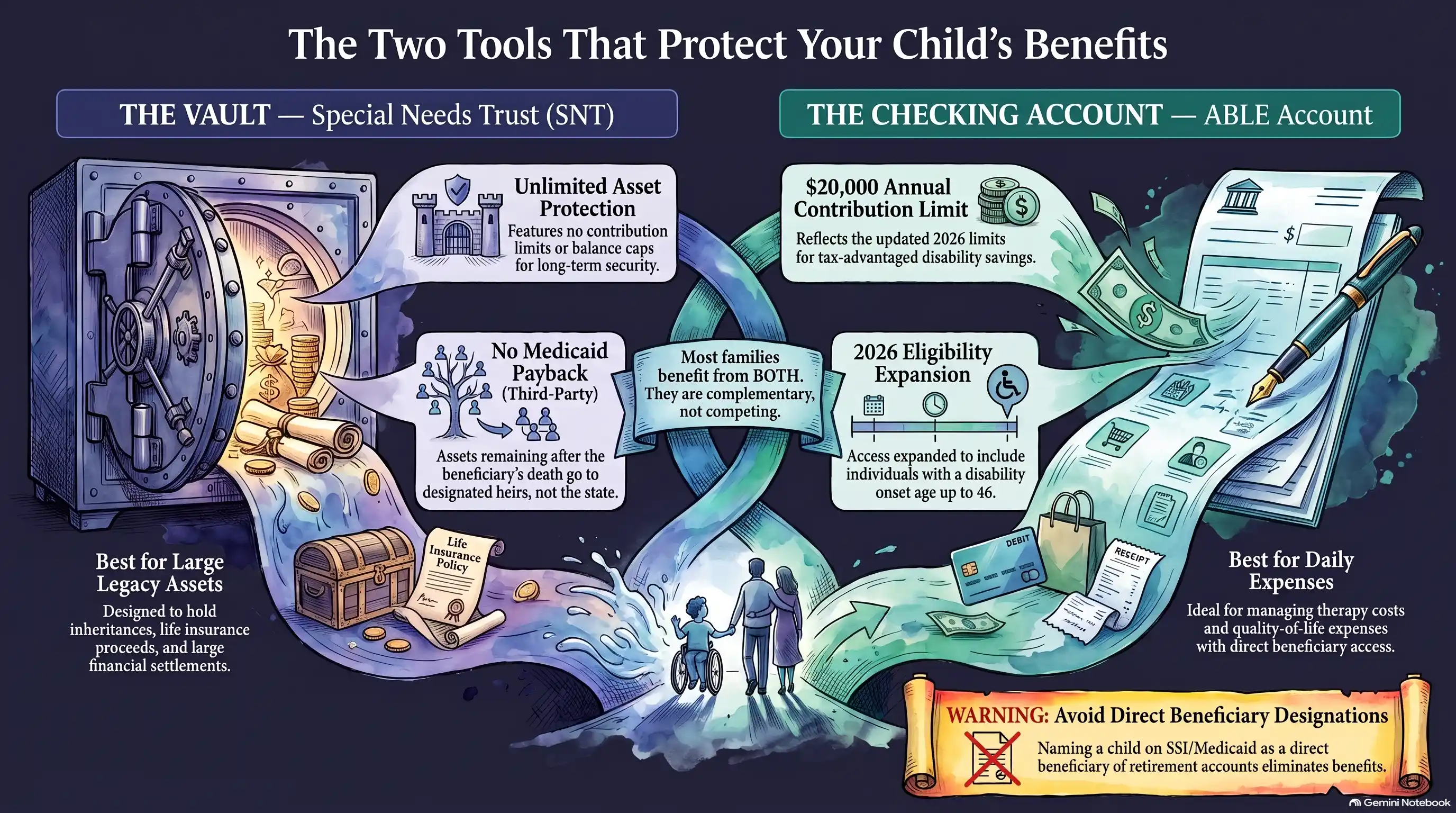
Two financial vehicles exist specifically to hold assets for a person with disabilities without triggering the asset limits that would eliminate their government benefits. Understanding both — and how they work together — is the foundation of any dependent child financial plan.
Tool 1: The Special Needs Trust
A Special Needs Trust is a legal structure that holds assets for the benefit of a person with disabilities while keeping those assets outside the beneficiary's countable resources for SSI and Medicaid purposes.
The assets inside the trust are not the child's assets in the legal sense that triggers benefit loss. They are held by a trustee — a family member, a trusted friend, or a professional trustee organization — who distributes funds for the child's benefit in ways that supplement rather than replace government benefits.
The trust can pay for things government benefits do not cover: therapy, equipment, education, recreation, travel, quality-of-life expenses, housing improvements, transportation, and countless other needs that SSI and Medicaid leave unaddressed. It cannot pay for things that government benefits are supposed to cover — primarily food and shelter — without affecting those benefits. The distinction requires careful trustee management and clear documentation.
There are two primary types of Special Needs Trusts. A third-party SNT is funded by parents, grandparents, or other family members — not by the beneficiary's own assets. This is the vehicle parents use to leave inheritance to a child with disabilities. A third-party SNT has no Medicaid payback requirement — when the beneficiary passes away, remaining assets go to whoever the trust designates, not to the government.
A first-party SNT is funded with the beneficiary's own assets — typically a legal settlement or inheritance received directly before the trust was established. First-party SNTs are subject to Medicaid payback — the state can claim reimbursement for Medicaid expenses from the trust remainder after the beneficiary's death.
For parents planning ahead, the third-party SNT is almost always the right vehicle. It has no contribution limits, no balance caps, and no Medicaid payback requirement. It is the vault that protects whatever the family puts in from any government claim.
Tool 2: The ABLE Account — Significantly Expanded in 2026
An ABLE account — Achieving a Better Life Experience — is a tax-advantaged savings account for individuals with disabilities that does not count against SSI or Medicaid asset limits up to $100,000.
In 2026, two significant changes expanded access to ABLE accounts:
First, the age limit expanded dramatically. ABLE accounts were previously available only to people whose disability began before age 26. As of January 1, 2026, that threshold increased to age 46 under the ABLE Age Adjustment Act. Millions of adults with disabilities who were previously ineligible — those whose disability began between ages 26 and 45 — can now open an ABLE account. If your adult child became disabled during that window, this is new access that did not exist before.
Second, contribution limits increased. The 2026 annual contribution limit from all sources combined is $20,000, up from $19,000 in 2025. For beneficiaries who work and do not participate in an employer retirement plan, the ABLE to Work provision allows an additional $15,650, for a total of $35,650 in annual contributions.
The ABLE account offers something the Special Needs Trust does not: the beneficiary can access their own money directly, without going through a trustee, if they have the mental capacity to manage it. This promotes independence and dignity in a way that trust distributions do not.
The practical limitation: ABLE accounts cap at $100,000 before SSI payments are suspended (Medicaid continues regardless). For families protecting a large inheritance, a settlement, or significant life insurance proceeds, the Special Needs Trust remains the primary vehicle. But the ABLE account is the better tool for the first $20,000 each year — functioning as a checking account for daily and supplemental expenses while the trust functions as the vault for larger assets.
The Letter of Intent — The Document No Attorney Will Tell You to Write
The Special Needs Trust and the ABLE account are the legal and financial infrastructure. The Letter of Intent is something different — and arguably the most important document in the entire dependent child planning picture.
A Letter of Intent is not a legal document. It has no binding authority. It is a detailed, personal document written by the parent describing everything that matters about the child's life, care, preferences, routines, and needs — for the people who will step into the caregiving role when the parent is no longer there.
No attorney will put this on your estate planning checklist because it is not their domain. No financial planner will require it. But special needs planning professionals universally consider it essential — because the trust and the ABLE account tell the trustee what to do with the money, while the Letter of Intent tells the caregiver how to actually care for the person.
What a comprehensive Letter of Intent covers:
Medical history in full detail — diagnoses, medications, dosages, prescribers, medical history, known reactions, what works and what does not. The successor caregiver who has never managed this child's medical care needs to walk into the first doctor's appointment knowing everything the parent knew.
Daily routines and preferences — what the child eats and what they will not eat. Sleep patterns. Sensory sensitivities. Calming strategies. What causes distress and what prevents it. The small details that make an enormous difference in daily quality of life and that the parent carries entirely in their memory.
Therapy and education — current providers, current goals, what has worked in the past, what approaches have been tried and abandoned and why. The institutional memory that took years to build and that would take years to rebuild without documentation.
Relationships and community — who the important people in the child's life are. Friends, teachers, providers, neighbors. The social network that is not visible in any legal document but that matters enormously to the child's quality of life.
Financial guidance for the trustee — not legally binding instructions, but practical guidance about how to use the trust funds in ways that reflect the parent's values and the child's actual needs. What kinds of expenditures the parent would have approved. What the child's long-term care goals are.
Hopes and values — what the parent hopes for the child's life. What independence looks like in their specific case. What quality of life means for this particular person. The philosophical foundation that should guide every decision the successor caregiver and trustee make.
The Letter of Intent should be updated regularly — at minimum annually, and whenever the child's situation changes significantly. It is a living document, not a one-time effort.
Guardian Succession Planning — The Question Most Parents Cannot Answer
If you have a child who will need a guardian after your death, the question is not just who — it is how.
Most parents have a person in mind. A sibling, a close friend, another family member. What most parents have not done is prepare that person for the role — the medical knowledge, the government benefit structure, the trust administration, the daily care requirements, the relationship with service providers, the legal responsibilities of guardianship.
Guardianship of an adult with disabilities is not the same as guardianship of a minor. It involves ongoing court oversight in most states, annual reporting requirements, legal authority over medical decisions, and potentially financial authority if the guardian is also the trustee. The person stepping into this role needs preparation, not just designation.
Three things that successor guardian preparation requires:
A formal conversation — not a casual mention that "you would be the person I would want." A direct, explicit conversation about what the role involves, what the commitment looks like, and whether the person is genuinely willing and able to accept it. Many people who would be touched to be asked would also, if given complete information, identify someone better suited. That conversation is more loving than assuming.
Shadowing and learning — ideally, the designated successor spends time with the child, learns their routines, meets their providers, and begins building the relationship before it is needed. A guardian who knows the child before the crisis is in an incomparably better position than one who is learning from scratch while also grieving.
A backup designation — the person you designate may not be available when needed. They may have moved, experienced health problems of their own, or had their own life circumstances change in ways that make the role impossible. Designating a primary and backup successor guardian, and keeping those designations current, ensures the plan works even when circumstances change.
Funding the Plan — How Much Is Enough
The question every parent eventually asks: how much money does the trust need to hold to fund my child's care for their lifetime?
The honest answer is that it depends on too many variables for any generic number to be useful — the child's specific care needs, their existing government benefits, their life expectancy, the cost of care in their location, whether they will live independently or in a supported setting, and the rate at which care costs will increase over time.
But the variables that matter most are identifiable:
The gap between what government benefits provide and what the child actually needs is the starting point. SSI, Medicaid, and other government programs cover basic living expenses and medical care for eligible individuals. The trust needs to fund what those programs do not — the therapy, the recreation, the quality-of-life enhancements, the housing upgrades, the transportation, the communication devices, the education, the relationship-building experiences that make a full life possible.
Life expectancy for the specific condition matters. A child with a condition that does not affect life expectancy may need 50-60 years of trust funding. A child with a condition that involves significant medical complexity may need a different calculation. Each situation requires individual modeling.
Care inflation — the rate at which disability-related care costs increase — has historically outpaced general inflation. Any funding model needs to account for this.
The funding vehicles available to parents include life insurance — specifically a permanent policy or a term policy large enough to fund the trust at the parent's death — systematic contributions to the trust during the parent's lifetime, and designation of the trust as beneficiary on retirement accounts, noting that the trust must be carefully structured to avoid the tax consequences of leaving retirement assets to a trust rather than an individual.
One critical warning: never name a child with disabilities as the direct beneficiary of a retirement account unless the account will be small enough to remain within benefit eligibility limits. The trust must be set up correctly — specifically as an eligible designated beneficiary trust — to preserve the ability to stretch distributions over the beneficiary's lifetime rather than requiring distribution within 10 years. This is a technical area requiring an estate attorney with specific special needs trust expertise.
The 2026 Rule Changes Every Parent Needs to Know
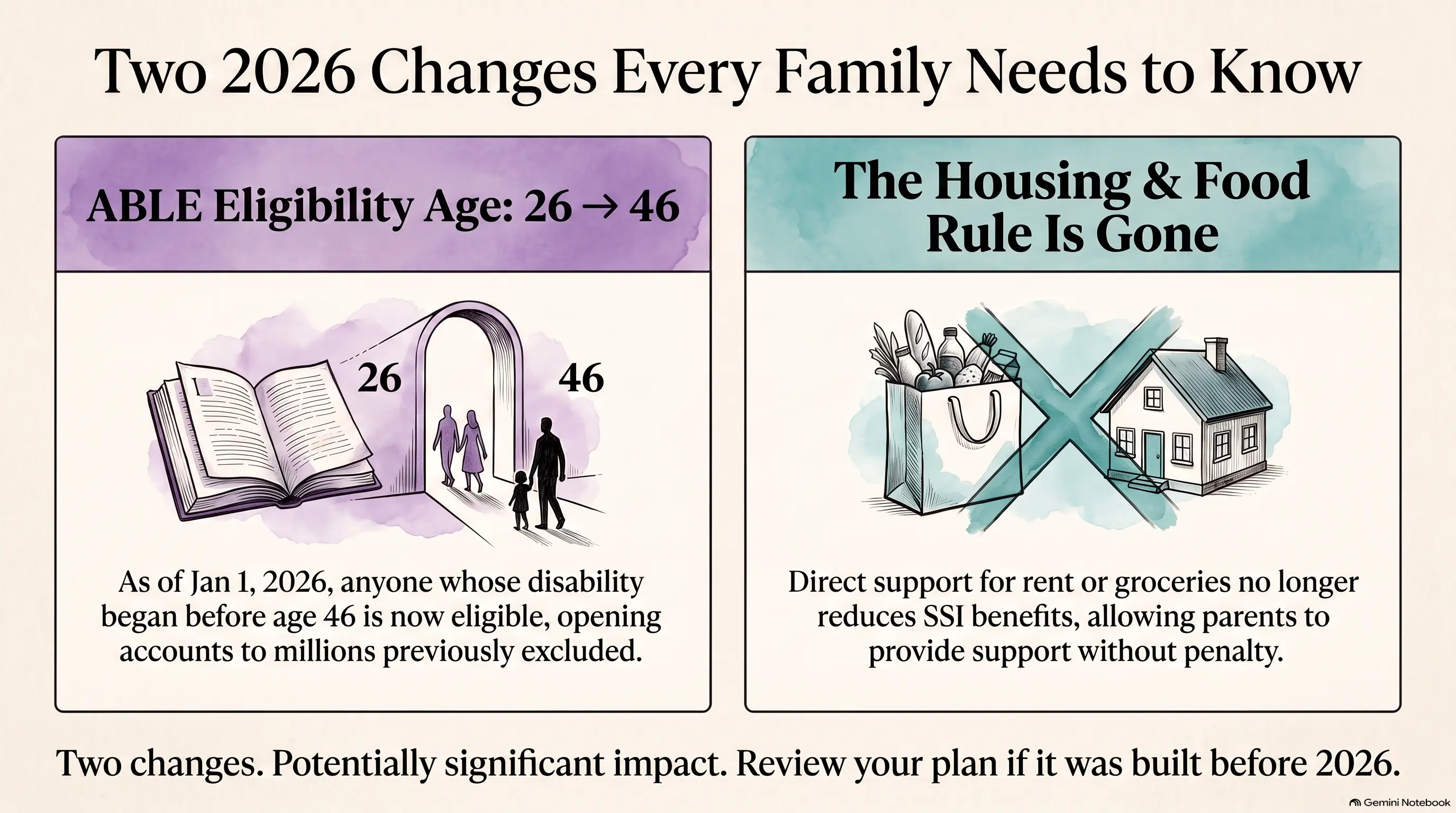
Two changes that took effect January 1, 2026 are significant enough that families who completed their planning before 2026 should review it:
ABLE Age Expansion: The disability onset age for ABLE eligibility expanded from 26 to 46. If your adult child became disabled between ages 26 and 45 and was previously ineligible for an ABLE account, they may now qualify. This changes the funding strategy for many families who previously relied entirely on the Special Needs Trust.
SSI In-Kind Support Elimination: The Social Security Administration eliminated the "in-kind support and maintenance" rule that previously reduced SSI benefits when a third party provided food or shelter. Under the old rule, if a parent paid for their child's rent or groceries directly, the child's SSI benefit was reduced by up to one-third. That rule is gone. Parents can now provide direct support for housing and food without affecting SSI — which significantly changes the financial planning picture for families where the parent provides direct support in addition to or instead of a trust.
If your plan was built before 2026, review it with a special needs planning attorney in light of both changes.
What Arthavita's Legacy Planning Module Does for Dependent Child Planning
For users with a dependent child, Arthavita's Legacy Planning section provides the documentation infrastructure that makes the plan actionable rather than theoretical.
The estate document tracker includes specific fields for Special Needs Trust documentation — trust name, trustee, successor trustee, date established, and location of the trust document. The beneficiary review feature flags any retirement account or life insurance policy that names the child directly rather than the trust — catching the mistake that eliminates government benefits before it happens.
The Legacy Vault, accessible to named executors and successor caregivers through Journey Partners, is the natural home for the Letter of Intent — the detailed, personal document that guides the successor caregiver through every aspect of the child's care. Time-limited, secure access means the successor caregiver can access everything they need without needing a full Arthavita account.
The Wealth Transfer Strategy feature models the funding gap — the difference between what government benefits will provide and what the child's complete care requires — and helps parents identify the appropriate combination of life insurance, trust contributions, and ABLE account funding to close it.
The Conversation Nobody Has — Until They Have To
Most parents of dependent children eventually have two financial planning conversations. The first is the one they have with an estate attorney or financial planner who does not specialize in special needs planning — and who gives them advice designed for a different situation. The second is the one they have after something goes wrong: the inheritance that eliminated the government benefits, the trust that was not structured correctly, the successor caregiver who had no idea what they were walking into.
The planning that prevents the second conversation is available. It requires finding professionals who specialize in this specific area — special needs certified financial planners, estate attorneys with special needs trust experience, and organizations in every state that provide guidance to families navigating this terrain.
The Academy of Special Needs Planners and the Special Needs Alliance both maintain directories of qualified professionals. State developmental disability agencies often have resource lists. The Arc, a national organization serving people with intellectual and developmental disabilities, maintains resources for families at every stage of planning.
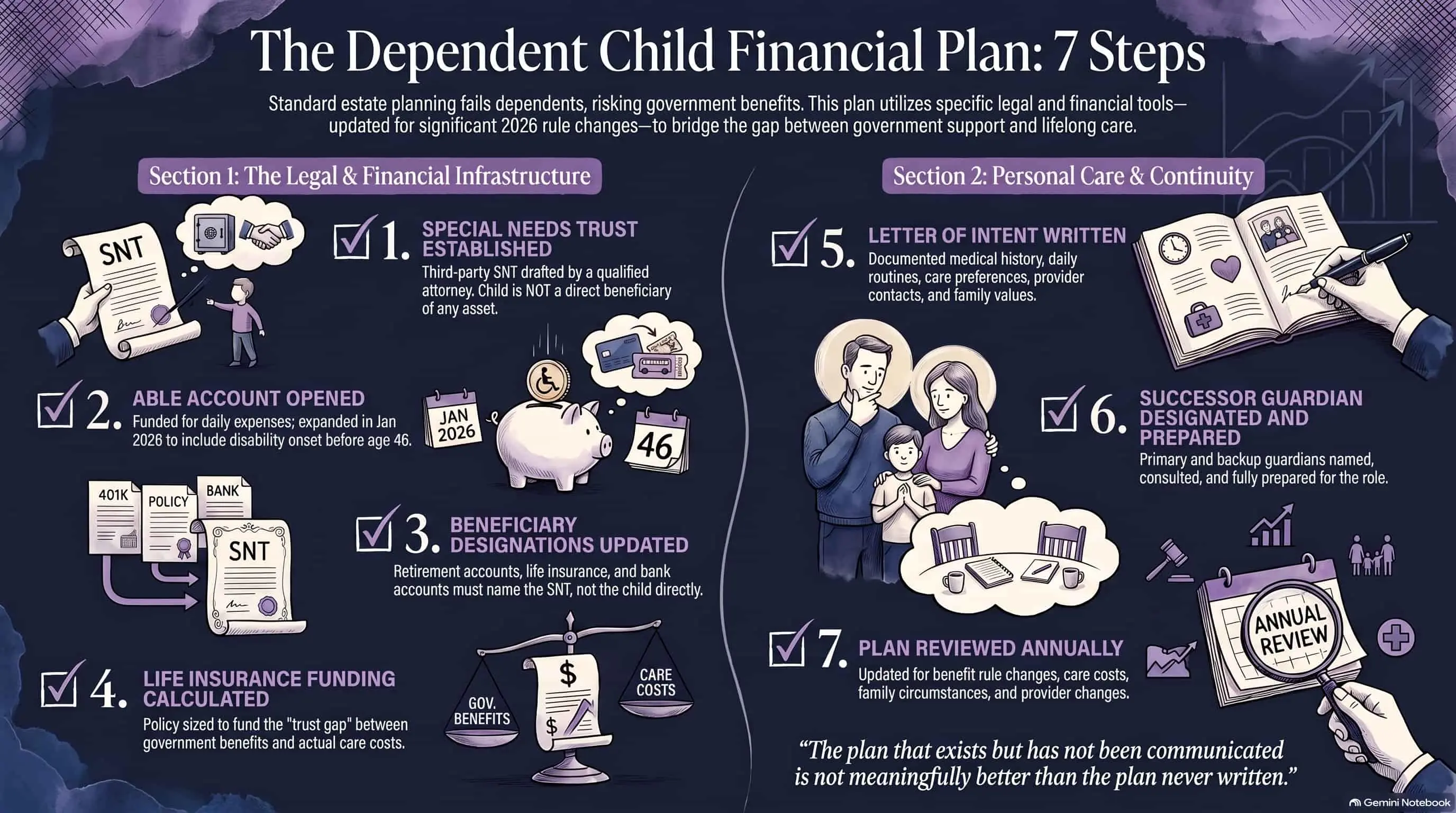
The financial tools — the Special Needs Trust, the ABLE account, the Letter of Intent, the guardian succession plan, the life insurance funding strategy — are not complicated in concept. They are unfamiliar because the financial planning industry built its standard toolkit for a different population. Families navigating this terrain are not unusual in their needs. They are underserved by a system that was not designed for them.
The planning that protects a dependent child after a parent is gone is one of the most important financial acts any parent can complete. It is also one of the most consistently delayed — because it requires confronting both mortality and the child's vulnerability simultaneously, and that is genuinely hard.
The answer to "what happens to my child the morning after I am gone" is not luck or family goodwill. It is a documented, funded, legally structured plan that has been communicated to the people who will carry it out.
That plan starts with the first step. Not with the perfect plan — with the first step toward building one.
Frequently Asked Questions
What is the difference between a Special Needs Trust and a regular trust?
A regular trust distributes assets directly to beneficiaries, who own those assets outright. For a person receiving SSI or Medicaid, that direct ownership eliminates benefits because the assets exceed the $2,000 SSI asset limit. A Special Needs Trust holds assets in a structure where the beneficiary does not own them directly — the trustee holds and manages them — so they do not count against benefit eligibility. The trust can pay for supplemental expenses that government benefits do not cover without affecting those benefits.
My child receives SSDI, not SSI. Does the $2,000 asset limit still apply?
SSDI — Social Security Disability Insurance — is an earned benefit based on work history, not a means-tested program. SSDI has no asset limit. However, if your child receives both SSDI and SSI — which is common when SSDI payments are low — the SSI asset limit still applies. Medicaid eligibility rules vary by state and may impose separate asset limits. Review your child's specific benefit structure with a special needs planning professional before making estate planning decisions.
Can I leave my IRA directly to a Special Needs Trust?
Yes, but the trust must be structured correctly to qualify as an eligible designated beneficiary, which allows distributions over the beneficiary's life expectancy rather than within 10 years. An incorrectly structured trust forces 10-year distribution, creating potentially large taxable income that could affect benefit eligibility. This is a technical area that requires an estate attorney with specific Special Needs Trust expertise — not a generalist estate attorney.
What if I cannot afford a Special Needs Trust right now?
Two lower-cost alternatives exist for families with limited immediate resources. An ABLE account can be opened with very little money and provides immediate benefit-protection for up to $20,000 per year in contributions. A pooled special needs trust — administered by a nonprofit organization — allows families to contribute to a master trust managed by professionals without the cost of establishing and administering a private trust. Pooled trusts are subject to Medicaid payback rules in most states, so they are not identical to a third-party SNT, but they provide meaningful protection at lower cost.
Who should serve as trustee of a Special Needs Trust?
The trustee must understand both the trust's legal requirements and the beneficiary's government benefit structure well enough to make distributions that supplement rather than replace benefits. A family member can serve, but must be educated about these rules and be willing to accept the ongoing administrative responsibility. A professional trustee — a bank trust department or a nonprofit trust company — provides expertise and continuity but costs more. Many families designate a family member as trustee with a professional co-trustee or advisor to provide guidance on benefit-related decisions.
What happens to the Special Needs Trust if my child passes away before me?
A well-drafted third-party Special Needs Trust specifies what happens to remaining assets if the beneficiary predeceases the parent. The parent can designate other beneficiaries, return the assets to the estate, or direct them to a charity. Because a third-party SNT has no Medicaid payback requirement, the full remaining balance goes to whoever is designated — the government has no claim.
Have a question this article didn't answer?
Every dependent child planning situation is different — the specific disability, the benefit structure, the family dynamics, and the available resources all shape what the right plan looks like. If something here raised a question specific to your situation, send us a note at support@arthavita.co and we will do our best to address it directly or in a future post.
Arthavita is an educational and planning platform. This article is for informational purposes only and does not constitute personalized financial, legal, or tax advice. Special needs planning involves complex interactions between federal and state law, government benefit programs, and individual circumstances. For personalized guidance, consult a qualified special needs planning attorney and a certified special needs financial planner.
Ketan Patel
Founder, Arthavita
Ketan Patel is the founder of Arthavita and a multi-industry entrepreneur with 30+ years of experience in technology and business operations. He built Arthavita to bring institutional-quality financial intelligence to individual investors.
LinkedIn ↗This article is for educational purposes only and does not constitute financial, tax, or legal advice. Arthavita is a recommendation-only platform. Always consult a qualified professional before making financial decisions.