
Caught in the Middle: The Financial Survival Guide for the Sandwich Generation
Nearly half of adults between 40 and 59 are simultaneously raising children and supporting aging parents. The average sandwich generation caregiver spends $10,500 per year on caregiving expenses — and that visible cost is not the largest financial damage. The real toll is the retirement savings that do not happen, the career advancement that gets passed up, and the compounding loss that accumulates silently over a decade of divided attention. This guide is for the person in the middle — the one holding everything together — with a financial framework built around the actual constraints of their actual life.
There is a word for your situation that almost everyone in it resists.
Sandwich generation. It sounds almost clinical — a demographic label someone coined in a research paper. It does not capture the reality of fielding a call from your mother's cardiologist at 8 AM, dropping your teenager at school at 7:45, and trying to remember whether you submitted your 401(k) contribution change before the deadline — all before your first meeting.
It does not capture the weight of knowing that two generations of people depend on you. Not just financially — though that too — but for decisions, logistics, presence, and patience that have no off switch.
Nearly half of adults between 40 and 59 find themselves in this position, according to Pew Research. The median retirement savings of sandwich generation caregivers is $50,000 — compared to $75,000 for non-caregivers of the same age. That $25,000 gap does not sound alarming. But it is the visible surface of a much larger financial disruption happening beneath it.
This article does not offer the advice to "take care of yourself first" as if that is a realistic instruction for someone managing two generations simultaneously. It offers something more useful: a financial framework for the person in the middle, built around the actual constraints of their actual life.
Why 2026 Is a Tipping Point for the Sandwich Generation
The sandwich generation has existed for decades. But 2026 marks a genuine inflection point in both scale and financial pressure.
People are living longer. The average 65-year-old American woman can now expect to live another 20.8 years. A 45-year-old whose parent is 72 may be managing some form of parental support for 15 to 20 more years — not a temporary season, but a structural feature of their financial life.
Adult children are achieving financial independence later. With housing costs at historic highs and student loan debt persistent, 57% of adults ages 18 to 24 were living in their parents' home in 2023. Many remain financially dependent well into their mid-20s. A 50-year-old with a 24-year-old still on the family health insurance plan is carrying a dependent longer than any prior generation expected to.
The long-term care system has not kept pace with longevity. Medicare does not cover custodial long-term care. Medicaid requires near-complete asset depletion before coverage begins. The gap between what aging parents have saved and what extended care actually costs falls on families — specifically on the adult children who are already managing two households of obligation.
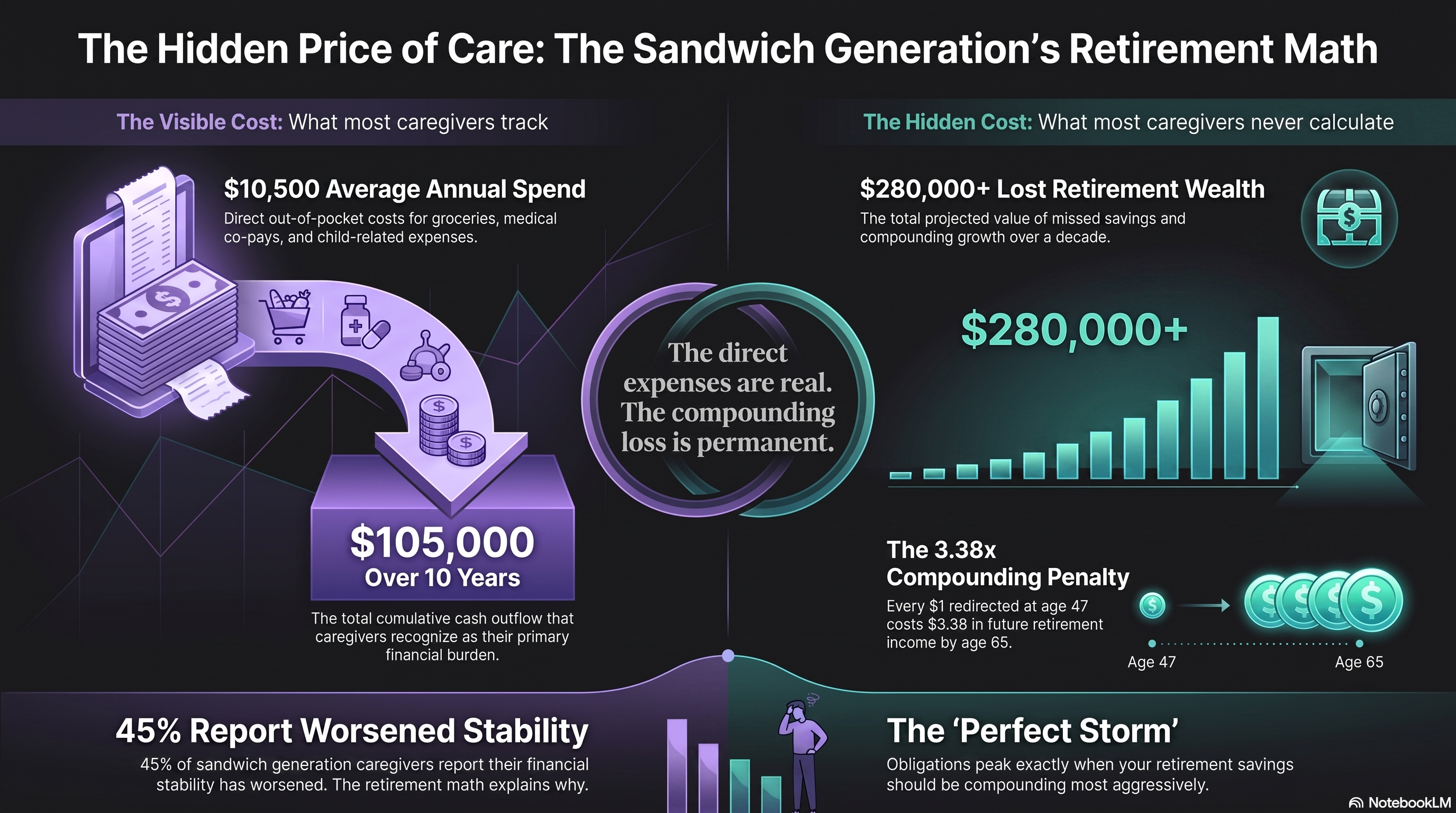
The result, as one 2026 analysis put it, is a "perfect storm" — individuals not just providing care but often significant financial assistance to both ends of the generational spectrum, at precisely the moment when their own retirement savings should be compounding most aggressively.
The Hidden Financial Cost Nobody Calculates
When most people think about the financial impact of being in the sandwich generation, they think about the direct expenses — the groceries they buy for their parents, the co-pays they cover, the school activities they fund. These are real. On average, sandwich generation caregivers spend about $10,000 to $10,500 per year on caregiving expenses. Over a decade, that is $100,000-plus in direct outflows.
But the direct expenses are not the largest financial cost. The largest financial cost is the retirement savings that do not happen.
Every year that a sandwich generation caregiver reduces their 401(k) contribution to free up cash for caregiving obligations is a year of lost compounding. The contribution they did not make at 47 does not just cost them the dollar amount — it costs them everything that dollar would have earned over the next 18 years before retirement. At 7% annual return, a dollar contributed at 47 becomes approximately $3.38 by 65. A dollar not contributed costs $3.38 in future retirement income.
Multiply that by $10,000 in annual caregiving expenses redirected from retirement savings, and the compound impact over a decade of sandwich caregiving is not $100,000. It is closer to $280,000 in lost retirement wealth.
The career impact compounds the damage further. 28% of sandwich generation workers work part-time due to caregiving responsibilities, and 12% are unemployed due to caregiving. Women are disproportionately affected — 60% of sandwich generation caregivers are women, and many are the ones who cut hours, decline promotions, or leave jobs entirely when caregiving becomes unmanageable. The income those career decisions sacrificed would have funded retirement contributions, built Social Security income, and produced the professional trajectory that creates financial security in later decades.
The full financial cost of the sandwich generation is not $10,500 per year. For many caregivers, it is $280,000 or more in lost retirement wealth per decade — before accounting for income foregone through career disruption.
That is the number nobody talks about.
The Five Financial Realities of the Sandwich Generation
Understanding the landscape clearly is the starting point. Not every person in this situation faces exactly the same pressures — some are providing primarily financial support to parents, some time and logistics without significant financial transfer, some managing adult children who have returned home. The specific priorities shift depending on the combination of pressures.
But five financial realities apply broadly to most people navigating this period.
Reality 1: Your Retirement Cannot Be Borrowed For
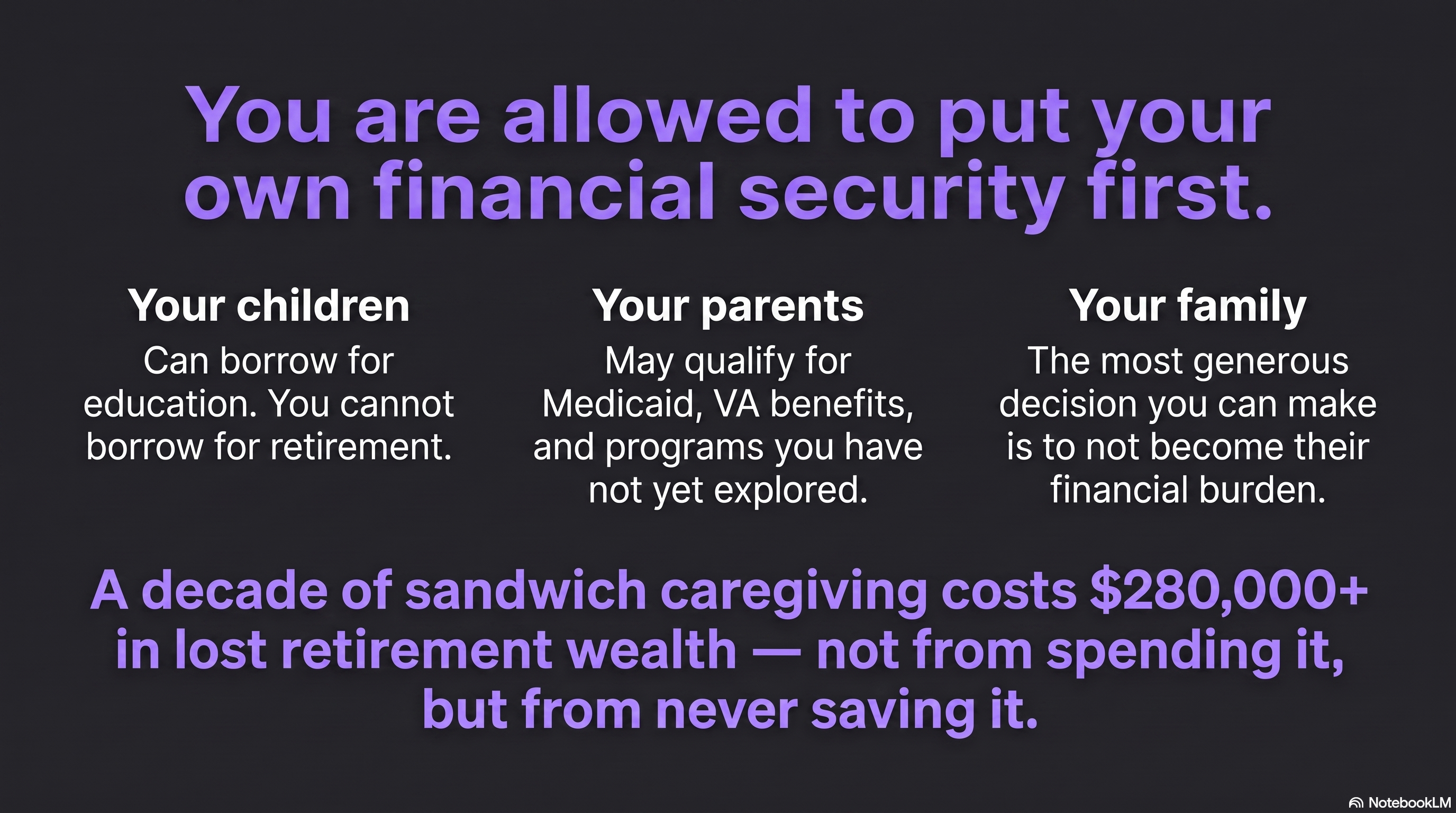
The most important financial principle for the sandwich generation is this: your children can borrow for education, and your parents may qualify for government programs you are not yet aware of — but you cannot borrow for retirement.
Every resource allocation decision needs to flow from this principle. When money is scarce and competing obligations press from every direction, retirement contributions come before additional support to adult children. Not because your children do not matter — but because depleting your retirement to fund their launch creates a future where your children are supporting you, which is the outcome most parents most want to avoid.
The employer 401(k) match is the non-negotiable floor. AARP found that 30% of caregivers struggle to meet their own expenses — but even within that constraint, the employer match must be captured. A 50-100% guaranteed return on that contribution beats every other financial decision available to someone in a compressed financial situation.
This is not a comfortable principle to apply when your 24-year-old is struggling or your parent needs help. It is the correct one.
Reality 2: Your Parents' Finances Need to Become Visible to You — Before a Crisis Forces It
One of the most expensive mistakes sandwich generation caregivers make is waiting until a crisis to understand their parents' financial situation. A parent hospitalized unexpectedly, or diagnosed with a condition requiring ongoing care, creates decision-making pressure at exactly the moment when clear information is hardest to obtain.
What you need to understand: which accounts exist and where they are held; what income sources they have — Social Security, pension, any remaining retirement accounts; what their monthly expenses are; what insurance they carry — Medicare supplemental, long-term care if any, life insurance; where their legal documents are — will, trust, durable power of attorney for finances and healthcare; and who has authority to act on their behalf if they cannot act for themselves.
Without this information, you cannot plan. You cannot estimate what care might cost relative to what resources exist. You are making financial decisions in the dark — which always costs more than making them with information.
The conversation is uncomfortable because it touches autonomy, mortality, and money simultaneously. The framing that makes it easier: "I want to make sure I know how to help if something happens." That is a different conversation from "I need to know what you have."
Reality 3: The Sibling Conversation Has to Happen — With Numbers
30% of sandwich generation caregivers struggle to meet their own expenses because of caregiving costs. A significant portion of that financial strain is concentrated in one sibling — the one who lives closest, the one who is most available, the one who became the primary caregiver by default rather than by agreement.
The financial burden of caregiving is rarely shared proportionally among siblings without an explicit conversation. The sibling who contributes 80% of the care and 80% of the financial support while a more distant sibling contributes nothing is making a unilateral decision to sacrifice their own financial security for their siblings' comfort — even if no one ever named it that way.
The conversation that needs to happen: what does the care actually cost in time and money? Who is contributing what? What is a fair distribution given each sibling's circumstances — geographic proximity, financial capacity, relationship history? What happens if the primary caregiver's capacity changes?
Put numbers on it. Families that have this conversation proactively manage caregiving better, fight less, and distribute the burden more equitably. Families that never have it concentrate the burden on whoever is willing to absorb it silently.
Reality 4: Long-Term Care Is the Financial Risk That Can Change Everything
The largest unmodeled financial risk for most sandwich generation caregivers is what happens when their aging parent needs long-term care beyond what the family can provide.
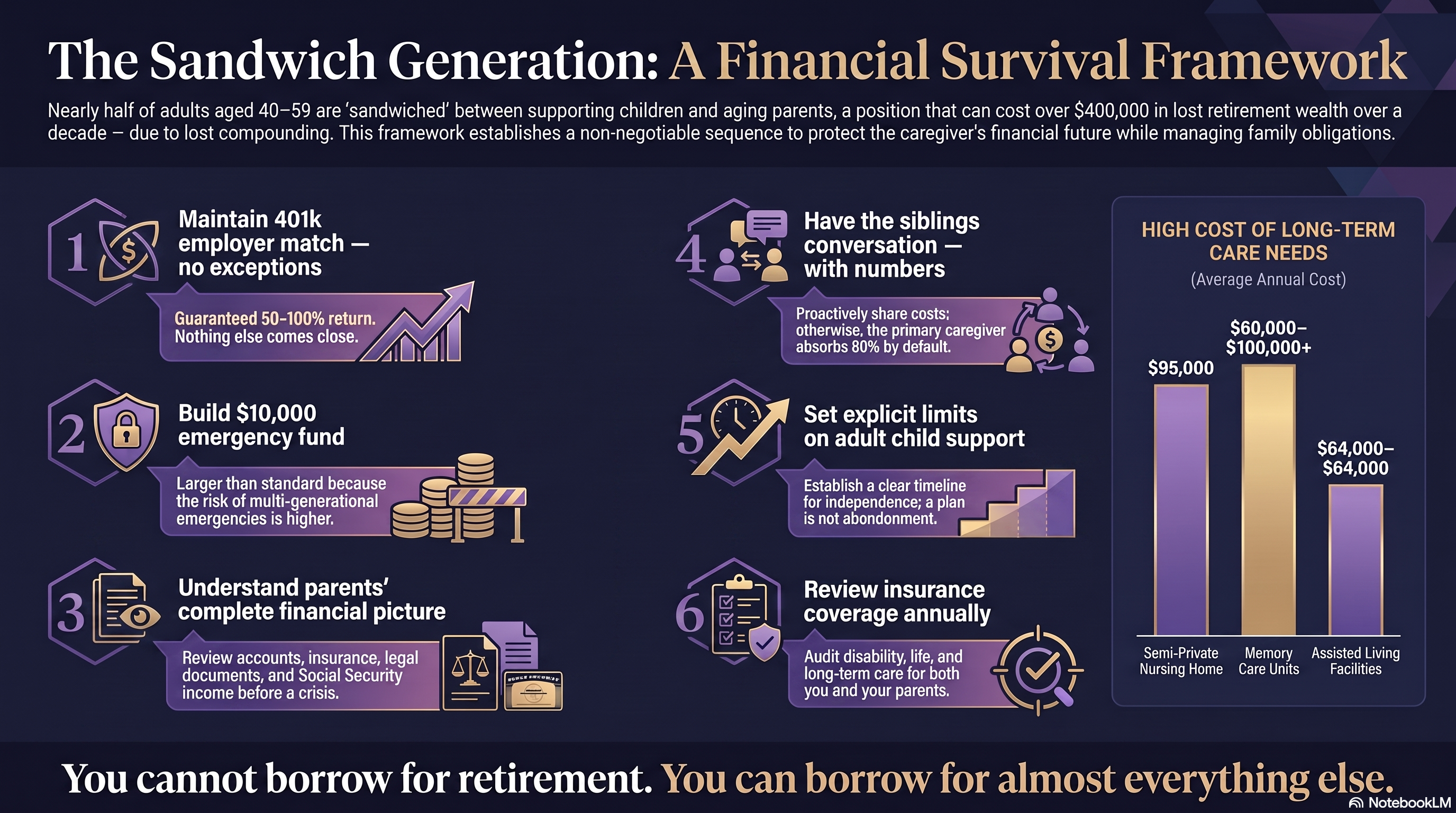
The costs are significant. The median annual cost of a semi-private nursing home room is approximately $95,000. Assisted living facilities average $54,000-$64,000 per year. Memory care units for parents with dementia or Alzheimer's can run $60,000-$100,000 or more annually. Medicare covers very little of this. Medicaid requires near-complete asset depletion — typically to $2,000 in countable assets — before it covers nursing home care.
A parent who requires two years of nursing home care needs $190,000 before Medicaid kicks in. If those assets do not exist, the cost falls on the family.
The planning response — ideally executed years before care is needed — involves: understanding what your parent's actual assets are and how long they would fund care at realistic costs; checking whether long-term care insurance was purchased at any point; understanding the Medicaid five-year look-back rule before any asset transfers are made; and if your parent has limited assets and care needs are likely, consulting an elder law attorney before the crisis, not during it.
Reality 5: Your Own Insurance Gaps Are Almost Certainly Larger Than You Think
The sandwich generation caregiver who is holding two generations together is also, almost certainly, the person whose absence would create the largest financial crisis for everyone around them.
Disability insurance — which replaces a portion of your income if illness or injury prevents you from working — is the coverage most sandwich generation caregivers do not have in adequate amounts. 58% of sandwich generation caregivers report fair or poor health, meaning the risk is not abstract. The probability of experiencing a disabling condition during working years is significantly higher than the probability of dying — yet most people have life insurance and no disability coverage.
If you became disabled and could not work for 18 months, what happens? To your retirement savings. To the support you provide your aging parents. To the financial position of your household. For most sandwich generation caregivers, the answer is devastating — because the financial architecture of two or three generations rests on their continued income.
Review both disability and life insurance coverage. This is not optional for someone in this position.
The Six Financial Priorities for the Sandwich Generation — In Order
With limited financial margin and competing obligations pressing from every direction, sequence matters. Here is the right order.
Priority 1: Maintain the Employer 401(k) Match — No Exceptions
The guaranteed return on the employer match is the highest-return financial decision available to anyone in a compressed financial situation. No caregiving expense, no adult child support, no parental care cost justifies walking away from it. Reduce contributions above the match if necessary. Do not reduce below it.
Priority 2: Build or Maintain a $10,000 Emergency Fund
The sandwich generation emergency fund needs to be larger than the standard three-month guideline — because the probability of an emergency is higher. A parent's hospitalization. A child's unexpected expense. A car repair that cannot wait. The $10,000 minimum provides a buffer that prevents each emergency from cascading into debt, paused retirement contributions, or decisions made under maximum pressure.
Priority 3: Understand Your Parents' Complete Financial Picture
Have the conversation. Get the documents organized. Know what exists, what it costs, and what the gap is between their resources and their realistic care needs. This is not a one-time conversation — it is an ongoing awareness that needs updating as their health and circumstances change.
Priority 4: Have the Siblings Conversation About Shared Responsibility
Establish an explicit agreement — in writing if possible — about who contributes what, how costs are shared, and what happens as care needs escalate. Do not let the default be that whoever shows up absorbs the full burden.
Priority 5: Set Explicit Boundaries on Adult Child Financial Support
Adult children who are financially dependent on sandwich generation parents need a clear timeline, clear limits, and a clear plan for transition to financial independence. "We will help with rent through December while you complete your job search" is a boundary. "We will figure it out" is not.
The financial support that does not have a defined end point tends to extend indefinitely. The retirement savings deferred to fund it do not come back.
Priority 6: Review Insurance Coverage Annually
Life insurance, disability insurance, and long-term care coverage for both you and your aging parents need to be reviewed as circumstances change. A parent who developed a serious health condition last year may no longer be insurable. A change in your income changes your disability replacement calculation. An adult child who is no longer financially dependent changes your life insurance calculation. Review annually — not when something goes wrong.
What the Retirement Math Actually Looks Like
The retirement savings impact of the sandwich generation rarely gets quantified honestly. Here is the math, using a straightforward example.
A 47-year-old sandwich generation caregiver earning $85,000 is contributing 8% to their 401(k) — $6,800 per year. Between caregiving expenses for their parent ($8,000/year) and continuing support for their 23-year-old ($4,000/year), $12,000 per year is flowing out to other generations. To free up cash, they have kept their contribution at 8% rather than increasing it to 15% as their income grew.
The contribution gap — the difference between 8% and 15% on an $85,000 salary — is $5,950 per year. Over 18 years to retirement at 7% annual return, that $5,950 per year gap compounds to approximately $219,000 in lost retirement wealth.
Add the compound impact of the direct caregiving expenses redirected from savings, and the total retirement cost of a decade in the sandwich position can easily exceed $400,000 — for someone who never missed a contribution, never stopped saving entirely, just kept the rate lower than it should have been and redirected the difference to caregiving.
That is the honest number. And it is why the six priorities above are not suggestions — they are the specific actions that prevent that number from becoming permanent.
What Arthavita's Dashboard Shows the Sandwich Generation
For users in the Family Focus life stage, Arthavita's Wealth Journey Dashboard surfaces the priorities most relevant to this specific financial situation — not generic retirement advice, but the specific pressure points of a household managing multi-generational obligations.
The Family Investing feature allows a household to see the aggregated financial picture across multiple family members — the combined portfolio, the shared goals, the household net worth that accounts for every account and every obligation. For sandwich generation households where finances are intertwined across generations, the ability to see the full picture in one view changes the quality of every financial decision.
The Life Events feature — with 25 action plans triggered by specific life events — includes plans specifically for parent health events, adult child transitions, and caregiving role changes. When a life event happens, the platform does not just acknowledge it — it generates a prioritized action plan that tells you exactly what to do first, second, and third.
The Legacy Vault, with Journey Partners providing time-limited access to named executors and family members, provides the infrastructure for organizing your parents' financial picture — the accounts, the documents, the insurance policies — in a way that the whole family can access when they need it, without anyone needing to figure out where everything is during a crisis.
And the 25,000-scenario Monte Carlo simulation, run against your actual household numbers, shows the retirement probability not just for the baseline scenario, but for scenarios that include ongoing caregiving expenses — so you can see what your retirement looks like if parental care costs continue for five years versus ten versus fifteen.
The Permission Structure Nobody Gives You
There is something that never appears in financial planning advice for the sandwich generation, and it needs to be said directly.
You are allowed to put your own financial security first.
Not at the expense of your children's safety or your parents' dignity. But in the face of the cultural and family pressure that says the good daughter, the responsible son, the capable adult does whatever it takes — you are allowed to set limits, to ask siblings for shared contribution, to tell an adult child that financial support has a timeline, to accept that your parents' care needs may exceed what you can personally fund without sacrificing your own retirement.
The financial damage of not doing these things is permanent. The retirement savings years that are lost cannot be recreated. The compound growth that did not happen cannot be reversed. The career advancement that was sacrificed does not return.
45% of sandwich generation caregivers report their financial stability has worsened due to caregiving. That statistic represents real people who made the generous choice without making the sustainable one — and who will carry the financial consequences into their own retirement years.
This is not permission to abandon the people who depend on you. It is permission to take seriously the fact that your financial security is also something people depend on — including your children, who will one day be in their own middle years and cannot afford to also be supporting you.
The most generous financial decision you can make for the people who come after you is to protect your own retirement security while you still have time to build it.
That is not selfishness. That is the most responsible thing a sandwich generation caregiver can do.
Frequently Asked Questions
My parent needs care now and has no savings. What do I do first?
Start with what programs they are eligible for before assuming the cost falls entirely on you. Medicaid covers nursing home care for those who qualify financially — and the income and asset limits vary by state. Area Agencies on Aging — every county in the US has one — can connect aging parents to subsidized services including meal delivery, transportation, and in-home support at low or no cost. Veterans who served may qualify for VA care benefits that are significantly underutilized. The conversation with an elder law attorney — often available for a flat-fee initial consultation — can clarify options before you assume the full financial responsibility.
How do I tell my adult child that financial support has to end?
Frame it as a plan, not a rejection. "We can help with rent through October, which gives you four months to build income to cover it" is a plan. "We cannot keep doing this" is a conversation without a structure. Set the timeline, be specific about what you will and will not cover after it, and hold to it. Adult children who have a defined transition period almost always manage the transition better than those who receive open-ended support that disappears without warning.
My sibling does nothing and I do everything. How do I address this?
Start with a direct conversation rather than an assumption that your sibling understands the imbalance. Many primary caregivers have never explicitly quantified what they are doing — hours per week, dollars per month — and siblings who are less involved often genuinely do not know the scope. Present the numbers. Propose a specific arrangement. If the sibling is unwilling to contribute equitably, consider whether aspects of care can be delegated to paid services funded by shared family contribution, rather than absorbed personally.
Should I take money from my retirement account to pay for parent care?
Almost never. The 10% early withdrawal penalty before age 59½, the income taxes on the full withdrawal, and the lost compounding make retirement account liquidation one of the most expensive ways to fund caregiving. Exhaust all other options first — your parent's own assets, Medicaid eligibility, VA benefits, family contribution sharing, community resources. A personal loan or home equity line, while not ideal, is less damaging in most cases than retirement account liquidation.
How do I protect my own retirement while supporting two generations?
The sequence in this article is the answer: employer match first, emergency fund maintained, insurance coverage reviewed, explicit limits set on adult child support, parents' financial picture made visible before a crisis. The discipline of not reducing retirement contributions below the match level — even when money is tight — is the single most important financial habit for sandwich generation caregivers. Everything above that floor can flex with circumstances. The match cannot.
At what point should I talk to an elder law attorney?
Before you need one. The Medicaid look-back period — five years before application — means that planning needs to happen well before care needs arrive to be effective. An elder law attorney can help structure your parent's assets in a way that preserves Medicaid eligibility while protecting family assets. They can also advise on power of attorney structures, trust vehicles for parents with cognitive decline, and the specific rules in your state. The cost of an early consultation is a fraction of the cost of planning too late.
Have a question this article didn't answer?
Every sandwich generation situation is different — the specific combination of a parent's health, an adult child's circumstances, and your own financial position creates a planning problem that is genuinely unique to your household. If something here raised a question specific to your situation, send us a note at support@arthavita.co and we'll do our best to address it directly or in a future post.
Arthavita is an educational and planning platform. This article is for informational purposes only and does not constitute personalized financial, tax, or legal advice. All financial decisions remain with you. For personalized guidance, consult a qualified financial or tax professional.
Ketan Patel
Founder, Arthavita
Ketan Patel is the founder of Arthavita and a multi-industry entrepreneur with 30+ years of experience in technology and business operations. He built Arthavita to bring institutional-quality financial intelligence to individual investors.
LinkedIn ↗This article is for educational purposes only and does not constitute financial, tax, or legal advice. Arthavita is a recommendation-only platform. Always consult a qualified professional before making financial decisions.