
Building the Foundation: The Financial Moves Every 35-Year-Old Should Make
The median retirement account balance for someone between 35 and 44 is $45,000. The Fidelity benchmark says it should be $130,000 — twice your annual salary. That $85,000 gap is real but entirely recoverable at 35 in a way it is not at 45\. The decisions made between 35 and 45 — not the heroic financial moves, but the structural ones — determine whether the wealth accumulation phase of life actually compounds into retirement security or quietly dissipates into lifestyle, competing obligations, and intention that never becomes action. This is the guide for the person who has built something but knows the foundation needs deliberate reinforcement before the next decade begins.
There is a version of 35 where everything feels like it is finally coming together.
The career has traction. The income is the highest it has ever been. The apartment gave way to a house or is about to. The financial basics — the 401(k), the Roth IRA, some savings — exist, even if the balances feel modest against the obligations that arrived alongside them.
And there is a version of 35 where the gap between where the financial picture is and where it should be starts to become visible in a way it was not at 28.
The mortgage is larger than expected. The children arrived and the childcare costs with them. The student loans are still there, paying down slower than planned. The retirement account has a balance that feels meaningful in isolation but small against the retirement target that feels abstract and far away. The raise came and somehow the savings rate did not change.
Both versions of 35 share the same underlying reality: the Foundation pillar of the financial journey — the base that everything else is built on — needs deliberate reinforcement before the Accumulation phase can do its work.
35 is not 28. Time is shorter, obligations are larger, and the margin for financial drift is smaller. But it is also not 45. The runway ahead — 30 years of compounding, peak earning years approaching, the longest period of wealth accumulation still ahead — is still long enough for structural decisions made today to produce dramatically different outcomes by retirement.
This is the guide for building that foundation deliberately, at 35, before the decade of peak earnings begins.
Where Most 35-Year-Olds Actually Stand
The Federal Reserve's Survey of Consumer Finances provides the clearest picture of where Americans in the 35-44 age bracket actually are financially.
The median retirement account balance for this group is $45,000. Against the Fidelity benchmark — which suggests having two times your annual salary saved by 35, approximately $130,000 for someone earning $65,000 — the typical 35-year-old is $85,000 behind the checkpoint.
The median net worth for someone between 35 and 44 is approximately $135,000. That number is more encouraging — but it is heavily influenced by home equity, which is not investable without a transaction. The liquid, investable wealth that actually funds retirement is substantially lower for most people in this age group.
This is not a crisis at 35. It is the expected consequence of a decade that involved student loan repayment, housing transitions, family formation, and competing financial demands — all of which are legitimate reasons for modest retirement balances and all of which can be addressed with deliberate structural changes in the decade ahead.
The compounding math at 35 is still favorable. A 35-year-old with 30 years to retirement who begins contributing $15,000 per year to retirement accounts at 7% annual return accumulates approximately $1.5 million by 65 — before accounting for whatever has already been saved. The window is not closed. It requires starting to use it deliberately.
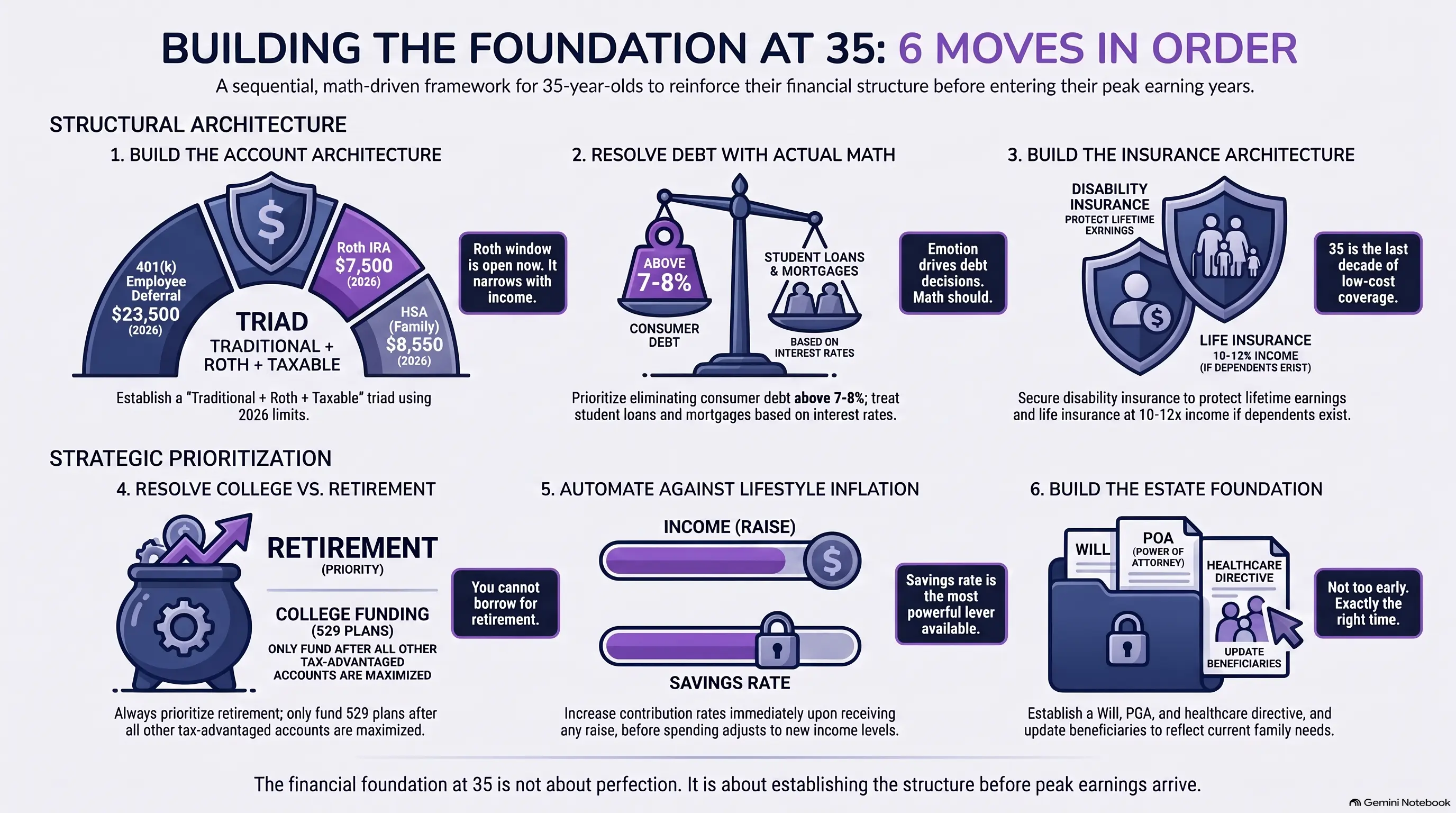
Move 1: Build the Account Architecture Before the Decade of Peak Earnings Arrives
The single most important structural decision for a 35-year-old is establishing the right combination of account types — traditional, Roth, and taxable — before peak earning years make some options unavailable or suboptimal.
At 35, many people are approaching but have not yet reached peak income. For most careers, income peaks somewhere in the mid-40s to early 50s. That means the next 10-15 years represent the period when the tax rate is often highest — which changes the Roth versus traditional calculus in ways that a 28-year-old in the 12% bracket does not face.
The framework for 35:
If in the 22% bracket: a mix of traditional and Roth contributions makes sense. Traditional contributions capture the deduction at a meaningful rate. Roth contributions — via direct Roth IRA or the Backdoor Roth for higher earners — build the tax-free balance that will be increasingly valuable as traditional balances grow toward RMD territory.
If in the 24% or higher bracket: traditional 401(k) contributions have stronger deduction value. Roth IRA contributions may be phased out. The Backdoor Roth — contributing a non-deductible amount to a traditional IRA and immediately converting to Roth — remains available regardless of income and should be executed annually.
If income is below the Roth IRA phase-out threshold of $150,000 for single filers: fund the Roth IRA fully before any additional traditional contributions above the employer match. The 30 years of tax-free growth from a Roth funded at 35 is the most powerful long-term tax advantage available to this age group.
The taxable brokerage account — often overlooked in the rush to maximize tax-advantaged accounts — has a role at 35 that it did not have at 28. For financial goals with a time horizon shorter than retirement, the taxable account provides flexibility that retirement accounts do not. It is also the vehicle for amounts that exceed retirement account contribution limits.
The 2026 Numbers for a 35-Year-Old
401(k) employee deferral limit: $23,500 Roth IRA contribution limit: $7,500 (phase-out begins at $150,000 single, $236,000 married) HSA family contribution limit: $8,550 (triple tax advantage — deductible, grows tax-free, tax-free withdrawals for medical)
The contribution sequence that maximizes tax efficiency:
- 401(k) to the full employer match — always first, guaranteed return
- HSA to the full family limit if on a qualifying high-deductible plan
- Roth IRA to the full limit
- 401(k) to the full $23,500 limit
- Taxable brokerage for additional savings beyond these limits
Move 2: Resolve the Debt Question With Actual Math, Not Emotional Intuition
At 35, most people are managing some combination of mortgage debt, student loans, and possibly remaining consumer debt. The right strategy for each depends on the interest rate — not on the emotional weight of the debt or on generic advice to pay off everything before investing.
Consumer debt above 7-8%: eliminate aggressively before any investment above the employer match. A 20% credit card interest rate is a guaranteed negative return that no investment can overcome. Every dollar not eliminated is earning whatever it earns in a portfolio while losing 20% to the credit card. The math is not close.
Student loans: the calculation depends specifically on the interest rate. Federal loans at 5-6% can reasonably coexist with investment contributions — the long-term expected return on a diversified portfolio historically exceeds this rate. Loans at 7-8% or above deserve more aggressive paydown, particularly for people who are not confident they will hold the investments through market downturns. Private loans at variable rates require ongoing monitoring.
Mortgage: for most 35-year-olds who purchased in the last few years, the mortgage rate may be materially higher than historical rates — in some cases above the expected long-term investment return. In that specific environment, additional mortgage paydown can be mathematically competitive with taxable investment. But maximizing tax-advantaged accounts — where the tax benefit adds to the effective return — almost always takes priority over additional mortgage paydown.
The debt resolution target for a 35-year-old: consumer debt completely eliminated, student loan strategy resolved with actual interest rate math, mortgage on its natural schedule unless the rate is high enough to reconsider.
The clarity that comes from resolving the debt question explicitly — not managing it indefinitely — is what frees the savings rate to do the work that needs to happen in the next decade.
Move 3: Build the Insurance Architecture Before It Gets Expensive or Impossible
At 35, you are still young enough to obtain high-quality disability and life insurance at rates that will never again be this low. Waiting until 40 or 45 — when health conditions commonly develop — can make coverage significantly more expensive or unavailable.
Disability insurance is the most important and most neglected insurance coverage for a 35-year-old. The probability of experiencing a disability that prevents work for 90 days or more is significantly higher than the probability of dying — yet most people have life insurance and no disability insurance.
Your earnings over the next 30 years represent your most valuable financial asset. A 35-year-old earning $80,000 who works to 65 will generate approximately $2.4 million in lifetime income at modest growth assumptions. Disability insurance is the coverage that protects that asset.
Group disability coverage through an employer typically covers 60% of base salary. For someone who relies on bonus or commission income, or who wants broader coverage, an individual long-term disability policy supplements the group coverage. Apply at 35 — the premiums are lower and the health underwriting is straightforward.
Life insurance at 35 — if dependents exist — should be sized for the income replacement, mortgage coverage, and education funding that the household would need if the earner passed away. The standard rule of thumb is 10-12 times annual income. A term policy for 20-25 years covers the period of maximum financial dependency, and term premiums at 35 are significantly lower than at 45.
Review and update beneficiary designations on every account. Marriage, children, and career transitions all create moments when beneficiary designations need to be updated — and they are almost never updated automatically. A retirement account that still names a parent as beneficiary from the account opened at 23 goes to the parent, not the spouse, regardless of what any will says.
Move 4: Address the College vs. Retirement Tension Explicitly
At 35 with young children, the college savings question arrives at exactly the moment when retirement savings are most important. The tension is real and deserves a direct answer.
Fund retirement before funding college. Not because your children's education does not matter — it does enormously. But because the financial hierarchy is clear: you cannot borrow for retirement, and your children can borrow for education. Your children also have access to scholarships, work-study, and 40 years of earnings ahead of them. You have a specific, finite window to build retirement savings at an income level that may never be higher.
A 529 account is worth funding — particularly if grandparents are contributing, and particularly because the SECURE 2.0 changes allow unused 529 funds to be rolled into a Roth IRA for the beneficiary after 15 years, reducing the risk of over-saving for education. But 529 contributions should follow retirement account maximization, not precede it.
The framing that changes the emotional difficulty of this prioritization: fully funding your own retirement is the most generous financial decision you can make for your children. The alternative — arriving at retirement underfunded — means your children spend their own peak earning years managing your financial situation rather than building their own.
Move 5: Protect Against Lifestyle Inflation With Automation
The single most reliable predictor of whether a 35-year-old will reach retirement financially secure is not investment returns, not stock selection, not timing the market. It is the savings rate — the percentage of income that goes to savings rather than consumption — and whether that rate rises with income or stays flat as income grows.
Lifestyle inflation is the default trajectory. Income rises; spending rises to meet it. The car is upgraded. The house is larger. The vacations are more frequent. Each individual upgrade feels reasonable and earned. The cumulative effect — a savings rate that never meaningfully improved despite a decade of income growth — is the most expensive financial outcome available to a 35-year-old.
The mechanism that prevents this is automation. Specifically: every time income increases — every raise, every promotion — increase the contribution rate before the new income appears in the checking account.
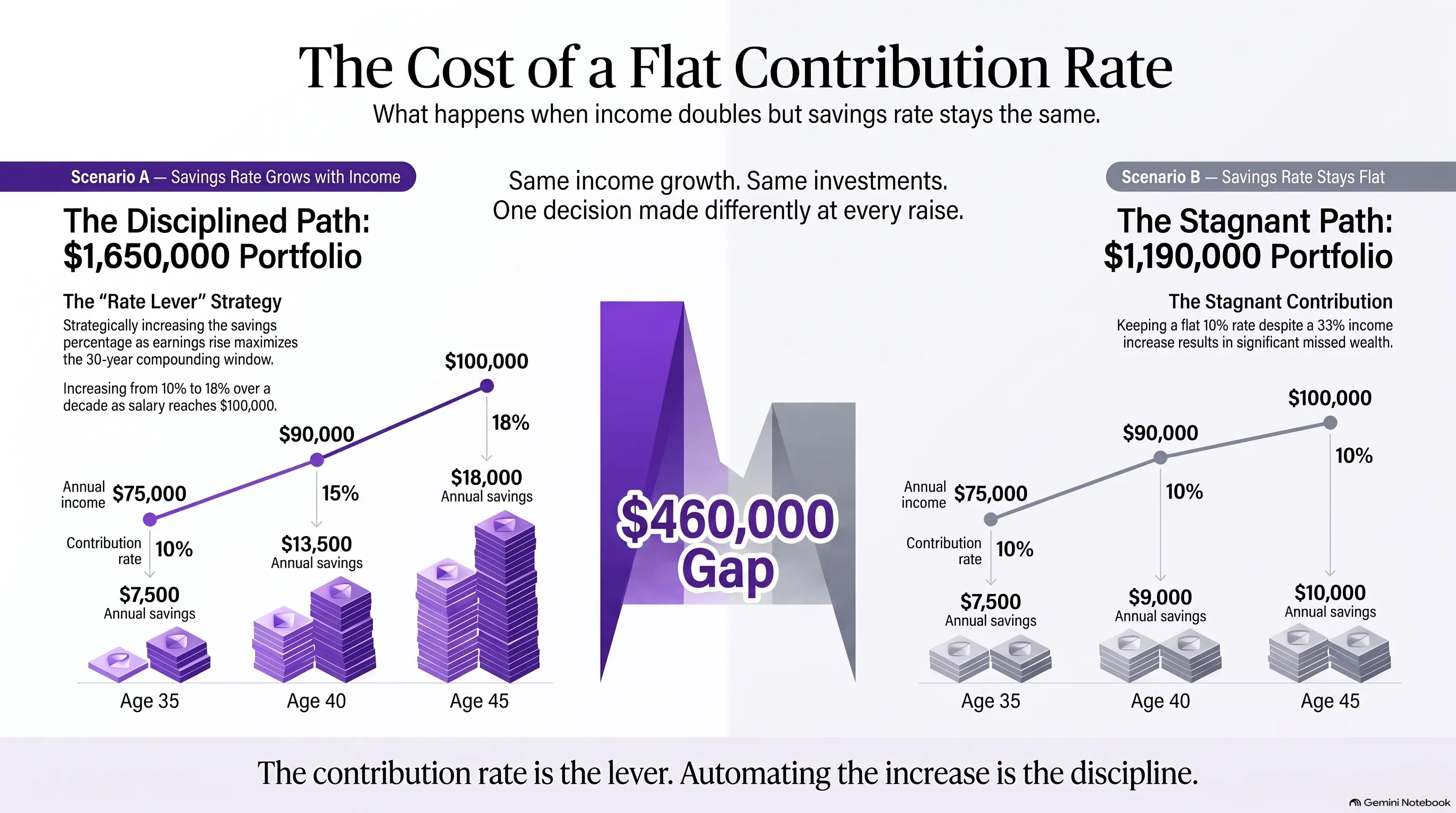
A 35-year-old earning $75,000 who contributes 10% to retirement is saving $7,500 per year. If that person's income grows to $90,000 over the next five years and the contribution rate stays at 10%, they are saving $9,000 per year. If they had increased the contribution rate to 15% as income grew, they would be saving $13,500 per year. The difference — $4,500 per year — compounds over 30 years at 7% to approximately $454,000 in additional retirement wealth.
That $454,000 is not the product of picking better investments. It is the product of a contribution rate that grew with income rather than remaining flat.
Automate the increase. Set a calendar reminder for the day a raise takes effect. Before the new paycheck arrives, log into the 401(k) and increase the contribution rate by 2-3 percentage points. Do it before the money appears, before the spending adjusts to the new income, before the lifestyle upgrade that was waiting for this raise gets funded instead.
Move 6: Build the Estate Foundation — It Is Not Too Early
At 35 with a mortgage, a spouse, and young children, the estate planning conversation is not optional. It is the specific situation that estate planning was designed for.
A will that names a guardian for minor children. Without it, the court decides. The person who would have been the obvious choice has no legal standing.
A durable power of attorney that designates someone to manage financial affairs if incapacitated. Without it, a serious illness or accident requires court proceedings before anyone can manage the finances.
A healthcare directive that documents medical treatment preferences. Without it, medical decisions default to next of kin in whatever hierarchy the hospital recognizes.
Life insurance beneficiary designations that reflect current family composition. The policy from five years ago that still names a parent as beneficiary does not go to the spouse. The form controls.
None of these documents are expensive or complicated at 35 in a straightforward situation — no blended family, no business interest, no complex asset structure. An estate attorney in most markets charges $1,000-$2,500 for the complete foundational package. The cost of not having it is paid by the people left behind, in the worst moment of their lives.
The Two-Layer Framework at 35
The 40s post introduced the two-layer retirement planning framework — the checkpoint benchmark and the actual retirement destination. At 35, both layers matter and both are recoverable if they are addressed now.
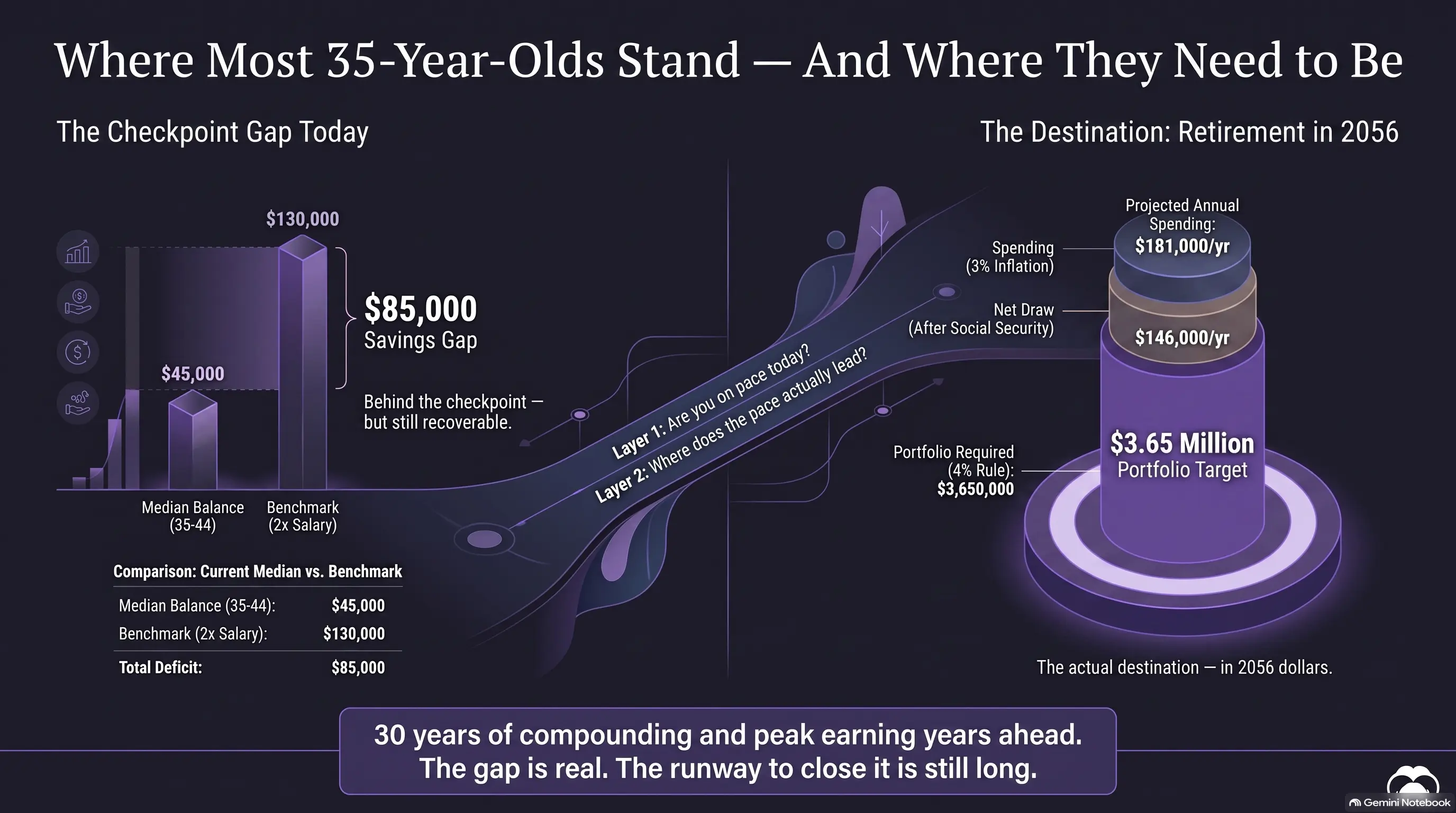
Layer 1 — The checkpoint: Fidelity's benchmark is two times annual salary by 35. At $65,000 income, that is $130,000. The median 35-year-old has $45,000. The $85,000 gap is real and requires a meaningful contribution rate — not a moderate one — to close over the next decade.
Layer 2 — The destination: A 35-year-old planning to retire at 65 in 2056 needs to model their actual retirement target in 2056 dollars. At 3% inflation, $75,000 of today's spending requires approximately $181,000 per year in 2056. After Social Security offset, the portfolio needs to fund the gap. That number — the actual 2056 retirement target — is the honest destination that every contribution decision should be evaluated against.
The person at 35 who knows both layers — who knows they are $85,000 behind the checkpoint and what the 2056 destination requires — has the information to make deliberate contribution rate decisions. The person who knows neither is operating on intention, which is how the savings rate stays flat for a decade while income doubles.
What Arthavita Shows a 35-Year-Old
For users in the Career Building and Family Focus life stages, the Arthavita Wealth Journey Dashboard surfaces the priorities most relevant to building the financial foundation in the mid-30s.
The three AI-prioritized action items for a 35-year-old typically address the most urgent structural gap: the insurance coverage that does not exist, the beneficiary designations that were never updated, the contribution rate that has not grown with income.
The Wealth Foundation Score — a composite 0-100 metric tracking net worth, cash flow, debt ratios, insurance coverage, savings rate, and estate documentation — shows exactly where the gaps are. For most 35-year-olds seeing it for the first time, the score reveals a financial life that is stronger in some dimensions and significantly weaker in others.
The two-layer retirement projection runs the checkpoint comparison against current balances and the inflation-adjusted destination target against actual numbers — so the contribution rate decision is informed by both where you are today and where you need to be in 2056.
Frequently Asked Questions
I am 35 with $45,000 saved. Is that enough?
It is the median — which means you are exactly in the middle of your peer group. Whether it is enough depends on your income, your retirement target, and what you do over the next 10 years. At 7% annual return, $45,000 grows to approximately $342,000 by 65 with no additional contributions. You need additional contributions — the question is how many and at what rate. Run the two-layer calculation with your actual numbers to find out.
Should I pay off my mortgage early or invest the extra?
For most 35-year-olds, investing in tax-advantaged accounts takes priority because the tax benefits — deduction, tax-free growth, employer match — add meaningfully to the effective return. Once tax-advantaged accounts are maximized, the comparison is between the after-tax return on investment and the after-tax cost of the mortgage interest. At current rates, this calculation is more nuanced than the standard advice and depends on your specific rate, your tax situation, and your risk tolerance.
How much life insurance do I actually need?
The calculation starts with 10-12 times annual income as a base, then adjusts for the mortgage balance remaining, the number of years until your youngest child is financially independent, whether your spouse works and what their income is, and what financial obligations the household carries. At $80,000 income with a $400,000 mortgage and two young children, a $1 million to $1.5 million 25-year term policy is a reasonable starting point for the primary earner.
Is the Backdoor Roth worth the complexity at 35?
Yes, if your income exceeds the Roth IRA phase-out threshold. The annual contribution of $7,500 into a Roth IRA via the Backdoor route — contribute non-deductible to traditional IRA, immediately convert to Roth — produces $7,500 of tax-free growth per year that compounds for 30 years without RMD obligations. The pro-rata rule applies if you have other traditional IRA balances, which can make the conversion taxable. Consult a tax professional on the mechanics if you have existing traditional IRA balances.
What is the single most important financial action for a 35-year-old?
Increase the retirement contribution rate — and commit to increasing it with every future raise. The contribution rate at 35 determines the retirement outcome at 65 more than any investment choice, any market prediction, or any other financial decision available to someone at this age. If currently contributing 6%, move to 9%. If contributing 9%, move to 12%. Do it before the next paycheck so the increase happens automatically. Then hold to the commitment to raise it again with the next raise.
Have a question this article didn't answer?
Every 35-year-old's financial situation is different — the specific debt, the specific income trajectory, the specific family obligations. If something here raised a question about your specific numbers, send us a note at support@arthavita.co and we will do our best to address it directly or in a future post.
Arthavita is an educational and planning platform. This article is for informational purposes only and does not constitute personalized financial, tax, or legal advice. All financial decisions remain with you. For personalized guidance, consult a qualified financial or tax professional.
Ketan Patel
Founder, Arthavita
Ketan Patel is the founder of Arthavita and a multi-industry entrepreneur with 30+ years of experience in technology and business operations. He built Arthavita to bring institutional-quality financial intelligence to individual investors.
LinkedIn ↗This article is for educational purposes only and does not constitute financial, tax, or legal advice. Arthavita is a recommendation-only platform. Always consult a qualified professional before making financial decisions.